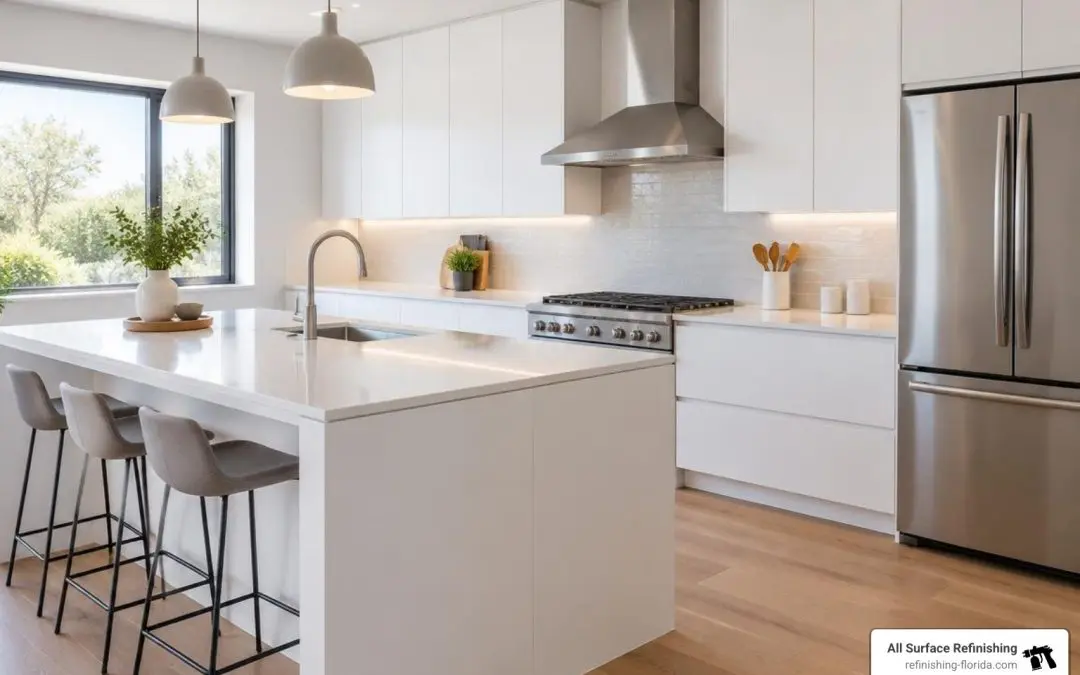
Handleless Kitchen Cabinets: A Clean Look With Practical Choices
Handleless kitchen cabinets create a smooth look without knobs or pulls. You open them using a built-in finger grip, a recessed channel, or a push-to-open latch. If you use your kitchen all day, try each option in person: a grip you can pull may feel easier on heavy drawers, while push-to-open works well where you want a completely flat front.
The idea dates back to the 1960s, but the choice is about more than looks. The right opening system should suit your cabinets, your hands, and how your family uses the kitchen.
I’m Frank Hernandez, and my years of cabinet refinishing work have taught me to look at how kitchen cabinets hold up to daily use, not just how they look in photos. In this guide, I’ll help you weigh handleless kitchen cabinets against the needs of the cabinets you already have.
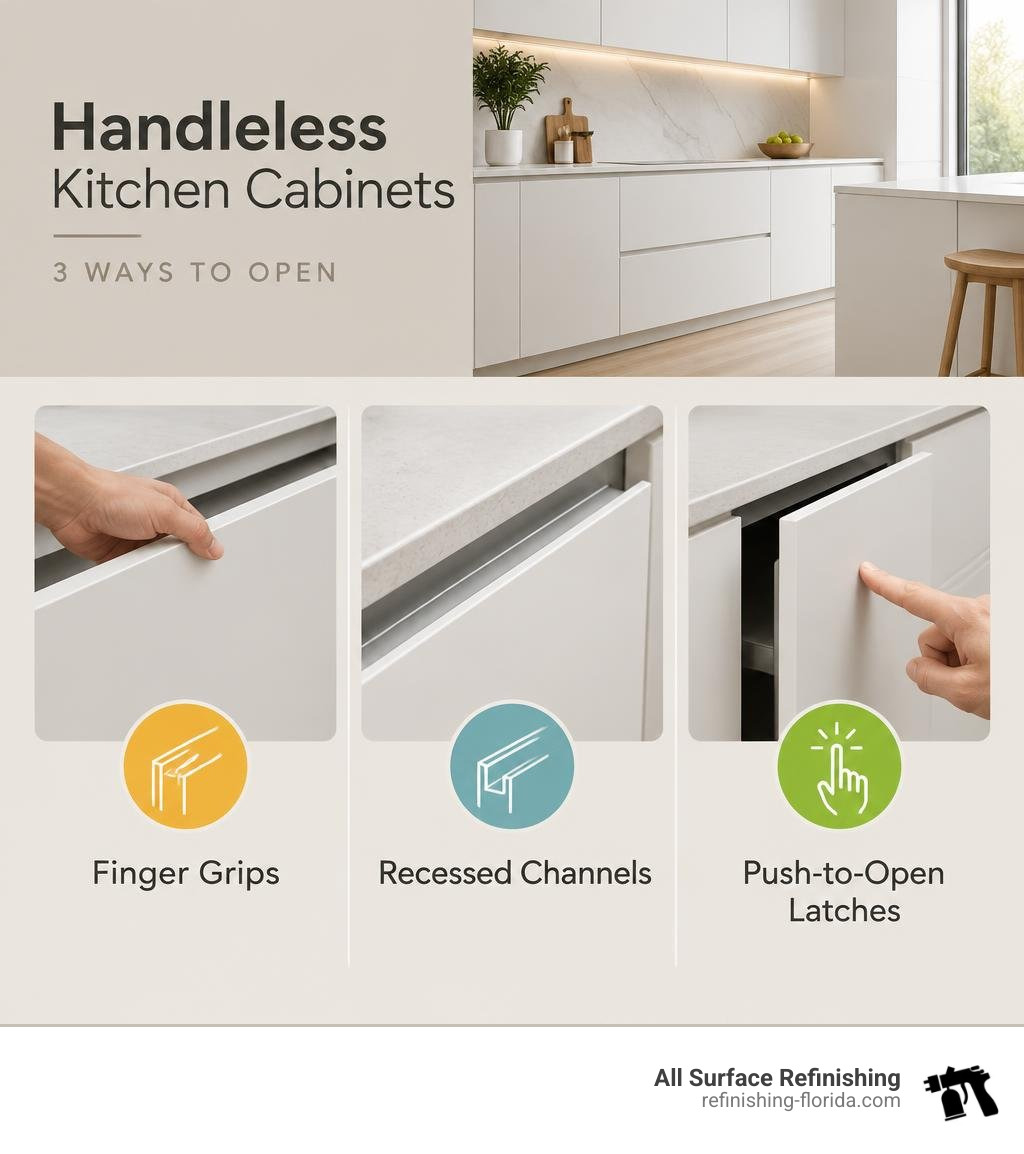
Basic handleless kitchen cabinets vocab:
Core Opening Mechanisms for Handleless Kitchen Cabinets
When planning a modern remodel, understanding how your doors and drawers operate is the first major milestone. Handleless cabinetry is not a single product; it is a category made up of distinct engineering methods. The primary opening mechanisms include continuous Gola channel rails, integrated J-pull routing, mechanical push-to-open touch latches, beveled chamfer edges, and motorized electronic sensor releases.
Each mechanism offers a different balance of ergonomics, aesthetic purity, installation complexity, and long-term maintenance.
| Mechanism Type | Primary Aesthetic | Ergonomic Feel | Relative Hardware Cost | Cleaning & Maintenance |
|---|---|---|---|---|
| Gola Channel Rail | Architectural, true recessed shadow gap | Firm grip behind door edge | Medium to High | Requires wiping dust from horizontal channels |
| Integrated J-Pull | Minimalist contour on door top/bottom | Deep curved groove pull | Low to Medium | J-groove catches crumbs and cooking dust |
| Push-to-Open (Mechanical) | Perfectly flush, zero visible gaps | Light hand or knee press | Low to Medium | Prone to surface fingerprints around touch points |
| Beveled 45° Edge | Clean profile with discreet shadow | Finger grip behind angled door | Medium | Low; wipe-down along edge |
| Electronic Servo-Drive | Ultra-luxury, completely flat fronts | Feather-light touch or wave | High | Minimal physical wear; sensor care required |
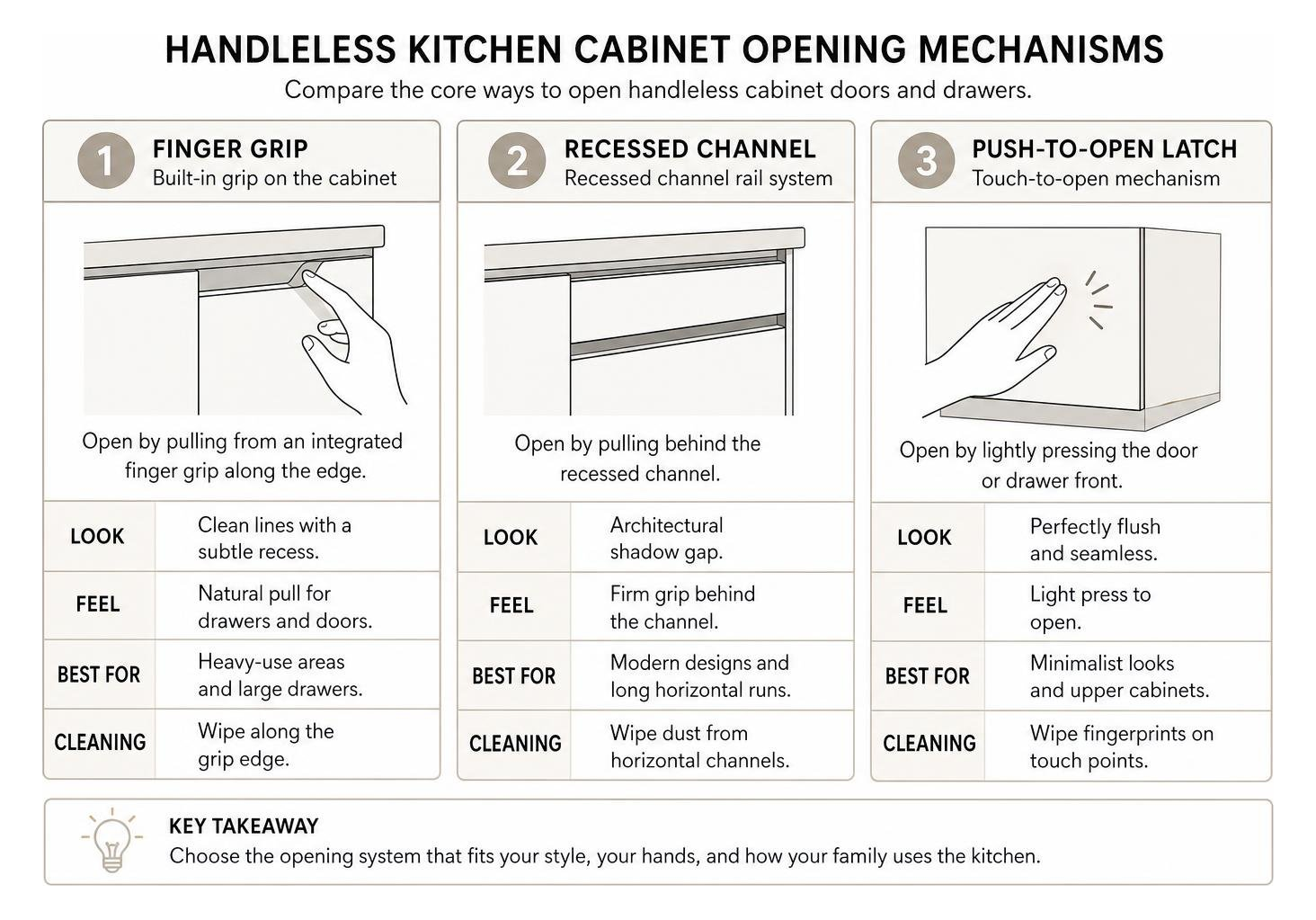
True Handleless Gola Profiles vs. Integrated J-Pull Systems
Homeowners often ask us about the difference between a “true handleless” layout and an integrated J-pull setup.
A true handleless system incorporates extruded aluminum Gola profile channels fastened directly into the cabinet carcass rather than the door. An upper horizontal “J-channel” sits directly underneath the countertop, while a horizontal “C-channel” sits between stacked drawers. When you reach for a drawer, your fingers slip behind the front panel into the recessed cavity. Because the channel is built into the cabinet box, the doors remain classic seamless slab doors, creating clean, uninterrupted horizontal lines across the entire room.
Integrated J-pull doors, by contrast, feature a “J” shaped curve routed directly into the top or bottom edge of the cabinet door itself. J-pull units are popular because they do not require specialized carcass modifications. Well-engineered units, like standard J-pull sink bases, meet rigorous durability benchmarks such as FIRA Gold standards. However, because each door contains its own groove, the continuous architectural shadow line of a Gola profile is replaced by individual door contours.
Push-to-Open and Mechanical Touch Latches
If your goal is a completely flat front with zero visible grooves or recessed rails, mechanical push-to-open hardware provides an ideal solution. These systems rely on spring-loaded magnetic catches and mechanical click releases installed inside the cabinet frame. A light press against the door triggers the latch, pushing the door forward several inches so you can swing it open.
For high-end installations, electric tip-on servo drives eliminate mechanical resistance entirely. A gentle tap with a hand, knee, or hip activates a small motorized piston that smoothly glides heavy pantry doors or deep pots-and-pans drawers open. Combining these mechanisms with soft-close piston dampeners ensures that closing the unit is whisper-quiet. When exploring wider kitchen cabinet styles, touch latches offer the purest expression of minimalist design.
Design Aesthetics, Materials, and Layout Configurations

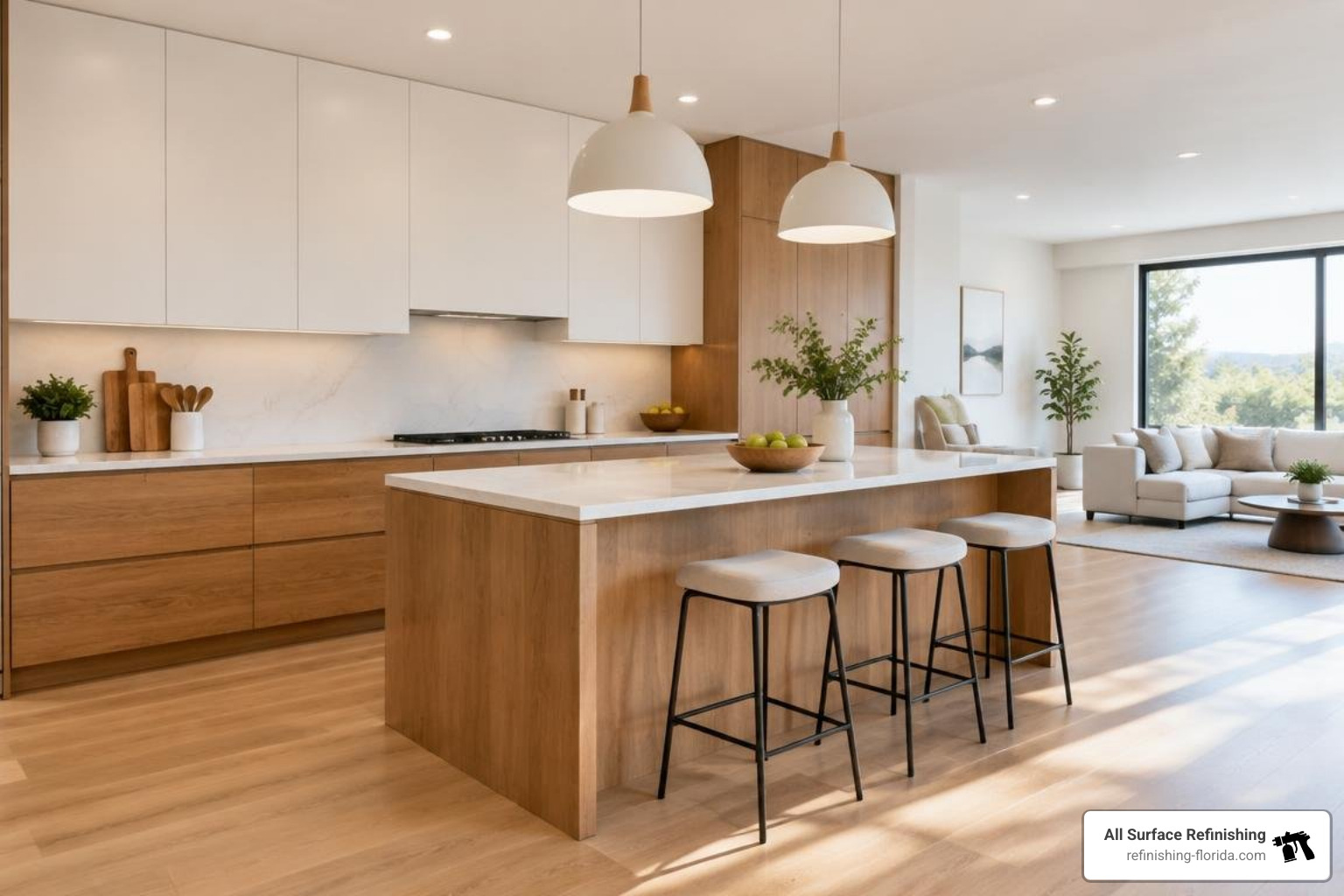
Handleless cabinets have evolved far beyond basic minimalist boxes. Today, they serve as the foundation for stunning open-concept living spaces throughout South Florida, from coastal condos in Miami Beach to spacious estates in Palm Beach Gardens. By removing protruding hardware, your kitchen cabinets blend into the architectural fabric of your home, creating visual depth and effortless flow.
You can also introduce warmth and balance by exploring two-tone cabinet ideas, such as pairing dark lower channel cabinets with natural wood or airy off-white uppers.
Material and Finish Pairings for Handleless Kitchen Cabinets
Because your fingers make direct contact with cabinet surfaces and channel recesses, selecting the right materials and finishes is essential:
- Super-Matte Anti-Fingerprint Laminates: Modern ultra-matte surfaces absorb light and feature thermal-healing or oleophobic coatings that resist skin oils, keeping dark tones looking immaculate.
- High-Gloss Lacquers: Perfect for maximizing ambient light in compact layouts in areas like Aventura or Fort Lauderdale, reflective gloss finishes add glamour and wipe clean effortlessly.
- Natural Oak & Walnut Veneers: Wood grain introduces organic texture to modern kitchens, contrasting beautifully with crisp aluminum or painted Gola rails.
- Fluted Glass Accents: Inset fluted or reeded glass wall cabinets bring subtle texture while breaking up monolithic runs of solid cabinetry.
- Dark Stone Countertops: Pairing thick quartz, quartzite, or porcelain slabs with contrasting channel rails creates a striking modern cabinet look inspired by high-end modernist architectural finishes.
Designing Wall and Base Handleless Kitchen Cabinets
Different zones in your kitchen call for different handleless solutions to balance form and everyday usability:
- Base Units: Wide pot drawers and pull-outs benefit most from horizontal Gola rails or deep beveled edges, allowing your fingers to pull heavy loads without strain.
- Full-Height Pantries: Vertical Gola rails installed between tall utility cabinets allow you to open floor-to-ceiling doors with an ergonomic side grip.
- Wall Cabinets: Upper units work best when designed with an extended bottom overhang lip (dropping the door roughly a quarter-inch below the carcass) or an integrated under-cabinet recessed LED strip channel. This provides a natural finger grip underneath without needing surface touch latches.
- Appliance Garages: Integrating pocket doors or push-latch tambour doors allows you to conceal blenders, coffee stations, and toasters, keeping your countertops completely clear.
Practical Remodeling Considerations: Costs, Maintenance, and Integration
Upgrading to handleless kitchen cabinets introduces unique practical factors that every homeowner should weigh before remodeling.
One major everyday benefit is enhanced safety. Without protruding metal knobs or handles, narrow walkways in galley kitchens or busy islands become safer for young children and less prone to snagging clothing.
However, channel systems require mindful cleaning habits. Because horizontal Gola profiles and routed J-pull grooves sit directly beneath work surfaces, they naturally catch food prep debris and dust.
Daily maintenance practices for channel rails:
- Dust horizontal channel profiles weekly using an anti-static microfiber cloth.
- Wipe grease or spills immediately with a damp microfiber cloth and mild, pH-neutral soap.
- Avoid abrasive scouring pads or harsh chemical degreasers that can scratch anodized aluminum finishes or dull painted surfaces.
- Vacuum channel corners periodically using a soft brush attachment to clear crumbs.
When integrating heavy appliances like panel-ready dishwashers and built-in refrigerators, standard push-latches are generally insufficient due to strong magnetic door seals. For these units, designers either incorporate specialized heavy-duty motor-assisted releases (such as electronic knock-to-open units) or utilize a discreet matching edge-profile grip.
From a budgeting standpoint, true handleless Gola cabinets generally command a 15% to 30% premium over conventional framed or overlay boxes. This price difference stems from the precision milling required to cut channel notches into carcass side panels, the cost of custom extruded aluminum hardware, and the strict installation tolerances required to keep reveal gaps perfectly uniform across long cabinet runs.
Frequently Asked Questions About Handleless Kitchen Cabinets
Are handleless kitchen cabinets more expensive than traditional cabinets?
Yes, true handleless cabinets are generally more expensive due to specialized carcass manufacturing, extruded aluminum rail systems, and the precision labor required for installation. However, J-pull options and push-to-open mechanical latches installed on standard slab doors provide cost-effective alternatives that achieve a similar modern aesthetic.
Will a handleless kitchen design go out of style?
Handleless kitchens have maintained enduring popularity since their introduction in 1960. Rooted in mid-century European modernism and architectural simplicity, clean slab cabinetry avoids the trend cycles often associated with decorative hardware, making it a timeless design choice that retains strong resale value.
Can you add hardware handles to handleless cabinets later?
Adding standard hardware to flat slab doors originally fitted with push-to-open latches is straightforward. However, doors featuring integrated J-pull curves or custom chamfered profiles cannot be converted easily to standard pulls, as the pre-routed grooves remain visible. In those situations, professional cabinet resurfacing or refinishing offers a reliable way to update your kitchen’s style without complete teardowns.
Conclusion
Handleless kitchen cabinets offer an unmatched combination of visual serenity, architectural elegance, and ergonomic flow. Whether you prefer the continuous lines of true Gola channel rails or the clean simplicity of push-to-open touch latches, eliminating visual clutter creates an open, welcoming heart for your home.
If you love the sleek lines of modern cabinetry but want to revitalize your existing layout cost-effectively, refinishing offers a smart, high-impact transformation. At All Surface Refinishing, we bring over 30 years of hands-on experience and more than 14,000 completed transformations to homeowners across South Florida. From Miami and Fort Lauderdale to Boca Raton, West Palm Beach, and Stuart, our team delivers durable, beautiful results tailored to your lifestyle.
Contact Frank Hernandez and the team at All Surface Refinishing today to discover how our specialized cabinet refinishing and painting services can transform your kitchen into a modern, functional showpiece.
