
Don’t Let a Drip Ruin Your Dip
Jacuzzi leak repair is easier than you think. Most leaks come from worn gaskets at pump or heater connections, and you can fix them yourself for under $50. Here’s your quick action plan:
Quick Fix Guide:
- Find the leak – Check pump unions, heater fittings, jets, and pipes for drips or wet spots
- Replace worn gaskets – Most leaks are from rubber O-rings that cost just a few dollars
- Use leak sealer – For small cracks up to 1/8 inch, pour sealer into the filter area and run jets for 24 hours
- Call a pro – If you can’t locate it, it involves electrical work, or there’s major shell damage
Common Repairs by Cost:
- DIY gasket replacement: Under $50
- Leak sealer bottle: $15-$30
- Professional repair: $200+
A leaking Jacuzzi can turn your backyard oasis into a source of stress and wasted water. The good news? Whether you’re dealing with a dripping pump union or a mysterious slow leak, most Jacuzzi repairs are straightforward DIY projects that don’t require specialized skills.
The life expectancy of a Jacuzzi is 15 to 20 years, but components like heaters last only 5 to 7 years, and pumps typically run 5 to 10 years. Regular maintenance and quick repairs when leaks appear will help you get the most from your investment.
I’m Frank Hernandez. My team and I have helped countless property owners across communities like Boca Raton, Fort Lauderdale, and Miami troubleshoot Jacuzzi leak repair issues before they escalate into major problems. My team has seen it all, from simple gasket swaps to complex shell damage requiring professional intervention.
This guide walks you through everything you need to know about finding and fixing Jacuzzi leaks, when to tackle repairs yourself, and when to call in expert help.
Detective Work: Finding the Source of Your Leak
Few things can ruin your day faster than the realization that your Jacuzzi is leaking. Even the tiniest crack in the wrong place can cause a big problem. Before we grab our tools, we need to play detective. The first step in any successful Jacuzzi leak repair is accurately locating the source.
Is that water around the base of your Jacuzzi a leak, or just evaporation? In our warm climate here in Miami-Dade County, evaporation can often mimic leak symptoms, especially during hot weather or with frequent use. To confirm a leak, fill your Jacuzzi to its normal water level, turn it off completely, and mark the water level. Monitor it for 24 hours. If the water drops more than an inch and you see visible moisture outside the tub, you almost certainly have a leak on your hands.
We start with a thorough visual inspection. Dry the entire exterior of your Jacuzzi, especially around the equipment bay, and look for any wet spots, drips, or puddles. Pay close attention to the pump, heater, jets, and all visible plumbing connections.
Locating the Drip: Simple Steps to Pinpoint the Problem
When a leak isn’t immediately obvious, we need to get a little more creative.
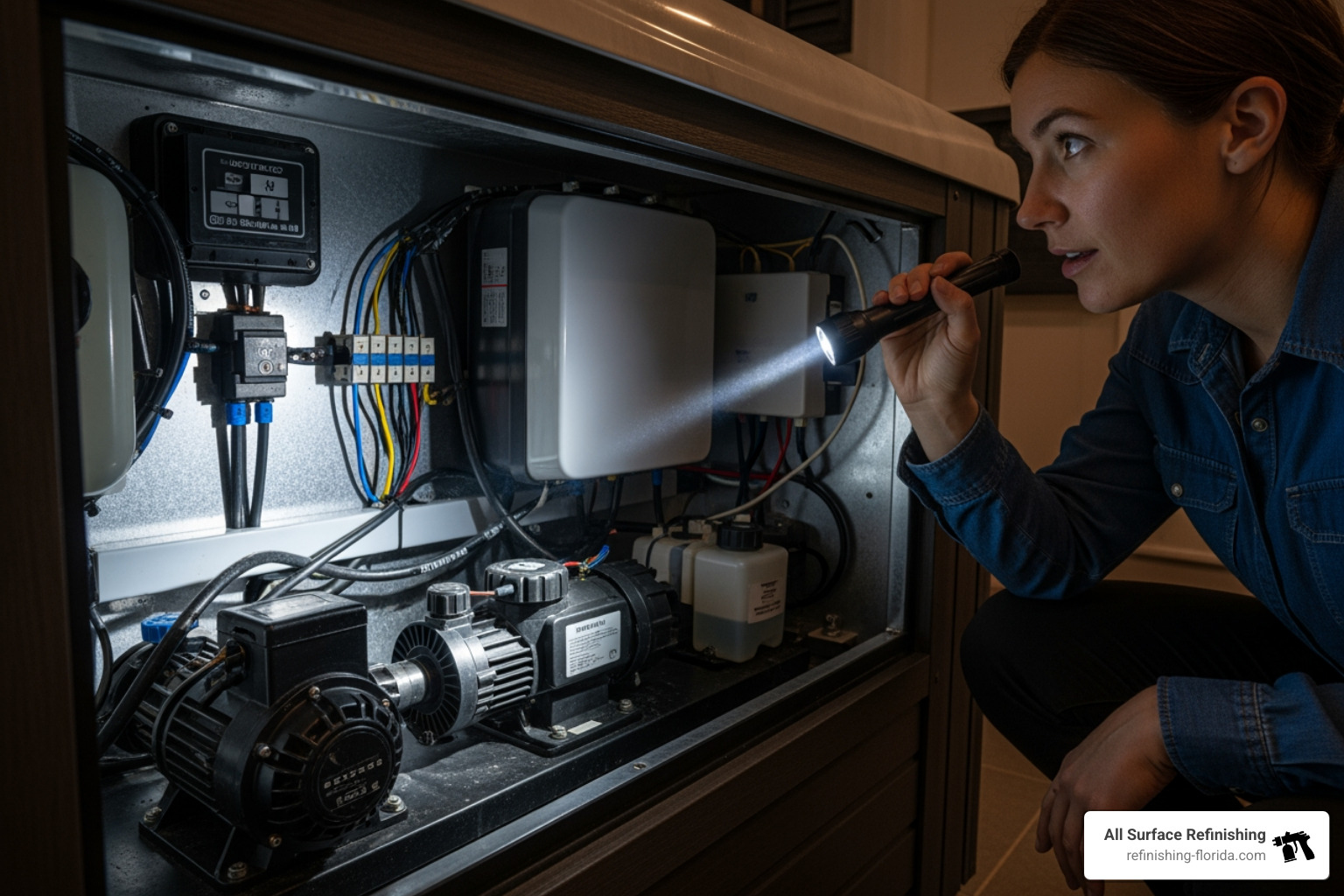
Checking the Equipment Bay: Turn off the Jacuzzi power and carefully remove the access panels. Use a flashlight to inspect all components within the equipment bay – the pump, heater, control pack, and all associated plumbing. Look for any signs of dripping water, wet components, or corrosion.
The Water Level Test (Again): If a visual inspection doesn’t reveal the culprit, try letting the Jacuzzi drain naturally. Mark the water level daily. The point at which the water stops dropping will often indicate the height of the leak. For example, if the water stops dropping at the level of the jets, the leak is likely in a jet or a pipe connected to it.
The Dye Test Method: This is one of our favorite tricks for elusive leaks. Add a few drops of leak detection dye (or even a small amount of dark food coloring) to the water near suspected leak points. With the pump off, observe closely. The dye will be drawn into the leak, pinpointing its exact location. This works wonders for small cracks or loose fittings.
Inspecting the Shell: While less common than plumbing leaks, cracks in the Jacuzzi shell can occur. Carefully inspect the interior surface of your tub for any hairline cracks, especially around jets and drains.
Looking for Wet Insulation: Many Jacuzzis, particularly in our Florida homes, have foam insulation around the plumbing to maintain heat. If you suspect a hidden leak, remove access panels, run the tub, and look for wet or damp foam. Wet foam is a tell-tale sign of a leak buried within the insulation. You may need to carefully cut away the wet foam to expose the leak.
Common Causes of Jacuzzi Leaks
Understanding why Jacuzzis leak helps us prevent them and identify the source quicker. From our experience across Aventura, Boca Raton, and Fort Lauderdale, these are the most common culprits we encounter:
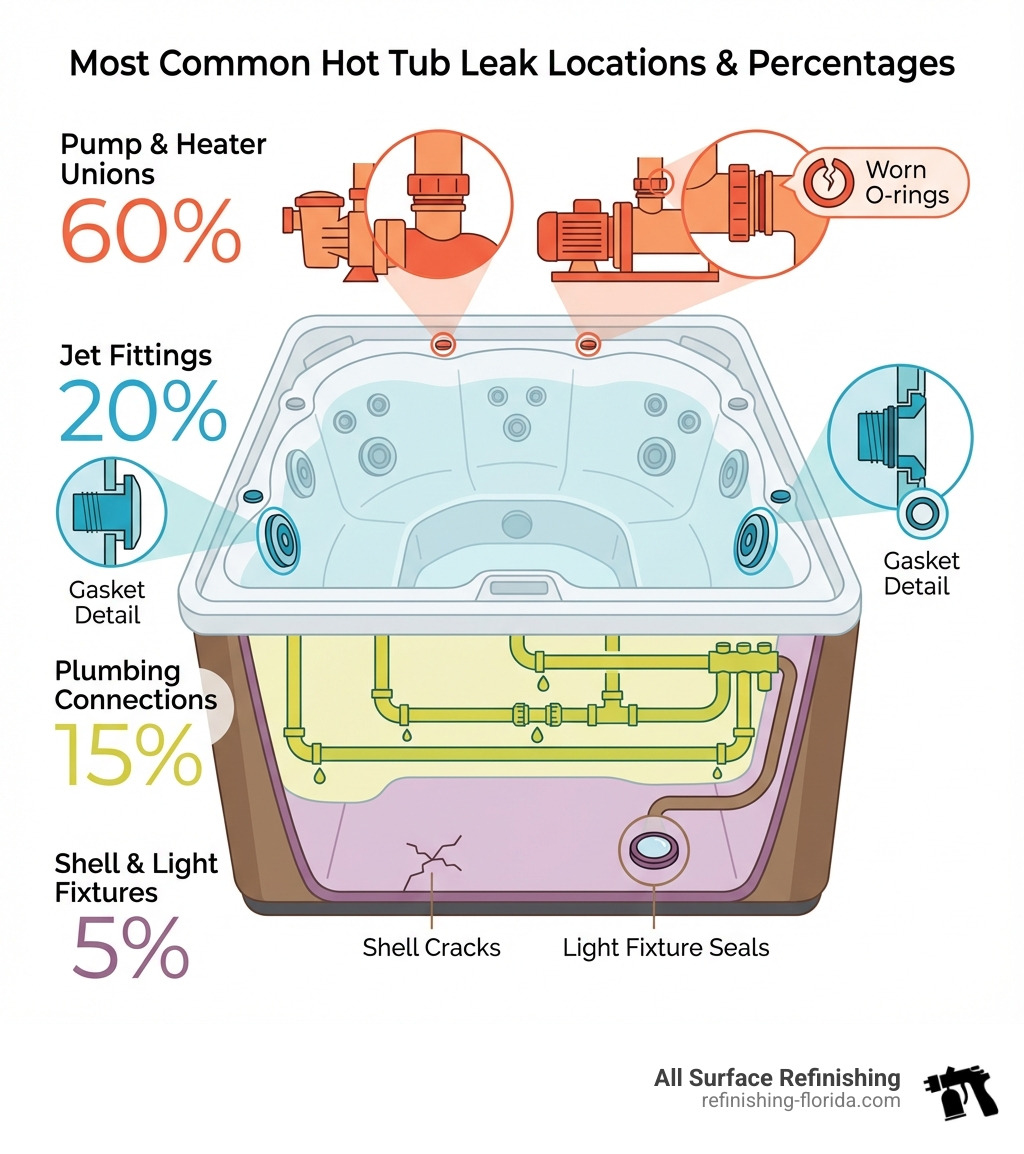
- Pump and Heater Unions: Most Jacuzzi leak repair issues stem from worn-out rubber gaskets in the union fittings on either side of the heater and/or pump. These components are under constant pressure and vibration, leading to gasket degradation over time. Heaters typically last 5 to 7 years, while pumps often last 5 to 10 years, making their connections prime candidates for leaks as they age.
- Jet Fittings: The individual jets in your Jacuzzi are another frequent source of leaks. Their gaskets can wear out, or the retaining nuts can loosen, allowing water to escape around the jet body.
- Valve Gaskets: Jacuzzis have various valves (like knife, slice, gate, or ball valves) that control water flow. Their internal gaskets are known to fail, leading to drips.
- Cracks in Plumbing: PVC pipes and hoses can develop cracks due to age, stress, or freeze damage (though less common in areas like Palm Beach County, it can happen during unexpected cold snaps). Improper installation can also lead to stressed connections that eventually crack.
- Shell Damage: While Jacuzzi shells are generally robust, physical impact or extreme temperature fluctuations can cause small cracks or pinholes.
- Light Fixture Seals: The seals around underwater light fixtures can degrade, creating a pathway for water to escape.
- Chemical Imbalance: Incorrect water chemistry can cause corrosion and premature degradation of seals, gaskets, and even plumbing components, accelerating the likelihood of leaks.
Your DIY Toolkit: Essential Tools and Materials
Before we dive into the actual repairs, let’s gather our arsenal. Having the right tools and materials on hand will make your Jacuzzi leak repair much smoother and prevent multiple trips to the hardware store.
Must-Have Tools for the Job
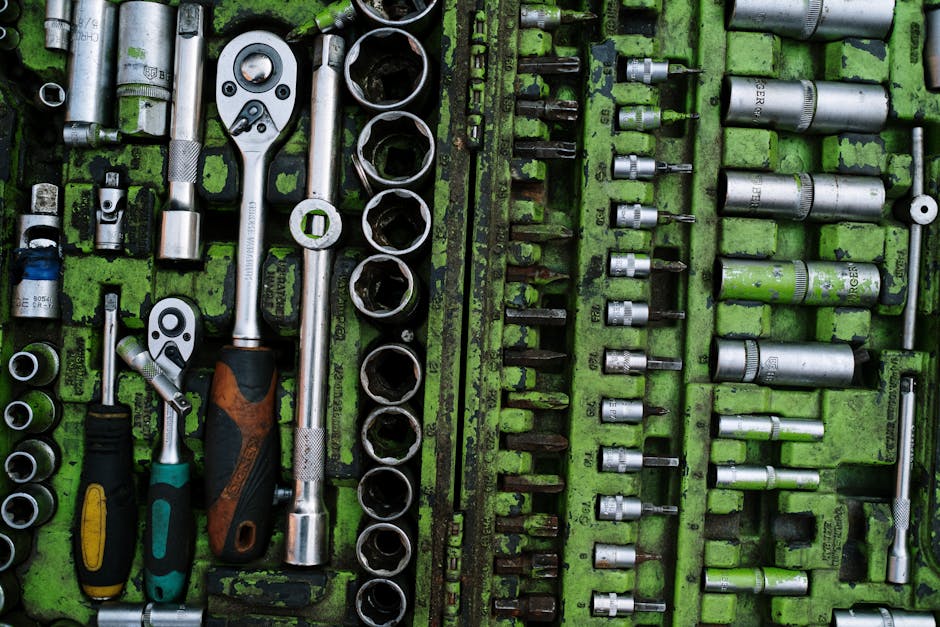
Here’s what we typically recommend having in your Jacuzzi leak repair toolkit:
- Screwdriver: Essential for removing access panels, tightening clamps, and various other tasks.
- Water pump pliers: Great for gripping and turning fittings, especially in tight spaces.
- Tubing cutter: For clean cuts on PVC pipes.
- Hacksaw: Useful for larger or more stubborn pipe cuts, particularly if a tubing cutter can’t fit.
- Spackle knife or putty knife: Handy for carefully prying open foam insulation or applying sealants.
- Flashlight or headlamp: Crucial for illuminating those dark, cramped areas beneath the Jacuzzi.
- Utility knife: For cutting foam insulation or trimming materials.
- Bucket and towels: For catching drips and wiping up spills.
Essential Repair Materials
Once you’ve identified the leak, these materials will help you make the fix:
- Replacement gaskets: Specifically for your pump and heater unions. It’s always a good idea to have a few spares.
- Assorted O-rings: You never know what size you’ll need for jets or other connections.
- PVC pipe or hose (if needed): If you have a cracked pipe, you’ll need to replace a section.
- Spa fittings and couplings: To connect new sections of pipe.
- Waterproof epoxy or sealant: For small cracks in the shell or minor pipe repairs. Ensure it’s marine-grade and suitable for Jacuzzi use.
- PVC primer and glue: For a strong, watertight bond when repairing PVC pipes.
- Leak-stopper liquid: Such as Marlig Fix-a-Leak, perfect for small, hard-to-find leaks.
- Spray foam insulation: To re-insulate areas where you’ve cut away foam to access a leak.
A Step-by-Step Guide to Jacuzzi Leak Repair
Now that we’ve located the leak and gathered our tools, it’s time to roll up our sleeves and get to work. Safety first! Always turn off the Jacuzzi power at the breaker before attempting any repairs. We also recommend closing any gate valves on either side of components like the pump and heater to isolate them and minimize water loss during the repair. The good news is, most Jacuzzi leak repair jobs can be done by the owner for less than $50.
Fixing Leaks in Pumps, Heaters, and Union Fittings
These are some of the most common leak sources, and often the easiest to fix.
- Turn off the power: Always start by cutting power to the Jacuzzi at the main breaker. Safety is paramount.
- Close gate valves: If your Jacuzzi has gate valves (often found on either side of the pump and heater), close them to prevent water from draining out of the tub when you disconnect components.
- Unscrew union nuts: Using your water pump pliers or by hand, carefully turn the large union nuts counter-clockwise to loosen them. These nuts connect the pump and heater to the main plumbing lines.
- Replace O-rings and gaskets: Once the union is separated, remove the old, worn-out rubber O-rings or gaskets. These are usually the culprits. Replace them with new, correctly sized gaskets. We often replace both gaskets at the pump and heater union fittings at the same time, as they tend to wear out concurrently.
- Hand-tighten fittings: Reassemble the union, making sure the new gasket is properly seated. Hand-tighten the union nuts first. Never use a wrench to overtighten these, as it can crack the plastic. A snug, hand-tight fit is usually sufficient.
- Test for leaks: Open the gate valves (if you closed them), restore power to the Jacuzzi, and let it run. Carefully inspect the repaired area for any drips.
Repairing Leaks from Jets and Light Fixtures
These leaks require a bit more finesse but are still very manageable.
- Jet Leaks: If a jet is leaking, it’s often due to a loose fitting or a degraded gasket.
- Drain the Jacuzzi below the level of the leaking jet.
- From the inside of the tub, unscrew the jet body.
- From the outside (accessing through the equipment bay), you might need to squeeze metal tabs on hose clamps to remove them, then remove the plastic retaining nut.
- Replace the worn gasket behind the jet or the entire jet assembly if it’s cracked.
- Reattach everything, ensuring a snug fit. Some jets may require a thin bead of silicone sealant around the gasket.
- If you had to remove insulation, cover the repair with new spray foam.
- Light Fixture Leaks: A leaking light fixture can be tricky.
- Turn off the Jacuzzi power.
- Remove the access panels to get behind the light fixture.
- Locate the leaking light. Often, the issue is a failing gasket.
- You might need to remove the bulb and retaining nut from inside the tub, then push the lens out from the back.
- Replace the gasket or, if the fixture itself is compromised, replace the entire light fixture. Since lights are often the same age, we sometimes recommend replacing all of them at once if one starts leaking. Reassemble and test.
Tackling Leaks in Hoses, Pipes, and Insulation
These leaks can be more challenging due to their hidden nature.
- Finding Leaks in Foam Insulation: As we discussed, wet foam is a key indicator. Once you’ve identified a wet area, you’ll need to carefully cut away the wet foam with a utility knife to expose the leaking pipe or fitting. Only remove as much foam as necessary.
- Repairing PVC Pipe Cracks:
- Once exposed, if you find a cracked PVC pipe, you’ll need to repair or replace the section.
- Turn off the Jacuzzi and drain it below the level of the leak.
- Use a tubing cutter (for clean cuts) or a hacksaw to cut out the damaged section of pipe.
- Clean the ends of the remaining pipe and the new section with PVC primer.
- Apply PVC glue evenly to both the pipe ends and the inside of new couplings.
- Quickly join the new pipe section with couplings, twisting slightly to ensure a good seal. Hold firmly for a few seconds.
- Allow the glue to cure according to the manufacturer’s instructions before refilling.
- Replacing Insulation with Spray Foam: After the pipe repair is complete and tested, use spray foam insulation to fill the void you created. This helps maintain your Jacuzzi’s energy efficiency.
How to Fix Small Cracks in the Jacuzzi Shell
Shell cracks are less common but can occur. For minor issues, a DIY fix is possible.
- Drain the tub: You need to drain the Jacuzzi completely below the level of the crack.
- Clean and dry the area: Thoroughly clean the cracked area with a degreaser and then dry it completely. The surface must be pristine for the repair to adhere.
- Apply waterproof marine-grade epoxy: For small hairline cracks, we recommend using a specialized waterproof, marine-grade epoxy or sealant. Apply it according to the product’s instructions, ensuring it fills the crack completely.
- Curing time: Allow the epoxy to cure fully. This can take several hours, or even overnight, depending on the product. Do not refill the tub until it’s completely cured.
- Test: Once cured, refill your Jacuzzi and check for any signs of the leak persisting.
The “Magic” Fix: Using Jacuzzi Leak Sealers
Sometimes, a leak is so small or so well-hidden within the foam insulation that locating it feels like finding a needle in a haystack. This is where a liquid leak sealer can be your best friend. These products are designed for small, hard-to-find leaks up to 1/8 inch in diameter. They work by circulating through your Jacuzzi’s plumbing and coagulating at the leak site, effectively sealing it from the inside.
How to Use a Liquid Leak Sealer
We’ve seen great success with products like Marlig’s Fix-a-Leak for these types of issues. Here’s how we typically approach using one:
- Remove filters: Before adding any sealer, always remove all cartridge filters from your Jacuzzi. The sealer can clog them, rendering them ineffective.
- Check water temperature: Ensure your Jacuzzi’s water temperature is between 70°F and up. The sealer works best in warmer water.
- Shake bottle well: Give the leak sealer bottle a good shake. If it’s cold, you can even warm it gently in hot water to help mix the contents.
- Add to filter intake: With your Jacuzzi’s circulation pump running (on low speed if possible), pour the entire contents of the bottle slowly into the filter intake area. This helps the sealer distribute evenly throughout the plumbing. If you don’t have a dedicated filter intake, you can pour it directly into the Jacuzzi water.
- Circulate water with pumps: Let the Jacuzzi pumps run for 4-6 hours (up to 8 hours for stubborn leaks), alternating between low and high-speed jets if your system allows. This ensures the sealer reaches every part of the plumbing system where a leak might be present. Remember to restart jets as their cycles kick off to keep the sealer moving.
With this procedure, you should expect a success rate of around 80% for small leaks.
Dosage, Timing, and Aftercare
The amount of sealer you use depends on the severity of the leak:
- 8oz vs. 32oz bottle usage: For minor drip leaks, an 8oz bottle is usually sufficient, regardless of your tub’s water volume (typically 250-1000 gallons). For more severe leaks, where you’re losing 1 to 1.5 inches of water per 24-hour period, a 32oz bottle may be required. We recommend starting with about 1/3 of the 32oz bottle for severe cases and adding more if needed.
- How long it takes to work: Most leak sealers require 24-72 hours to fully work. After the initial circulation period, we advise turning off the Jacuzzi and letting it sit for 48 hours to allow the sealer to cure and to check for stability in the water level.
- Draining and cleaning the tub post-treatment: Once the leak has stopped, it’s crucial to properly drain and clean your Jacuzzi. If night temperatures are above 40°F (which is most of the time here in Broward County!), drain the spa completely. While it’s draining, wipe down the interior surfaces with a warm, wet cloth to remove any sealer residue and prevent white staining.
- Curing period: After draining and cleaning, we recommend allowing the Jacuzzi to sit empty for 5-7 days. This allows the leak sealer to fully cure and harden within the plumbing, creating a lasting seal. After this period, you can refill your Jacuzzi, balance your chemicals, and resume normal operation. If draining isn’t feasible due to colder temperatures (rare in our service areas like Miami-Dade and Palm Beach County, but possible), you can reinstall your filters to collect any remaining product residue, then clean the filters thoroughly before resuming use.
Prevention and When to Call a Professional
An ounce of prevention is worth a pound of cure, especially when it comes to Jacuzzi leaks. Regular maintenance is key to keeping your Jacuzzi in top shape and avoiding the headaches of Jacuzzi leak repair. Even in our beautiful Florida climate, proactive care can save you time and money.
Preventative Maintenance to Avoid Future Leaks
- Weekly Water Chemistry Checks: Maintaining proper water chemistry is vital. Imbalanced water can corrode components, degrade seals, and even damage the shell over time. We recommend checking your pH, alkalinity, and sanitizer levels weekly.
- Regular Inspection of Seals and Fittings: Make it a habit to visually inspect all accessible seals, gaskets, and fittings during your routine maintenance. Look for any signs of wear, cracking, or loosening. A quick hand-tightening of a union nut can prevent a small drip from becoming a major leak.
- Maintaining Proper Water Level: Always keep your Jacuzzi filled to the manufacturer’s recommended water level. Running it too low can put strain on the pump and other components, while overfilling can lead to water escaping from areas not designed to be submerged.
- Using a Quality Jacuzzi Cover: A good cover not only helps retain heat but also protects your Jacuzzi from debris and UV rays, which can degrade the shell and components over time.
- Proper Winterization: While full winterization isn’t typically necessary in most of our service areas like West Palm Beach, Hollywood, or Homestead, if you plan to leave your Jacuzzi unused for an extended period during cooler Florida nights, ensure it’s properly drained and protected to prevent any potential freeze damage to the plumbing.
Knowing When to Call an Expert
While many Jacuzzi leak repair jobs are DIY-friendly, there are times when calling a professional is the smartest and safest option. For larger repairs or when hiring a Jacuzzi repair company, expect to spend at least $200.
We understand the complexities of Jacuzzis, and we’re always here to help residents in areas like Coral Gables, Weston, and Jupiter. You should definitely call us or another qualified professional if:
- You can’t locate the leak: If you’ve tried all the detective work and still can’t pinpoint the source, a professional has specialized tools and experience to find even the most elusive leaks.
- The leak is in a difficult-to-access area: Some leaks are buried deep within the Jacuzzi’s structure or are behind components that are challenging to remove.
- The repair involves complex plumbing or electrical work: Messing with electrical components or intricate plumbing without proper knowledge can be dangerous and lead to further damage.
- There’s significant structural damage to the tub shell: While small cracks can be DIY fixed, extensive shell damage often requires professional repair to ensure structural integrity and a lasting seal.
- You’re not comfortable with the repair: If any step of the repair process makes you uneasy, it’s always better to err on the side of caution and call an expert. Our team can assess the situation and provide expert solutions for tub and shell repairs in communities throughout Miami-Dade, Broward, and Palm Beach County.
Conclusion: Keep Your Jacuzzi in Perfect Condition
A Jacuzzi leak doesn’t have to be a disaster. With the right approach, many repairs are manageable DIY projects. By understanding the common causes, knowing how to locate a leak, and having the right tools and materials, you can tackle most Jacuzzi leak repair issues yourself, saving both time and money.
Regular maintenance and swift action at the first sign of a drip are your best defenses against major problems. By following this guide, you can enjoy your Jacuzzi as a source of relaxation for years to come. Our team is always ready to assist homeowners throughout Miami-Dade, Broward, and Palm Beach counties, ensuring your Jacuzzi, bathtub, or tile surfaces perform flawlessly.
