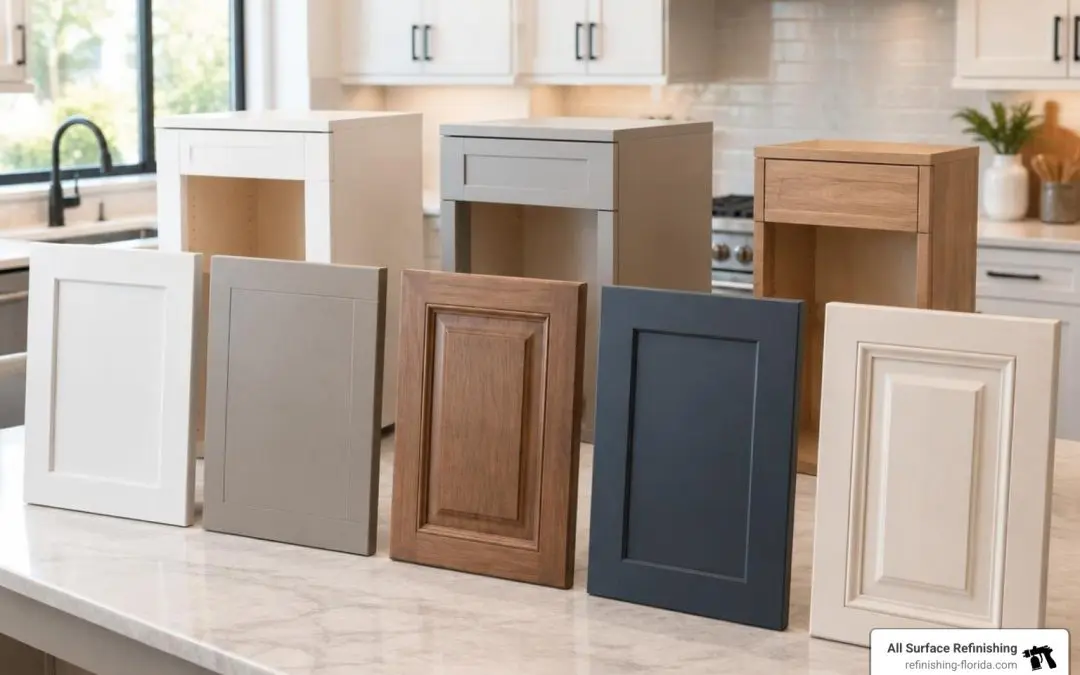
Real-World Cost Breakdown: How Much to Redo Kitchen Cabinets by Scope
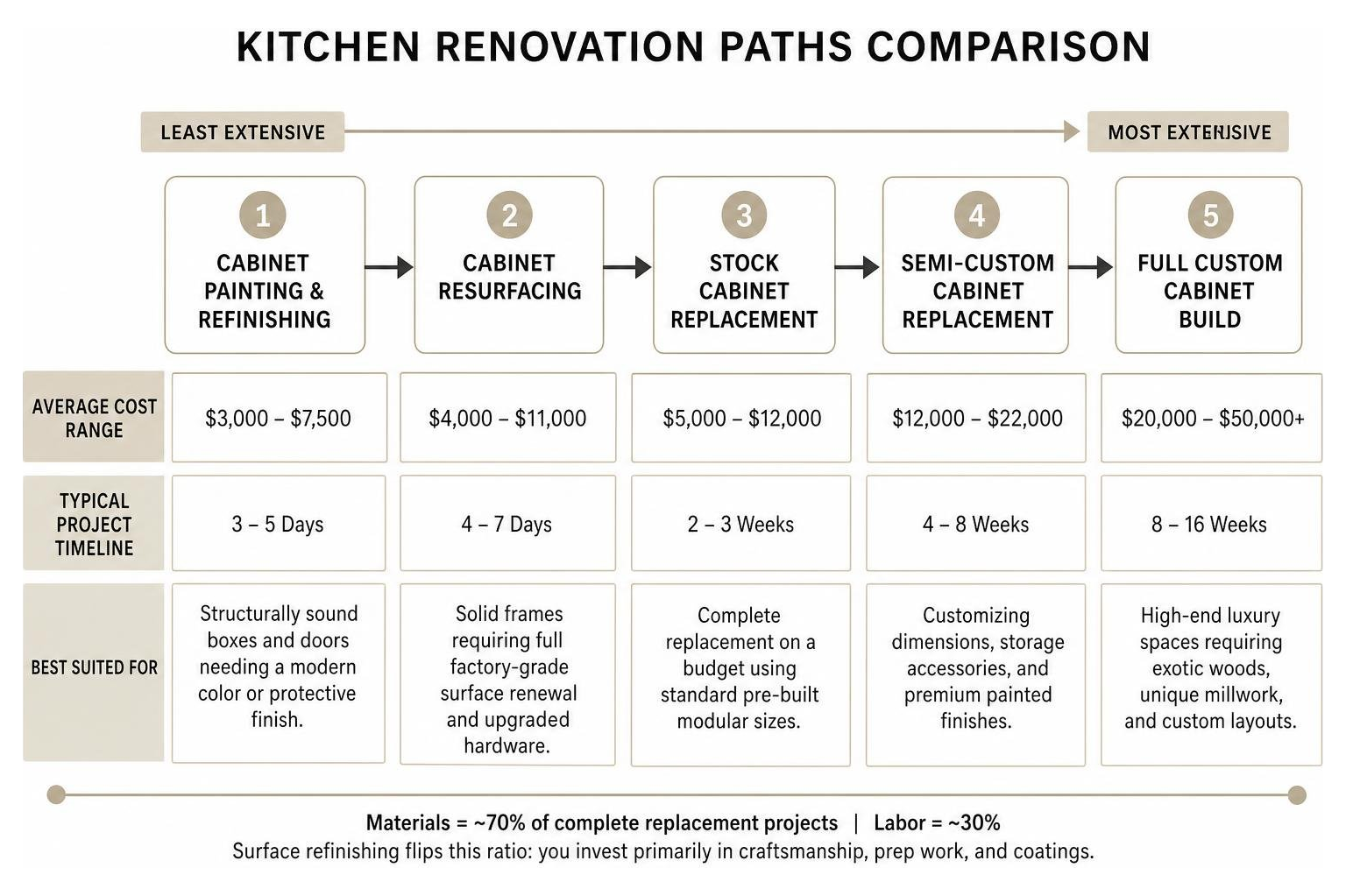
Every kitchen project begins with defining your scope. Homeowners often ask how much to redo kitchen cabinets when comparing cosmetic updates against total tear-outs. Because cabinetry constitutes the structural foundation of your kitchen workspace, your chosen method determines everything from the final invoice to project duration.
| Project Scope | Average Cost Range (Standard Kitchen) | Typical Project Timeline | Best Suited For |
|---|---|---|---|
| Cabinet Painting & Refinishing | $3,000 – $7,500 | 3 – 5 Days | Structurally sound boxes and doors needing a modern color or protective finish. |
| Cabinet Resurfacing | $4,000 – $11,000 | 4 – 7 Days | Solid frames requiring full factory-grade surface renewal and upgraded hardware. |
| Stock Cabinet Replacement | $5,000 – $12,000 | 2 – 3 Weeks | Complete replacement on a budget using standard pre-built modular sizes. |
| Semi-Custom Cabinet Replacement | $12,000 – $22,000 | 4 – 8 Weeks | Customizing dimensions, storage accessories, and premium painted finishes. |
| Full Custom Cabinet Build | $20,000 – $50,000+ | 8 – 16 Weeks | High-end luxury spaces requiring exotic woods, unique millwork, and custom layouts. |
Materials make up roughly 70% of complete replacement projects, with skilled labor accounting for the remaining 30%. In contrast, choosing professional surface refinishing flips this ratio: you invest primarily in master craftsmanship, prep work, and high-performance coatings while eliminating thousands of dollars in new lumber costs. For an itemized look at how these numbers balance, check out our cabinet resurfacing cost breakdown to plan your budget efficiently.
Budget Estimates: How Much to Redo Kitchen Cabinets in 2026
The national average for a standard kitchen remodel in 2026 sits around $27,000. Within that total, cabinetry consistently represents the largest single line item, consuming between 25% and 35% of the overall spend. Homeowners pursuing a minor cosmetic update often spend between $5,000 and $15,000 overall, whereas major structural gut renovations can easily escalate past $50,000 to $130,000+.
According to industry data on kitchen remodel scope benchmarks, minor updates focused on surfaces and hardware deliver the highest return on investment—often recouping 80% to 95% of their cost upon resale. When you retain the existing functional footprint and renew the cabinetry exterior, you avoid triggering expensive electrical rewiring or plumbing relocations.
Stock, Semi-Custom, and Custom Cabinet Tiers
If your existing cabinet boxes are warped, mold-damaged, or structurally failing, new boxes become necessary:
- Stock Cabinets ($80 to $160 per linear foot uninstalled / $3,000 to $8,000 installed): These units come mass-produced in fixed 3-inch width increments. They are typically constructed from furniture-grade particleboard with thin laminate or thermofoil veneers.
- Semi-Custom Cabinets ($150 to $300 per linear foot uninstalled / $8,000 to $20,000 installed): Semi-custom lines offer deeper flexibility with custom depths, specialty storage inserts, and solid wood face frames. Most homeowners undergoing full cabinet replacement land in this middle tier.
- Custom Cabinetry ($500 to $1,400+ per linear foot / $20,000 to $50,000+ installed): Custom wood shops build every box to the exact sixteenth of an inch. They utilize premium 3/4-inch furniture-grade plywood, dovetail joinery, and specialized finishes.
Cabinet box construction significantly dictates lifespan. High-density plywood holds mechanical fasteners better and resists moisture damage far better than standard particleboard—making plywood construction essential around high-moisture sink base cabinets and dishwashers.
Primary Price Drivers: Materials, Labor, and Finishes
When calculating the final investment for your kitchen cabinets, specific material selections and finishing techniques push estimates higher or lower.
- Box and Door Substrates: Medium-density fiberboard (MDF) provides an exceptionally smooth, uniform surface for solid painted colors because it does not expand or contract with humidity shifts. Solid wood species like maple and cherry offer classic durability, while premium lumber like walnut and rift-sawn white oak command 60% to 130% price premiums.
- Finish Applications: Factory-grade multi-step paint finishes require rigorous sanding, high-build primer coats, post-catalyzed conversion coatings, and controlled curing. A flawless opaque painted finish requires substantial labor, which is why examining professional cabinet painting expenses helps homeowners evaluate written proposals accurately.
- Hardware & Slides: Upgrading from standard hinges to integrated soft-close European concealed hinges and full-extension under-mount drawer slides generally adds $40 to $150 per cabinet opening, depending on hardware grade.
Calculating How Much to Redo Kitchen Cabinets per Linear Foot
Contractors typically measure cabinetry projects in linear feet—the horizontal measurement across the front of your base and upper wall cabinets. In standard configurations with stacked upper and lower units, a 25-linear-foot kitchen equates to roughly 50 total linear feet of casework.
Reviewing per linear foot installation data reveals that basic installation labor alone ranges from $50 to $120 per linear foot. When factoring in premium multi-tier crown molding, decorative end panels, and custom scribe molding to match uneven drywall, labor charges adjust accordingly.
Labor Rates and Regional Price Fluctuations
Labor costs depend heavily on your local market. Finish carpenters and master cabinet refinishers command wage rates that reflect regional cost-of-living differences. Across South Florida—including coastal communities in Miami-Dade, Broward, and Palm Beach County—trade labor rates average $35 to $85 per hour per technician.
For instance, projects in Miami, Pembroke Pines, and Fort Lauderdale may show a 5% to 15% variation based on building access regulations, parking constraints, and municipal permit overheads. Working with an experienced local contractor ensures that these variables are accounted for upfront.
Hidden Expenses and Budget Traps to Avoid
Over 60% of renovation budgets experience cost overruns of 15% or more due to unexpected items that were excluded from baseline estimates. Watch out for these standard secondary line items:
- Tear-Out and Dumpster Fees: Demolishing old cabinetry and hauling debris to local disposal facilities costs between $400 and $1,200.
- Trim and Fillers: Extended filler strips, toe-kick boards, light rail moldings, and multi-piece crown moldings easily add $500 to $2,500.
- Out-of-Square Corrections: Older homes frequently feature bowed wall studs or unlevel subfloors. Installers must spend extra hours shimming boxes and scribing frames to maintain plum lines.
- Drywall and Electrical Repairs: Removing wall-mounted cabinets often uncovers unpainted drywall patches, cutouts, or outdated wiring circuits that require patching before new installations can begin.
Understanding these variables through a dedicated cabinet refinishing pricing factors overview ensures your contingency fund remains intact throughout the renovation.
Smart Ways to Save on Your Cabinet Remodel
You do not need to overspend to achieve a luxury kitchen aesthetic. Use these practical, proven strategies to protect your renovation budget:
- Keep Your Existing Layout: Maintaining your current sink, refrigerator, and range locations preserves existing plumbing lines, gas connections, and 220V appliance feeds, saving anywhere from $3,000 to $8,000 in mechanical subcontractor fees.
- Choose Professional Refinishing Over Full Demolition: If your cabinet boxes are plumb, level, and structurally sound, refinishing the existing framework provides a factory-grade transformation at a fraction of full replacement costs.
- Source Your Own Hardware: Purchasing knobs, bar pulls, and organizers directly online allows you to avoid the standard 40% to 80% markups often applied by retail showrooms.
- Avoid the DIY Trap: While tackling the job yourself seems economical, consumer paint products and paint brushes cannot match the chemical resistance and smooth finish of professional-grade coatings. Reviewing the true costs of DIY painting projects highlights how rental sprayers, surface degreasers, and wasted weekends quickly erode theoretical savings.
Frequently Asked Questions About Kitchen Cabinet Costs
What is the most cost-effective way to redo kitchen cabinets?
The most cost-effective solution is professional cabinet refinishing combined with upgraded hardware. By preserving structurally sound cabinet boxes and doors, you bypass the expense of purchasing new lumber, demolition labor, and countertop removal. This approach yields high aesthetic value while keeping project expenses between $3,000 and $7,500 for most kitchens.
How much of a kitchen remodel budget should go toward cabinets?
Cabinetry should comfortably represent 25% to 35% of your total kitchen remodel allocation. If you have an overall budget of $30,000, plan to invest roughly $7,500 to $10,500 into your cabinets, leaving sufficient capital for quartz countertops, plumbing fixtures, tile backsplashes, and high-efficiency appliances.
How long does a typical cabinet transformation take?
Surface refinishing and resurfacing typically take between 3 and 7 business days, minimizing downtime in your household. In comparison, ordering semi-custom or custom replacement cabinetry involves manufacturing lead times of 4 to 12 weeks, followed by 1 to 3 weeks of on-site demolition, installation, and countertop templating.
Conclusion
Upgrading your kitchen cabinets enhances both daily functionality and long-term property value. By evaluating material quality, comparing project scopes, and planning for minor site prep, you can select the perfect path for your home without overspending.
At All Surface Refinishing, we bring over 30 years of industry experience and more than 14,000 completed kitchen and bathroom transformations to every project. We specialize in providing high-end, fast, and durable cabinet refinishing services throughout Miami, Pembroke Pines, Fort Lauderdale, and surrounding communities across South Florida. (Please note that while we provide factory-grade refinishing and coating services, we do not sell standalone retail paint.)
Ready to revitalize your space? Explore our comprehensive kitchen cabinet refinishing guide for Miami to see how our proven resurfacing process delivers factory-smooth results at a fraction of replacement costs.
