Why Porcelain Sink Repair Saves You Time and Money
Porcelain sink repair is a cost-effective solution that can restore your damaged sink to like-new condition without the expense and hassle of replacement. Whether you’re dealing with a small chip from a dropped cosmetic jar or stubborn stains that won’t scrub away, understanding your repair options can save you hundreds of dollars.
Quick Answer: Your Porcelain Sink Repair Options
- Minor chips and scratches – DIY epoxy repair kits ($14-$40) are an option for small cosmetic damage, but results can vary.
- Hairline cracks – Can be sealed with two-part epoxy to prevent leaks and further damage
- Larger chips or multiple cracks – Professional refinishing ($225-$650) provides a durable, seamless finish
- Structural damage with leaking – Full sink replacement is necessary
Repair typically takes:
- DIY fixes: 5-10 minutes application + 12-24 hours curing time
- Professional refinishing: 1-2 days for complete resurfacing
The research shows that refinishing costs about half the price of replacing your sink. For South Florida property owners and managers, this means you can update damaged bathroom and kitchen sinks without the disruption of demolition and new installation.
I’m Frank Hernandez, President of All Surface Refinishing, and I’ve been specializing in porcelain sink repair and refinishing throughout South Florida since 2011. My team has helped countless property owners restore their damaged sinks to pristine condition, saving them time and money while delivering results that often exceed their expectations.
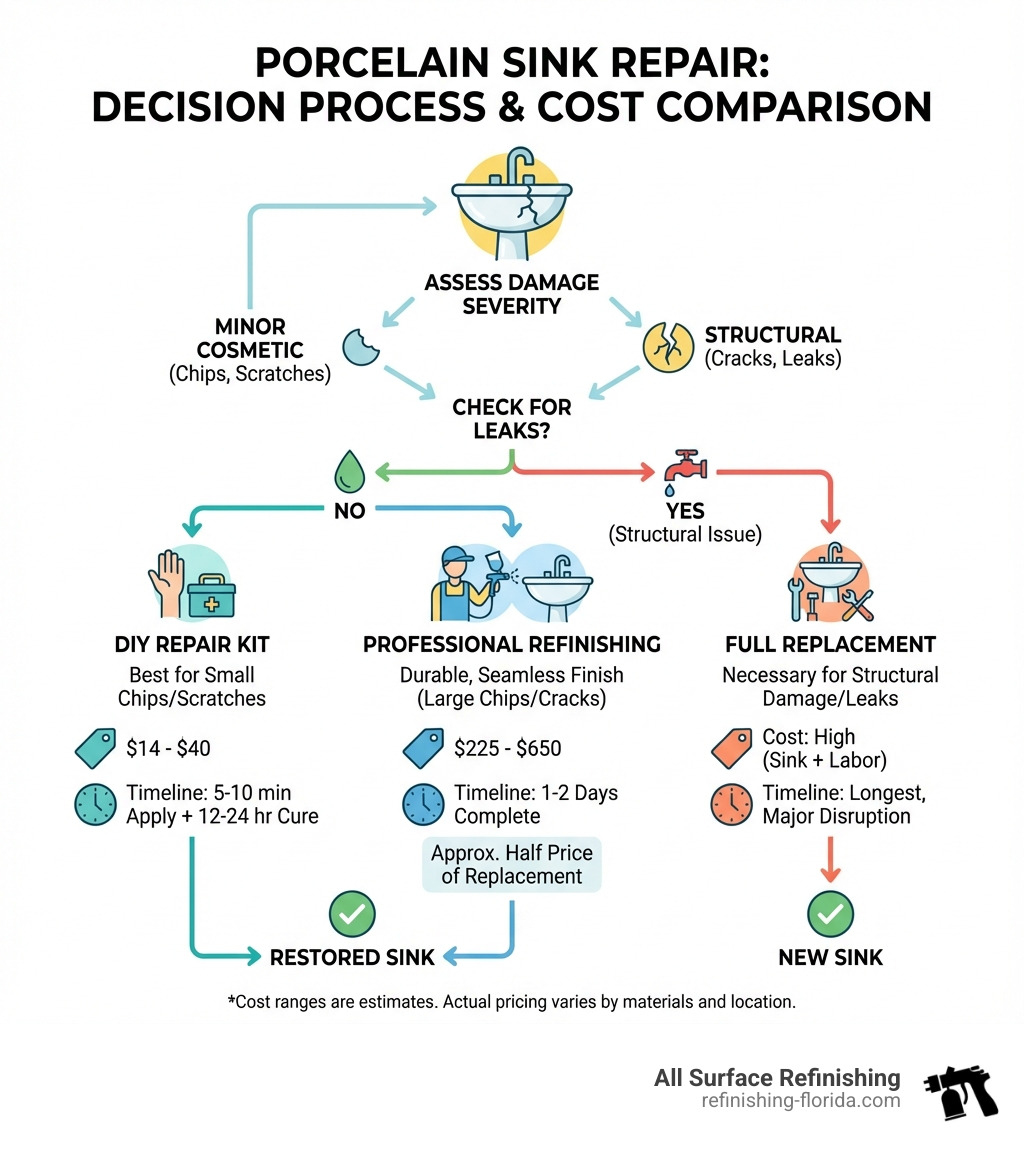
Assessing the Damage: Should You Repair or Replace Your Sink?
That moment when you find a flaw in your pristine porcelain sink can be disheartening. But before you panic and consider a full replacement, it’s crucial to understand the nature of the damage. Not all imperfections require the same solution. We’ll help you assess the situation and determine the best course of action for your porcelain sink repair.
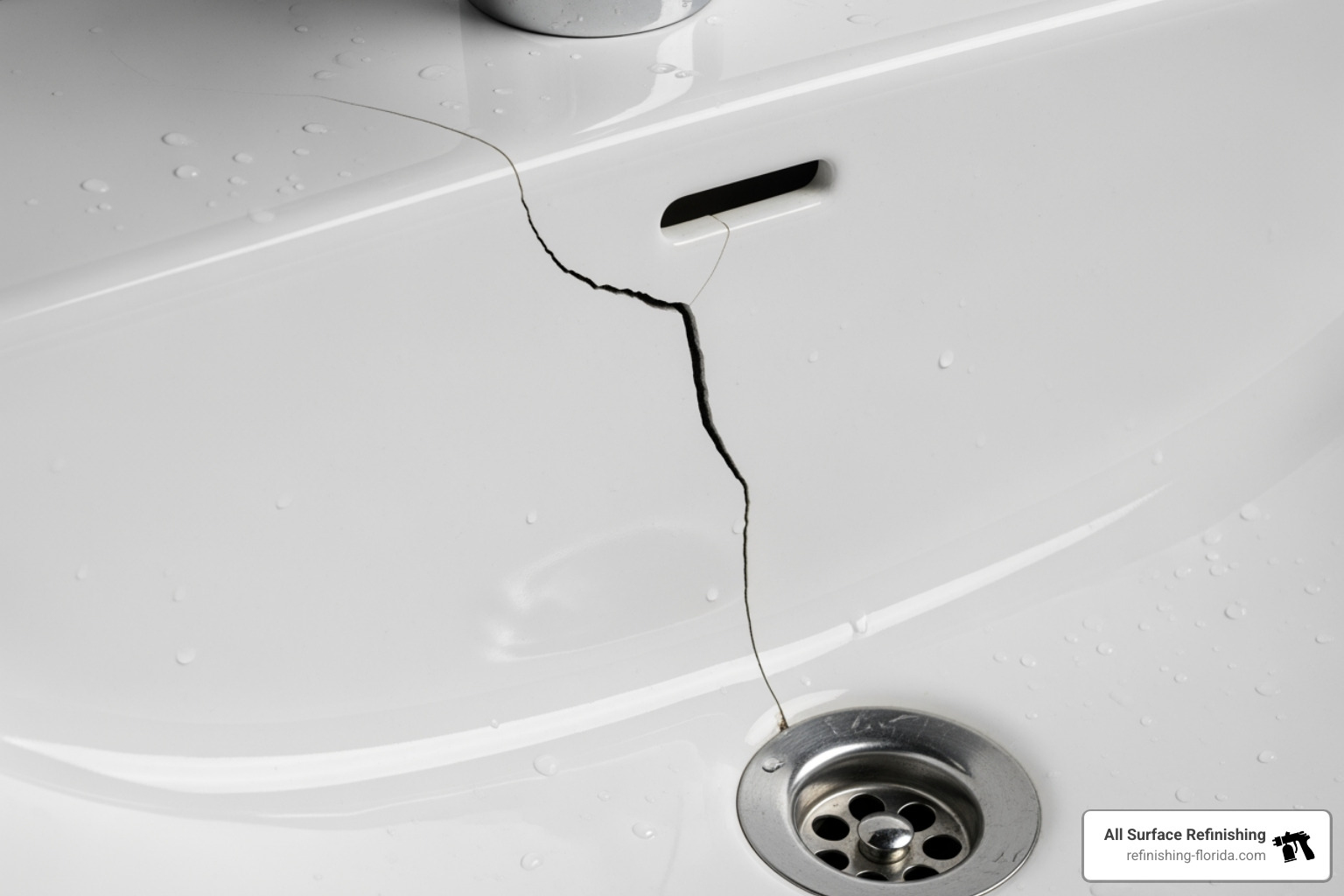
Porcelain sinks are beloved for their smooth, glossy finish and classic aesthetic, but they are not indestructible. Over time, or with a single mishap, they can suffer various forms of damage.
Common Causes of Damage to Porcelain Sinks:
- Impact Damage: This is perhaps the most common culprit. Dropping heavy objects—a ceramic mug, a cast iron pot, or even a glass cosmetic jar—can easily cause chips or cracks. Even minor bumps over time can create hairline cracks.
- Thermal Shock: Sudden and extreme temperature changes can stress the porcelain. Pouring boiling water into a cold sink, or vice versa, can lead to hairline cracks or exacerbate existing ones.
- Harsh Chemicals and Abrasive Cleaners: While porcelain is durable, prolonged exposure to caustic cleaning products can degrade the finish, making it more susceptible to staining and damage. Abrasive scrubbers can also scratch the surface.
- Wear and Tear: Over years of use, the protective enamel layer can thin, leading to dullness, minor scratches, and increased vulnerability to stains.
- Manufacturing Errors or Installation Stress: Sometimes, hidden flaws from manufacturing or stress during installation can lead to cracks appearing over time without an obvious cause.
- Corrosion: For older cast iron sinks with a porcelain enamel coating, a chip that exposes the underlying cast iron can lead to rust if left unrepaired. This rust can then spread under the porcelain, causing more damage.
Types of Damage and When to Repair vs. Replace:
Understanding the type and severity of damage is key to making an informed decision about porcelain sink repair.
- Chips: These are typically small pieces of porcelain that have broken off, exposing the underlying material.
- When to repair: Small chips (dime-sized or smaller) that are purely cosmetic and don’t compromise the sink’s integrity are excellent candidates for DIY repair kits or professional spot repair.
- When to replace: If chips are very large, numerous, or expose a significant area of rusting cast iron, replacement or professional refinishing might be more practical.
- Hairline Cracks: These are thin, superficial cracks that don’t typically go all the way through the sink material.
- When to repair: If the hairline crack is not leaking and primarily affects the appearance, it can often be filled and sealed to prevent it from worsening and to restore the aesthetic. However, ignoring these can lead to leaks and mold growth.
- When to replace: If the hairline crack is leaking water, or if it’s part of a larger structural crack that extends significantly, replacement is usually necessary.
- Stains: Discoloration that won’t scrub away.
- When to repair/refinish: Most stubborn stains can be removed with deep cleaning, or completely covered and eliminated through professional refinishing, which applies a new, fresh surface.
- When to replace: Only if the stains are indicative of deeper structural issues, or if you’re opting for a full aesthetic overhaul that goes beyond refinishing.
- Rust: Often appears around drains or in chipped areas of cast iron core sinks.
- When to repair/refinish: Small rust spots can be treated and then repaired with epoxy or covered during professional refinishing. Prompt repair is crucial to prevent spread.
- When to replace: If rust is extensive, has compromised the structural integrity of the sink, or is causing widespread discoloration, replacement may be the only viable option.
When is it More Practical to Replace a Porcelain Sink Instead of Repairing It?
While porcelain sink repair is often a fantastic, cost-effective solution, there are definite scenarios where replacement makes more sense:
- Structural Compromise and Leaks: If your sink has large cracks or holes that are actively leaking water, or if its structural integrity is severely compromised, repair might only be a temporary fix. A leaking sink can lead to significant water damage to your cabinetry and subfloor, making replacement a safer long-term investment.
- Extensive Damage: When the sink has multiple large chips, deep gouges, or a network of spiderweb cracks, a DIY repair might be too complex or yield an unsatisfactory aesthetic result. Professional refinishing can address extensive cosmetic damage, but if the underlying structure is too weak, even refinishing may not be suitable.
- Outdated Style or Desire for a Change: Sometimes, the damage is an opportunity for an upgrade. If your sink is old, an undesirable color, or doesn’t fit your current bathroom or kitchen aesthetic, replacing it might be the best option for a complete renovation. The average cost of sink installation falls between $225 and $650, excluding the sink itself.
Here’s a quick comparison to help you decide:
| Feature | DIY Repair | Professional Refinishing | Full Replacement |
|---|---|---|---|
| Cost | $14 – $40 (for repair kits) | ~Half the cost of replacement | $225 – $650 (installation) + sink cost |
| Time | A few hours (application) + 12-24 hr cure | 1-2 days (complete resurfacing) | 1-2 days (installation) |
| Durability | Varies; best for cosmetic, minor issues | 15+ years (with proper care) | New sink lifespan |
| Aesthetics | Can be noticeable; hard to color match | Seamless, factory-new finish; custom colors | Brand new appearance |
| Complexity | Low to moderate | Professional expertise required | Moderate to high (plumbing, removal, install) |
| Warranty | None | Often comes with a 5-year warranty | Manufacturer warranty on new sink |
For more comprehensive solutions regarding your bathroom’s look and feel, explore our Bathroom Refinishing services.
Understanding the DIY Porcelain Sink Repair Process
While a do-it-yourself porcelain sink repair might seem like a quick fix for minor chips and scratches, it’s a process fraught with potential pitfalls. Before you purchase a DIY kit, it’s important to understand what the repair entails and the challenges you might face.
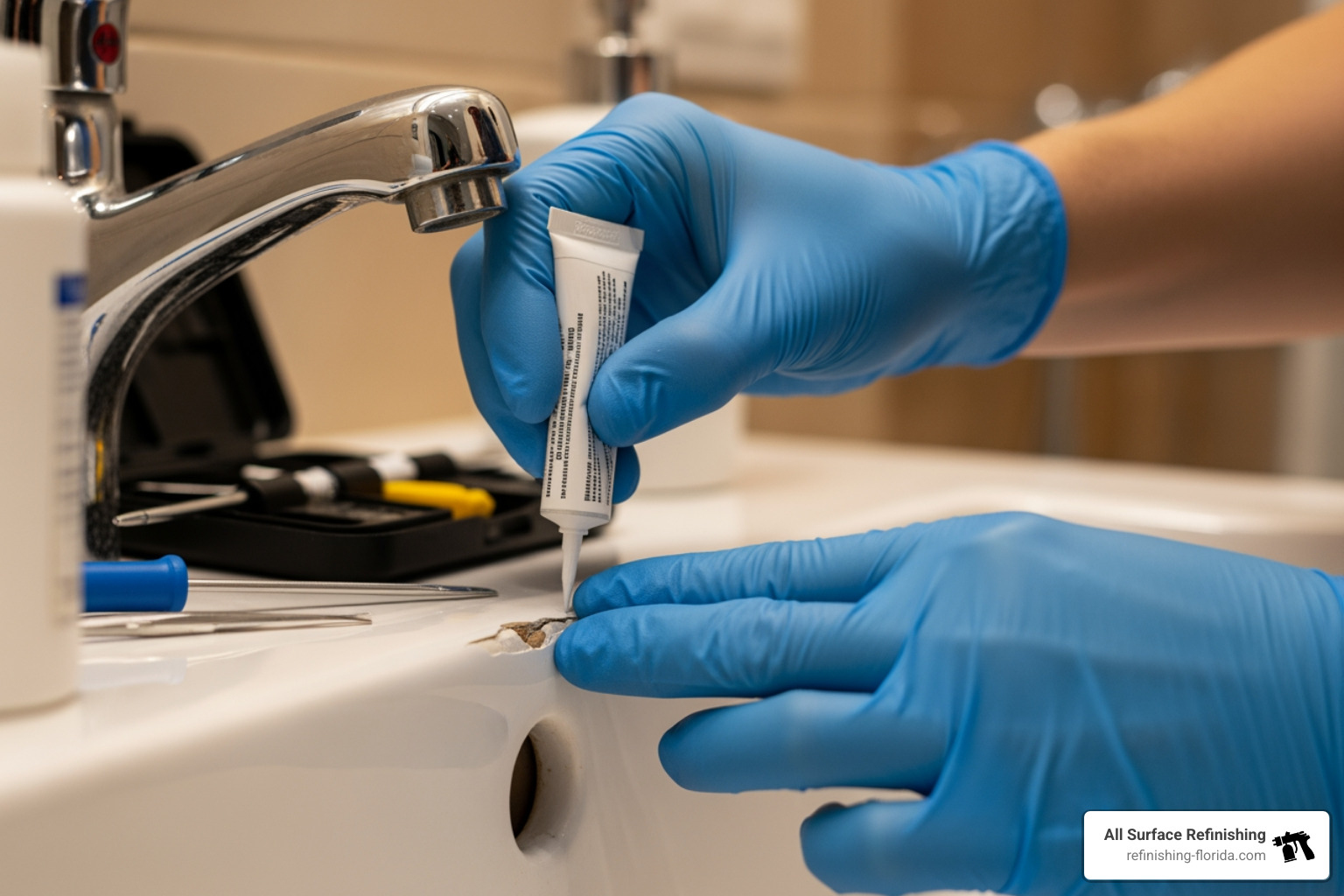
A typical DIY repair involves several critical stages, each requiring precision and care:
- Surface Preparation: The damaged area must be flawlessly clean, dry, and then carefully sanded. The goal is to roughen the surface for the epoxy to bond, but improper sanding can easily scratch the surrounding porcelain, expanding the visible damage.
- Epoxy Application: Most kits use a two-part epoxy that must be mixed in exact proportions. An incorrect ratio can result in a patch that never fully hardens. Applying the filler smoothly to match the sink’s contour is difficult, and the repair often ends up looking lumpy or uneven.
- Finishing and Color Matching: This is where most DIY repairs fall short. The cured epoxy must be sanded perfectly flush with the sink’s surface, a task that can dull the finish if not done correctly. Furthermore, DIY kits typically come in a generic white, making a perfect color match nearly impossible for most sinks. The result is often a visible, discolored patch that draws more attention to the original flaw.
While a DIY kit may seem cost-effective at $14 to $40, the risk of an unsightly or failed repair is high. The process requires specific tools, including fine-grit sandpaper, putty knives, and safety equipment, and demands a steady hand and a keen eye for detail.
Safety first! When performing any DIY projects, it’s wise to be mindful of your necessary safety equipment.
Given these challenges, a DIY repair is often a temporary solution that lacks the durability and seamless appearance of a professional job. For a result that truly restores your sink’s beauty, professional refinishing is the more reliable option.
Beyond sinks, we also offer services to refresh your entire kitchen or bathroom. Explore our Countertop Refinishing Services to see how we can transform your space.
When to Call a Professional vs. DIY Repair
While DIY porcelain sink repair can be effective for minor blemishes, there comes a point where professional expertise is not just recommended, but essential. Understanding this distinction can save you time, money, and future headaches.
Limitations and Potential Risks of DIY Porcelain Sink Repair:
- Color Mismatch: DIY kits often come in a standard white. If your sink is an off-white, almond, or another color, achieving an exact color match is extremely difficult for a DIYer. The repair might stand out, looking more like a patch than a seamless fix.
- Uneven Texture and Finish: Many DIY kits use brushes or rollers for application, which can lead to streaks, brush marks, or an uneven, dull texture. It’s almost impossible for a DIYer to replicate the smooth, glossy, factory-new finish of porcelain.
- Lack of Durability: While suitable for very small cosmetic issues, DIY repairs may not hold up well to daily use, heat, or cleaning chemicals, especially for larger chips or cracks. They can chip, yellow, or peel over time, leaving you back at square one.
- Inadequate for Structural Damage: DIY kits are not designed to address structural cracks or significant holes that compromise the sink’s integrity or cause leaks. Attempting to fix these with a DIY kit is often a waste of money and can lead to more serious water damage.
- Safety Concerns: Some DIY kits, particularly those for refinishing, may contain dangerous etching primers or strong chemicals that require proper ventilation, safety equipment, and training to handle safely. Without these, you risk health hazards.
Advantages of Professional Refinishing for Porcelain Sink Repair:
When the damage is beyond a simple cosmetic touch-up, or if you desire a truly flawless and long-lasting result, professional refinishing is the superior choice. At All Surface Refinishing, we offer expert services across South Florida, including Miami, Fort Lauderdale, West Palm Beach, Boca Raton, and many more locations, resurfacing your sinks with precision and care.
- Seamless, Factory-New Finish: Our professionals use specialized equipment, proprietary bonding agents, and advanced acrylic coatings that adhere directly to your existing porcelain. This results in a smooth, high-gloss finish that looks and feels brand new, without any visible patches or texture differences.
- Durability and Longevity: Professional refinishing extends the useful life of your sink for 15 years or more. Our process is designed to withstand daily use, heat, and cleaning, offering a durable solution that outperforms DIY kits. We stand by our work with a 5-year warranty on services.
- Custom Color Matching and Aesthetic Upgrades: Unlike generic DIY kits, professional refinishing allows for precise color matching, even for unique or older sink colors. We can also change the color of your sink entirely, offering a wide range of designer colors to update your bathroom or kitchen aesthetic without the mess and expense of replacement.
- Cost-Effective: Professional refinishing costs approximately half the price of replacing a sink, saving you significantly on demolition, removal, and installation fees.
- Fast and Convenient: Most professional sink refinishing can be completed in just one to two days, minimizing disruption to your home or commercial property.
- Expert Craftsmanship: Our technicians have the training and experience to properly prepare the surface, fill all chips and cracks, and apply coatings evenly, ensuring a high-quality, long-lasting repair.
When Professional Help is Needed:
Consider calling All Surface Refinishing for your porcelain sink repair if:
- Large or Multiple Cracks/Chips: When the damage is extensive, a professional can restore the entire surface more effectively and durably.
- Extensive Staining or Rust: If your sink is deeply stained or has significant rust spots (especially common in older cast iron core sinks), refinishing can completely cover and seal these imperfections.
- Desire for a Color Change: If you want to update the look of your sink to match a new bathroom or kitchen décor, professional refinishing offers numerous color options.
- Structural Integrity Concerns: While we focus on surface refinishing, if the damage is severe enough to question the sink’s structural integrity, we can advise on the best course of action.
Learn more about our comprehensive Bathroom Refinishing Services in Miami, FL and other South Florida locations.
Frequently Asked Questions about Fixing Porcelain Sinks
We often get questions about porcelain sink repair, and we’re happy to share our expertise to help you make the best decisions for your home or commercial property.
How long does a porcelain sink repair typically take?
The duration of a porcelain sink repair depends significantly on the method chosen and the extent of the damage.
- DIY Repair Time: For small chips or hairline cracks, the active application time for a DIY kit can be as quick as 5-10 minutes. However, you must account for drying and curing times. Some epoxies dry to the touch in 10 minutes, but a full cure, where the repair reaches its maximum hardness and durability, can take 12-24 hours. If multiple layers are needed for deeper chips, each layer requires drying time, extending the overall process.
- Professional Refinishing Timeline: For professional services like ours at All Surface Refinishing, spot repairs on chips or cracks can often be completed in just a few hours. A complete resurfacing of a bathroom vanity, including the sink, can typically be completed within about two days. This includes thorough cleaning, repair of imperfections, and application of a new, durable finish.
How can you ensure the repair matches the sink’s color?
Achieving a perfect color match is one of the trickiest aspects of porcelain sink repair.
- DIY Kit Limitations: Most DIY repair kits come in a generic white. While some kits offer pigments that you can mix to try and match your sink, this requires a very keen eye and can be difficult to get just right, especially for older, off-white, or custom-colored sinks. The repair might still be visible as a slight discoloration or patch.
- Professional Color Matching Techniques: This is where professional refinishing truly shines. Our technicians at All Surface Refinishing are experts in color matching. We have access to a wide range of tints and can custom-mix colors to precisely match your existing sink’s shade or even change it to a completely new color if desired. This ensures the repair, or the entire refinished surface, blends seamlessly with your bathroom or kitchen décor, providing a factory-new finish that’s virtually indistinguishable from original porcelain.
What are the best practices for maintaining a repaired porcelain sink?
Proper maintenance is key to extending the life and appearance of your porcelain sink repair, whether it’s a DIY fix or a professional refinish.
- Gentle Cleaning: Always use mild, non-abrasive cleaners and soft cloths or sponges. Avoid harsh chemicals, scouring powders, or abrasive pads, which can damage the repaired area or the surrounding finish.
- Avoid Harsh Chemicals: Limit the use of caustic cleaning products, drain cleaners, and strong acids or alkalis. These can degrade the repair material or the refinished surface over time. For guidance on using chemicals safely, refer to resources like Canada’s health safety guidelines.
- Prevent Future Impacts: Be mindful of dropping heavy or sharp objects into the sink. Consider using a sink protector or a rubber mat to cushion impacts, especially in busy kitchen sinks.
- Annual Inspection: Regularly inspect your sink for any new hairline cracks or chips, and address them promptly. Small issues are much easier and cheaper to repair than larger, more advanced damage.
- Avoid Thermal Shock: Try to avoid sudden temperature changes, such as pouring boiling water into a cold sink. While porcelain is durable, extreme thermal shock can stress the material and lead to new cracks or worsen existing ones.
Restore Your Sink’s Beauty with Confidence
Whether you’re a homeowner in Coral Springs, a property manager in Fort Lauderdale, or a business owner in Miami, dealing with a damaged porcelain sink can be frustrating. We hope this guide has illuminated your options for porcelain sink repair.
While a DIY repair kit might seem like a quick fix for minor cosmetic chips, achieving a truly durable, seamless, and long-lasting result often requires professional expertise. For larger cracks, extensive staining, or when you desire a complete aesthetic change, professional refinishing is undoubtedly the superior choice.
At All Surface Refinishing, we are South Florida’s trusted experts in revitalizing bathroom and kitchen surfaces. With over 30 years of experience and 14,000+ projects completed, our team is dedicated to providing cost-effective, fast, and high-quality solutions for your bathtubs, cabinets, tiles, and sinks across locations like Boca Raton, West Palm Beach, Pembroke Pines, and beyond. We pride ourselves on delivering results that not only fix the damage but also revitalize your space.
Don’t let a damaged sink detract from your home or property’s appeal. Contact us today for a free estimate and let us help you restore your sink’s beauty with confidence. Get a free estimate for professional Vanity Refinishing Services.
