
Top Commercial Coating Formulas for Kitchen and Bathroom Cabinets
Standard architectural coatings are formulated for drywall flexibility, but high-traffic millwork demands industrial cross-linking polymers. True commercial systems withstand repeated impact, high-velocity cleaning chemicals, and constant exposure to skin oils. Whether updating a busy hospitality suite, medical office, or busy family home, choosing the right commercial coating ensures doors and drawer faces will not scuff, peel, or soften under heavy use.
Key Durability Factors in Commercial Grade Cabinet Paint
Industrial millwork coatings utilize specialized cross-linking resins that cure significantly harder than standard household wall paint. In demanding environments like cooking spaces and washrooms, surfaces face moisture intrusion, airborne grease, and daily scrubbing.
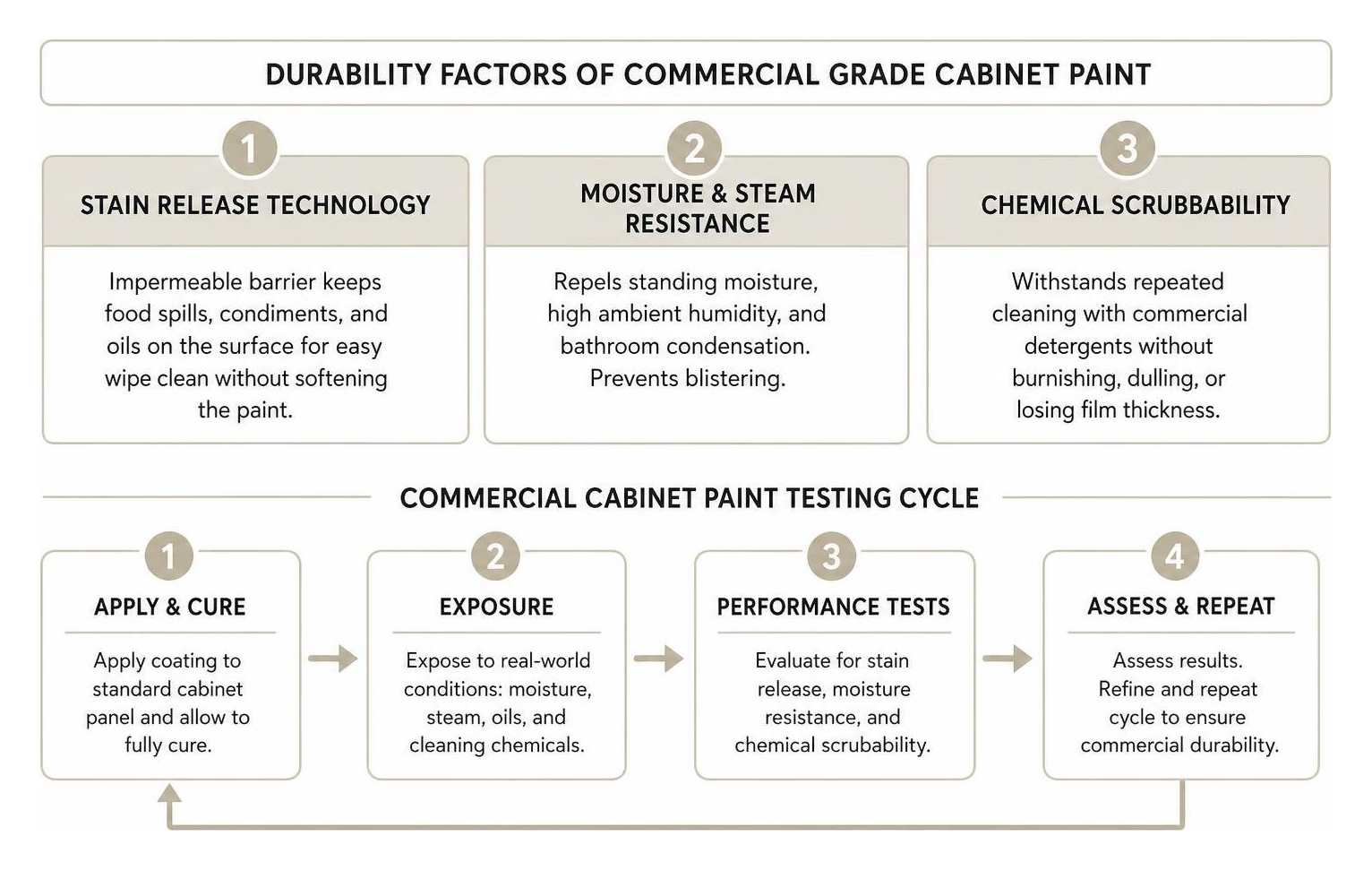
When selecting products, especially for high-humidity areas, understanding the ultimate guide to the best paint type for bathroom cabinets helps prioritize the specific qualities that prevent film failure:
- Stain Release Technology: Commercial-grade acrylic and urethane resins create an impermeable barrier that keeps food spills, condiments, and oils on the surface where they can be wiped clean without softening the paint.
- Moisture and Steam Resistance: Standard paints blister when exposed to humidity, while commercial enamels repel standing moisture, high ambient humidity, and bathroom condensation.
- Chemical Scrubbability: These formulas withstand repeated cleaning using commercial detergents without burnishing, dulling, or losing film thickness.
- Yellowing Resistance: Modern waterborne hybrids replace traditional oil varnishes, maintaining pure white and custom colors over years of UV exposure.
Early Block Resistance and Curing Timelines
A defining attribute of high-tier cabinet paint is early block resistance—the ability of a coating to resist sticking to itself when two painted surfaces are pressed together under pressure.
Standard consumer wall paints remain tacky for weeks, leading to ruined edges when cabinet doors close against face frames. Commercial enamels, by contrast, achieve early block resistance and dry tack-free in as little as 2 hours under standard conditions (77°F and 50% relative humidity).
While modern enamels dry to the touch in 1 hour and allow doors to be rehung quickly, full chemical curing requires approximately 14 days (up to 2 weeks). During this curing window, the polymer chains complete their cross-linking process to reach maximum surface hardness. Homeowners and facility staff can safely open and close doors after initial drying, but aggressive scrubbing with liquid detergents should wait until this two-week cure is complete.
Choosing the right paint requires matching the resin chemistry to the room’s traffic level, budget, and environmental conditions. When evaluating commercial coating products, reviewing painting cabinets heres the top paint pick provides practical insight into how various formulations balance flow, odor, and long-term durability.
| Formula Type | Primary Resin Chemistry | Typical Coverage per Gallon | Recoat Window | Best Use Case |
|---|---|---|---|---|
| Urethane Alkyd Hybrid | Waterborne urethane-modified alkyd | 350–400 sq. ft. | 4 hours | High-touch residential millwork, built-ins, and trim |
| Pre-Catalyzed Waterborne Epoxy | Single-component acrylic epoxy | 300–400 sq. ft. | 2 hours | Commercial kitchens, medical offices, and institutional washrooms |
| Industrial Acrylic Enamel | High-solids 100% acrylic | 400–450 sq. ft. | 2–3 hours | Moisture-prone bathrooms and rapid-turnaround refinishing |
Evaluating Waterborne Alkyd Commercial Grade Cabinet Paint
Waterborne alkyd paints represent a major leap forward in coating technology. Traditional oil-based alkyds offered exceptional flow and leveling, but they yellowed over time, emitted high VOCs, and required harsh solvents for cleanup.
Modern urethane-modified alkyds, such as Pro Industrial™ Urethane Alkyd Enamel – Sherwin-Williams, combine the leveling behavior of oil with the color retention, non-yellowing qualities, and water cleanup of water-based coatings. These urethane alkyd blends provide tough chip and abrasion resistance comparable to silicone alkyds. Many of these industrial formulas are certified suitable for use in USDA-inspected food processing and commercial service facilities, making them reliable choices for both busy commercial spaces and luxury residential kitchens.
Pre-Catalyzed Waterborne Epoxy and Urethane Hybrids
For institutional environments subject to aggressive sanitizing and constant physical contact, single-component pre-catalyzed waterborne epoxies provide exceptional durability. Products like Pre-Catalyzed Waterborne Eggshell Epoxy Coating HP140 | Behr Pro offer heavy-duty chemical and severe scrub resistance without the complexity of measuring and mixing separate catalyst components on-site.
These pre-catalyzed coatings dry quickly, maintain low VOC levels, clean up with warm water, and meet regulatory standards for incidental food contact. This makes them ideal for commercial food preparation areas, break rooms, schools, and medical facilities where cabinets must be sanitized repeatedly without degrading the protective finish.
High-Performance Acrylic Enamels
High-solids 100% acrylic cabinet enamels provide rapid drying, minimal odor, and reliable flexibility. Specialized coatings such as Insl-X® Cabinet Coat | Benjamin Moore are engineered with adhesion promoters capable of bonding over sound polyurethane, factory clear coats, and smooth surfaces without peeling.
Similarly, BEHR PREMIUM® Interior/Exterior Cabinet, Door & Trim Enamel Paint | Behr Pro offers self-leveling flow that dries to a hard, durable finish with low VOC emissions (less than 50 g/L). For property managers and homeowners needing quick project turnarounds, these premium acrylic enamels dry to the touch in 1 hour and accept recoats in 2 hours, minimizing downtime while delivering a lasting finish.
Professional Application Methods for a Factory-Smooth Finish
Achieving a clean, factory-smooth look requires the right application method. For comprehensive step-by-step guidance on equipment setup and staging, a practical guide to painting kitchen cabinets professionally explains how professionals organize workspace flow to ensure uniform results.
Spraying vs Rolling and Brushing Techniques
While DIY painters often pick up a brush or roller, application method directly affects surface texture and film uniformity:
- Fine Finish Spraying: Professional refinishers use high-volume low-pressure (HVLP) or fine-finish airless sprayers set between 1500 and 2500 PSI. Using an airless spray tip size between .013″ and .015″ matched with a fine 60-mesh filter atomizes the coating into an even mist, eliminating brush strokes entirely. Choosing cabinet spray painting get a flawless finish without the brush strokes remains the gold standard for replicating true factory-built millwork.
- Rolling Application: If spraying is not feasible, use a high-density 1/4-inch nap mohair roller sleeve instead of a foam roller. Foam rollers introduce air bubbles that dry into micro-stippling, whereas mohair lays down a uniform, flat film.
- Brushing: Reserve 100% nylon/polyester synthetic brushes exclusively for tight interior corners and profile recesses, allowing self-leveling enamels to flow flat naturally.
Surface Preparation and Primer Selection
Prep work accounts for roughly 90% of a long-lasting cabinet finish. Applying premium paint over grease, wax, or glossy finishes without proper prep causes premature peeling and flaking.
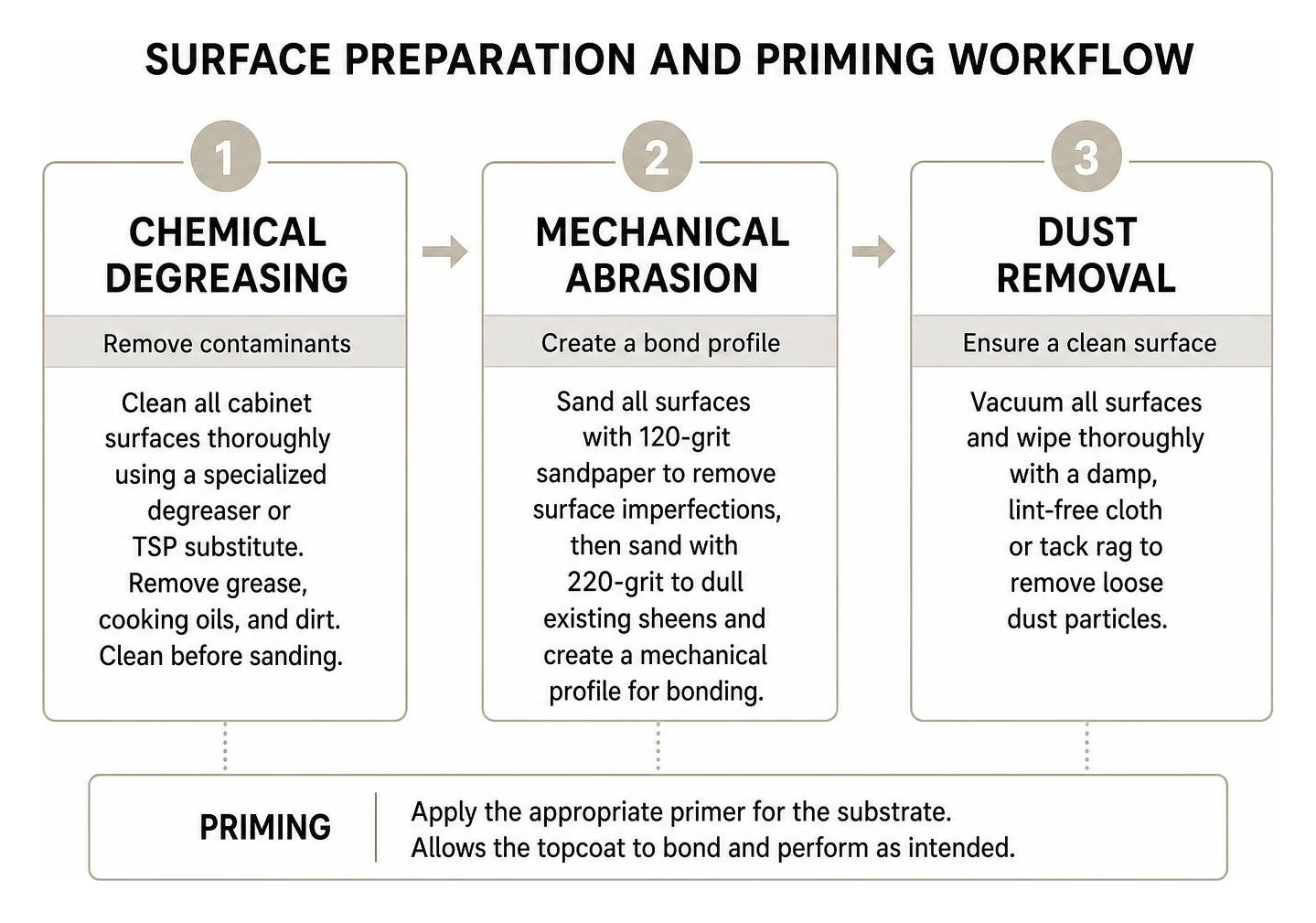
Following the proven protocols in our cabinet refinishing complete guide 2025 ensures permanent coating adhesion across every substrate:
- Chemical Degreasing: Clean all cabinet surfaces thoroughly using a specialized degreaser or TSP substitute to remove grease, cooking oils, and dirt. Scuff-sanding before degreasing drives oils directly into the wood pores, so always clean first.
- Mechanical Abrasion: Sand all surfaces with 120-grit sandpaper to remove surface imperfections, followed by 220-grit paper to dull existing sheens and create a mechanical profile for bonding.
- Dust Removal: Vacuum all surfaces and wipe thoroughly with a damp lint-free cloth or tack rag to remove loose dust particles.
- Bonding Primer Application: Apply a dedicated stain-blocking bonding primer (or synthetic shellac for open-grained woods like oak or tannin-rich woods like cherry) to prevent bleed-through and ensure a strong bond.
- Inter-Coat Sanding: After the primer and between each subsequent topcoat, lightly hand-sand with 320-to-400-grit sandpaper or a fine sanding pad. This knocks down raised wood grain, ensuring a level, glass-smooth final finish.
Frequently Asked Questions About Commercial Cabinet Coatings
Do commercial cabinet enamels require a clear topcoat?
No. Commercial-grade cabinet enamels are self-sealing formulations engineered to cure into a hard, non-porous finish on their own. Adding a consumer clear coat over modern hybrid or urethane enamels is unnecessary and can cause issues: clear topcoats may yellow over time, trap moisture, or interfere with the underlying paint’s natural flexibility and adhesion.
How long do commercial cabinet paints take to fully cure?
Drying and curing are two distinct stages:
- Dry to Touch: 1 hour under standard conditions (77°F, 50% relative humidity).
- Recoat Window: 2 to 4 hours for most acrylics and urethane alkyds; 6 hours for specific heavy-build coatings.
- Tack-Free/Door Hanging: 2 to 24 hours depending on the product’s block resistance.
- Full Cure: 14 days (2 weeks). The painted surface can handle normal use within days, but avoid harsh chemical cleaning and heavy scrubbing until the full 14-day cure is complete.
What is the best sheen for high-traffic commercial cabinets?
Satin and semi-gloss are the industry standards for high-traffic cabinets.
- Satin Finish: Provides a soft, low-reflective luster that hides minor wood grain and surface imperfections while hiding fingerprints and smudges better than higher glosses.
- Semi-Gloss Finish: Delivers slightly higher light reflectivity and moisture resistance, making it easy to wipe down in busy kitchens and commercial bathrooms.
Matte sheens should generally be avoided on high-touch cabinets because they burnish when scrubbed, while full high-gloss finishes highlight every underlying substrate flaw.
Conclusion
Upgrading your kitchen, vanity, or workspace with durable industrial coatings provides long-term value, factory-smooth aesthetics, and dependable protection against daily wear. While standard consumer paints often peel and chip within months, high-performance hybrid urethanes, pre-catalyzed epoxies, and advanced acrylic enamels deliver lasting washability, block resistance, and color retention.
We do not sell paint in retail stores; instead, our team provides complete resurfacing and refinishing services to transform worn woodwork, bathtubs, and countertops. To learn more about how we update residential and commercial spaces across South Florida, browse our comprehensive services cabinet offerings.
If you are a property manager, facility director, or homeowner in Fort Lauderdale, Miami, West Palm Beach, Boca Raton, Coral Gables, or surrounding communities, reach out to our team at All Surface Refinishing. Schedule a consultation for our commercial cabinet resurfacing services to bring lasting durability and factory-grade quality to your next project.
