
Custom vs. Semi-Custom vs. Stock: Evaluating Kitchen Cabinet Makers
Every kitchen project begins with a fundamental decision about how your cabinetry will be built and sourced. Cabinetry lines fall into three main categories: stock, semi-custom, and full custom. Each tier serves a distinct purpose, balancing cost, design flexibility, and manufacturing lead times.
- Stock Cabinets: These are mass-produced in fixed modular increments (typically 3-inch intervals). They are pre-manufactured, stored in regional warehouses, and offer the most budget-friendly entry point. However, stock units leave little room for layout adjustments. If your kitchen wall measures 127 inches, stock boxes will require filler strips to bridge the gaps, leaving usable space behind decorative panels.
- Semi-Custom Cabinets: Built upon standard box dimensions, semi-custom lines permit selected modifications. Manufacturers can reduce cabinet depth, alter door styles, change finishes, or integrate specialty organizers like spice pull-outs or trash systems. Semi-custom gives you a tailored appearance without paying for one-off engineering.
- Full Custom Cabinets: Fabricated from raw lumber and sheet goods to your exact architectural specifications. True artisan cabinetmakers do not rely on pre-set boxes. Whether you have awkward sloped ceilings in a historic Coconut Grove home or need specific appliance paneling in Bal Harbor, custom cabinetry eliminates filler strips and utilizes every cubic inch.
Understanding how much do new kitchen cabinets actually cost helps determine whether custom fabrication fits your overall project budget.
| Feature | Stock Cabinetry | Semi-Custom Cabinetry | Full Custom Cabinetry |
|---|---|---|---|
| Dimension Increments | Standard 3-inch increments only | Standard widths with depth/height modifications | Any fractional measurement down to 1/16th inch |
| Material Options | Limited wood species, engineered cores | Broad selection of hardwoods and veneers | Exotic hardwoods, specialized veneers, premium cores |
| Finish Selections | 3 to 10 standard paint/stain options | Dozens of curated factory paints and stains | Unlimited custom color matching and hand finishes |
| Storage Customization | Basic fixed or adjustable shelves | Catalog accessories (lazy susans, rollout trays) | Bespoke internal drawers, charging slots, hidden kicks |
| Price Tier | Low to moderate entry-level | Mid-range to upper-middle | Premium investment tier |
Understanding Cabinet Construction: Framed vs. Frameless
Beyond modular sizing, the structural design of the box dictates daily accessibility and durability. The two primary methods are American framed construction and European frameless (full access) construction.
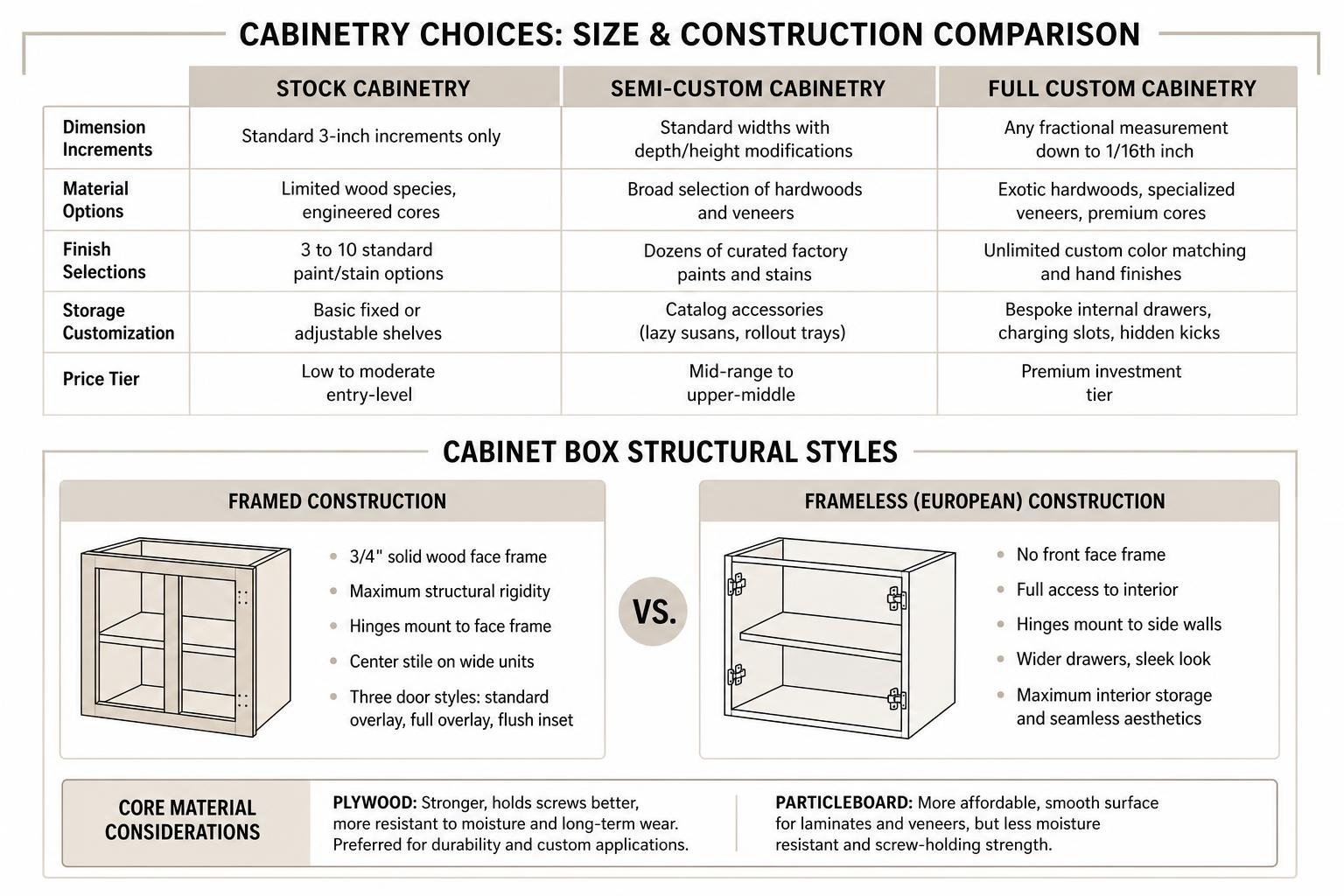
- Framed Cabinetry: A solid 3/4-inch hardwood frame is fastened to the front edges of the cabinet box. This face frame gives the box structural rigidity, keeping the unit square during shipping and installation. Framed cabinets can accommodate three door styles: standard overlay, full overlay, or flush inset. The frame provides long-term stability and eases installation on uneven walls, though the frame slightly narrows the opening for drawers and interior roll-outs.
- Frameless Cabinetry: Popularized in modern European designs, frameless cabinets dispense with the front face frame. The cabinet sides, top, and bottom are thicker (typically 3/4-inch furniture board or plywood) to provide standalone strength. Doors mount directly to the interior box walls via concealed hinges. Frameless units offer seamless aesthetics and maximum interior storage, making them a standard pick for contemporary spaces across Miami and Fort Lauderdale.
Plywood vs. Particleboard Core Materials
The core material used for the cabinet box determines how well the unit handles heavy stone countertops, continuous door cycling, and regional indoor humidity:
- Furniture-Grade Plywood: Constructed from alternating layers of wood veneer glued under high pressure, plywood offers exceptional tensile strength and superior screw-holding power. It resists sagging across wide shelf spans and tolerates minor water exposure better than pressed alternatives. Upgrading to all-plywood construction is widely regarded as a practical choice for high-traffic kitchens.
- Particleboard and Medium-Density Fiberboard (MDF): Particleboard consists of wood particles bonded with synthetic resin. While budget-friendly and dimensionally stable under steady climate conditions, standard particleboard swells significantly if exposed to standing water from sink leaks. MDF, however, provides an ultra-smooth surface for painted doors, preventing the grain telegraphing that can occur on natural solid wood slabs.
Choosing Between National Brands and Regional Cabinetry Specialists
Homeowners must decide whether to purchase factory-built cabinetry through regional dealer networks or hire an independent local shop. Both paths offer distinct practical advantages depending on your remodeling schedule and design goals.
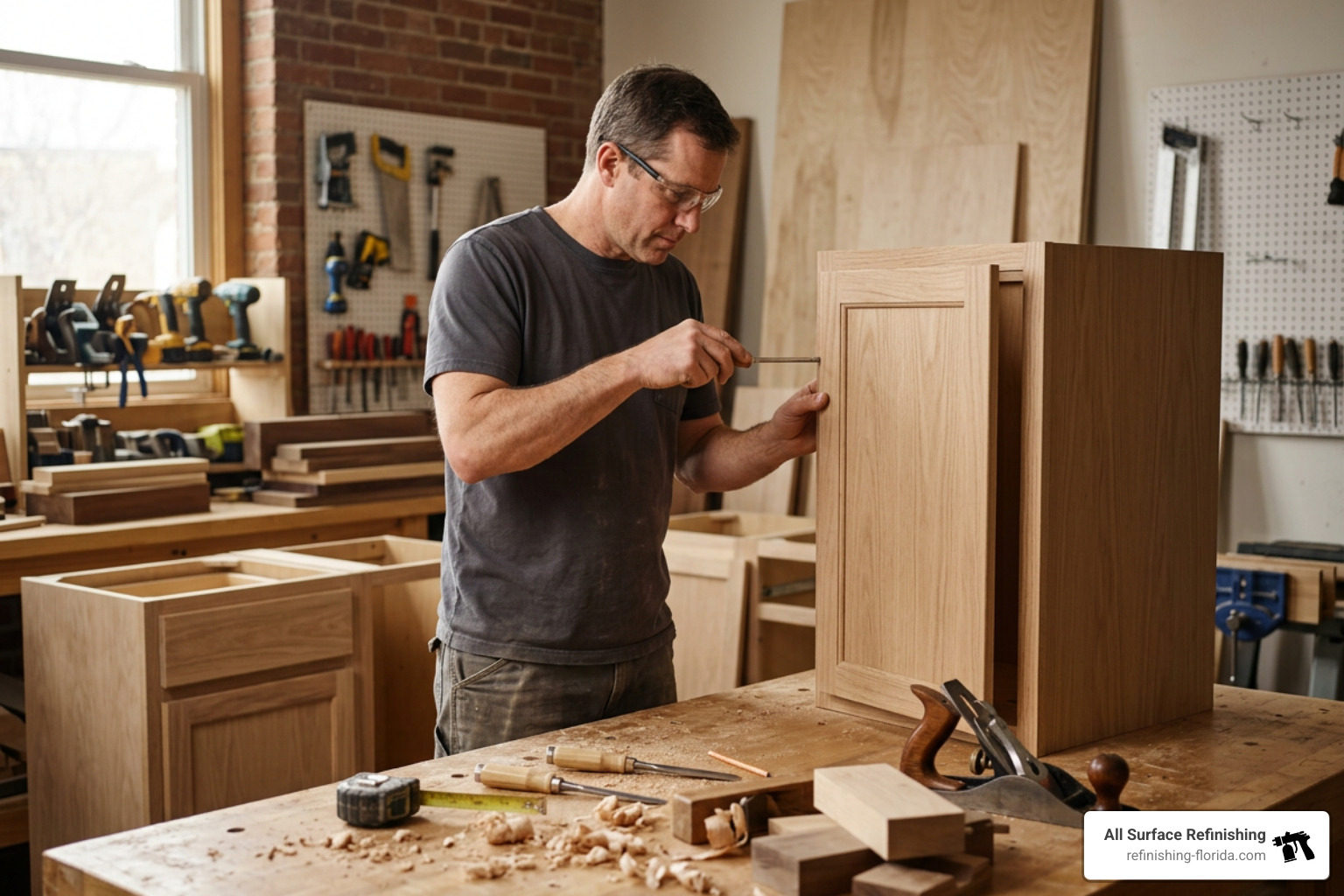
National cabinet manufacturers rely on highly automated assembly lines to produce uniform catalog lines. These brands distribute products through kitchen showrooms and big-box dealers across Palm Beach County and Broward County. Factory production offers reliable warranty backing and specialized robotic finish booths. However, making alterations outside standard catalog dimensions can incur steep upcharges or cause factory delays.
For specialized projects requiring hands-on craftsmanship, homeowners often reference a local custom cabinetry directory to find regional woodworkers capable of building fully tailored storage solutions.
Why Work with Local Kitchen Cabinet Makers
Partnering with a regional cabinetmaker offers direct communication and custom fabrication advantages:
- Architectural Precision: A local maker visits your home to take field measurements, designing boxes around existing electrical panels, plumbing chases, and irregular wall framing.
- Bespoke Storage Details: You can request custom configurations, such as deep pantry pull-outs, integrated knife blocks, appliance garages, or specialized toe-kick drawers that maximize under-cabinet dead space.
- Personalized Oversight: Rather than dealing with third-party customer service reps, you communicate directly with the woodworker building and finishing your cabinetry.
Production Lead Times and Budget Expectations
Fabrication schedules vary considerably between factory lines and custom wood shops:
- Stock Lines: Generally ship within 1 to 3 weeks.
- Semi-Custom Lines: Average 4 to 8 weeks, depending on the complexity of door styles and finish selections.
- Custom Cabinet Makers: Typical shop lead times range from 6 to 14 weeks. Custom artisans mill raw lumber, craft joints in-house, and apply specialized hand finishes before scheduling installation.
Reviewing the complete guide to refinish cabinet cost and value helps homeowners weigh whether the timeline and expense of full custom builds align with their overall property plans.
Material Quality, Finishes, and Durability
The finish applied to your kitchen cabinets serves two roles: creating your visual style and acting as a physical barrier against moisture, kitchen oils, and daily impact.

Modern manufacturers and wood shops use industrial coatings such as catalyzed conversion varnish or post-catalyzed polyurethane. These factory-applied coatings cure chemically, forming a hard, protective shield. When evaluating finish durability, review the recommendations in our kitchen cabinet refinishing guide 2026 to understand how different coatings perform over years of steady kitchen use.
Painted vs. Stained Finishes: Long-Term Performance
Choosing between painted and stained finishes involves understanding how each material wears and ages:
- Stained Wood: Wood stains penetrate deep into the cellular structure of the lumber, highlighting natural grain patterns. Because the stain integrates directly into the wood fiber, it handles knocks, bumps, and localized moisture with minimal noticeable damage. Stains do not peel or chip, making them well-suited for busy family kitchens.
- Painted Cabinetry: Enamels and lacquers create an opaque, uniform color film over the wood or MDF substrate. While painted finishes provide clean, modern appeal, they form a surface layer that remains susceptible to chipping along sharp door profiles, joints, and edges. Wood naturally expands and contracts with indoor humidity shifts, which can create hairline hairline cracks at the stile-and-rail joints of five-piece doors. Regular touch-up maintenance is normal for painted surfaces over time.
Key Questions to Ask Kitchen Cabinet Makers During Consultations
Before signing a contract or placing a deposit with a cabinetmaker or showroom, ask these targeted questions:
- Box Construction: Are the cabinet sides, tops, and bottoms constructed from 1/2-inch or 3/4-inch furniture-grade plywood, or standard engineered particleboard?
- Drawer Assembly: Are the drawer boxes built using 5/8-inch solid hardwood with English dovetail joinery, or are they stapled and glued together at butt joints?
- Hardware Specifications: Which brands of drawer slides and hinges are included? Are they full-extension, under-mount soft-close mechanisms with multi-axis adjustment?
- Finish Application: What type of topcoat is applied in the shop, how many total coats are sprayed, and is the finish baked or chemically catalyzed?
- Installation and Warranty: Does your shop handle the installation directly with in-house trades, or do you sub-contract out the final fitting? What does your structural and finish warranty cover?
Frequently Asked Questions About Cabinet Manufacturing
What is the typical lead time for custom kitchen cabinets?
Custom cabinet builds typically require 6 to 12+ weeks from approved shop drawings to final delivery. The timeline accounts for lumber procurement, custom milling, door fabrication, multi-step finish curing, and precise installation scheduling.
Are painted cabinets less durable than stained wood cabinets?
Yes. Stained wood absorbs pigment into the grain, whereas paint forms an external film over the surface. Paint is more prone to visible edge chipping, impact scratches, and hairline fractures at door frame seams due to the natural expansion and contraction of the underlying wood.
When should homeowners choose resurfacing over custom replacement?
If your existing cabinet boxes are structurally square, built with sound plywood cores, and your current kitchen layout functions well, replacement is often unnecessary. Reviewing our cabinet resurfacing 101 guide explains how professional surface transformations update your kitchen’s aesthetic in days rather than months, saving significant project costs.
Conclusion
Investing in your kitchen cabinetry requires matching your storage requirements, aesthetic tastes, and budget against the right manufacturing method. Whether you choose semi-custom factory lines or commission a local woodworker to build custom cabinetry for an unusual space, prioritizing all-plywood boxes, dovetail drawers, and premium conversion finishes ensures your kitchen withstands daily use.
When your existing cabinet boxes remain structurally sturdy and your layout already meets your needs, full tear-outs are not your only option. At All Surface Refinishing, our experienced team provides cost-effective, fast, and high-quality transformations for kitchens and bathrooms across Palm Beach County, Broward County, Miami-Dade County, Martin County, Saint Lucie County, and Indian River County. Explore our professional cabinet services to discover how precision refinishing, painting, and resurfacing can revitalize your space.
