
Why Home Depot Unfinished Cabinets Can Be a Smart Kitchen Choice
Home Depot unfinished cabinets are worth considering when you need standard kitchen storage but want control over the final color and hardware. The strongest value is usually in Hampton Bay assembled base cabinets: common 24-inch-deep, 34.5-inch-high units come in widths from 9 to 36 inches, while sink, drawer, corner, pantry, and wall cabinet options support a full layout. Compare the box material, door material, assembly method, dimensions, and total finishing work before you buy.
For a quick benchmark, standard unfinished base cabinets often fall around $83 to $179, while larger sink bases and pantry cabinets can cost more. Raw wood, MDF, plywood, and furniture-board construction do not perform the same way, especially in busy kitchens where moisture, cleaning, and daily use matter.
For property owners in South Florida, the key is to weigh the upfront cabinet price against the labor and materials needed for a durable finished surface. An unfinished cabinet can offer a custom look, but it is only as good as its construction, preparation, and final coating.
I’m Frank Hernandez, President of All Surface Refinishing, and I have worked in surface refinishing for more than a decade. In kitchens across Fort Lauderdale, Miami, and West Palm Beach, I have seen how proper preparation and professional finishing can help Home Depot unfinished cabinets fit a property’s style and budget.
Evaluating Home Depot Unfinished Cabinets: Types and Configurations
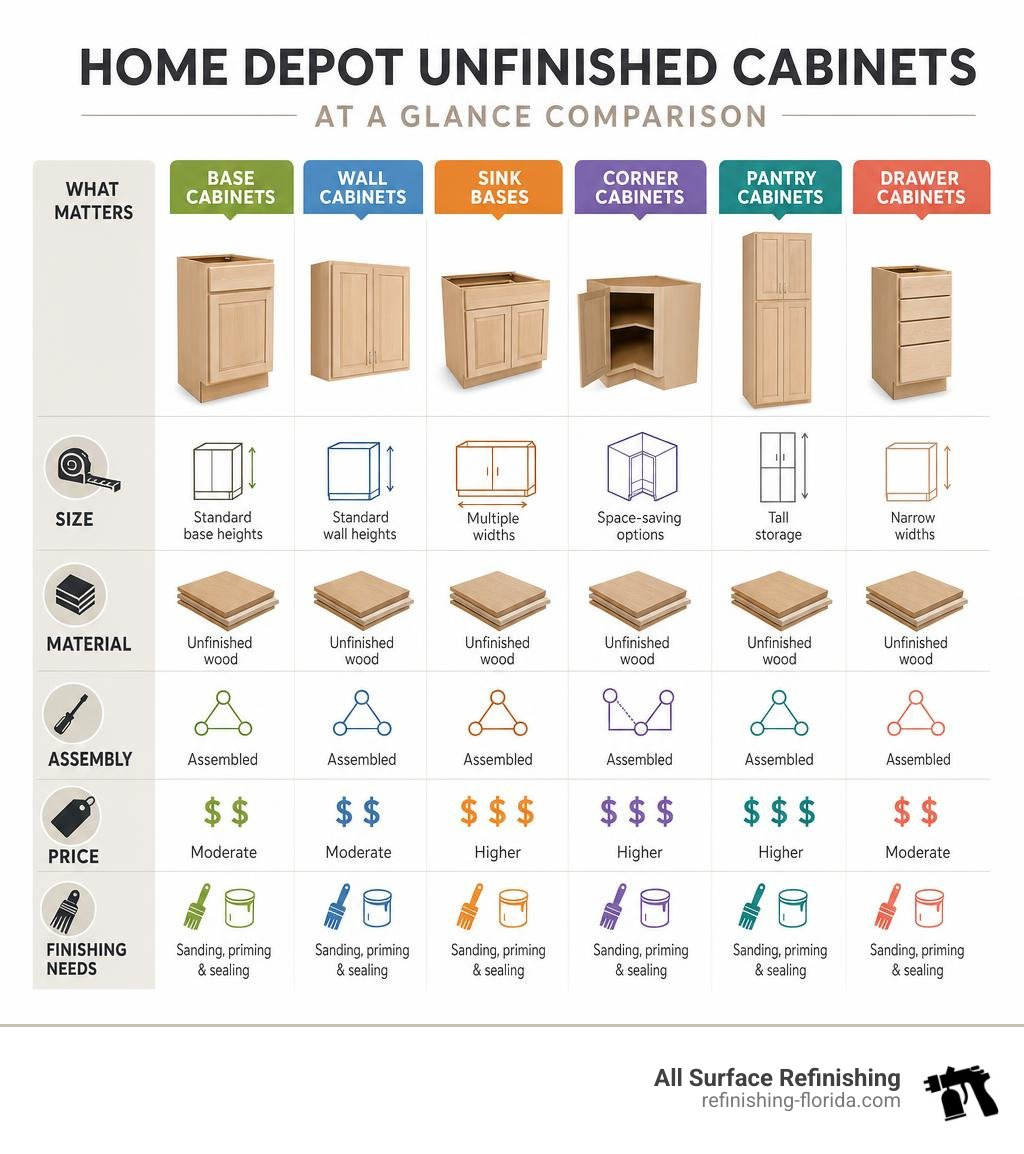
When you walk into a store or browse online for home depot unfinished cabinets, you will find nearly 300 different listings designed to fit various kitchen footprints. These units act as a blank slate for property owners who want custom aesthetics without custom-millwork price tags. To configure a functional room, you need to understand how the primary cabinet types interact.
- Standard Base Cabinets: The workhorses of the kitchen. These units feature a combination of a top drawer and lower doors, or full-height doors enclosing adjustable shelving.
- Wall Cabinets: Upper cabinetry designed to store dishes, glassware, and dry goods. They mount directly to wall studs and keep counters clear.
- Sink Base Cabinets: Engineered with open internal cavities and false drawer fronts to accommodate plumbing lines, garbage disposals, and undermount basins.
- Drawer Base Cabinets: Configured with three or four stacked sliding drawers instead of swinging doors, making heavy pots and pans accessible.
- Pantry (Tall) Cabinets: Vertical units extending up to 84 or 90 inches high, maximizing vertical storage for dry goods and small appliances.
- Corner Cabinets: Specialized solutions such as blind base units or rotating Lazy Susans designed to make awkward 90-degree corner spaces functional.
For technical planning and clearance requirements, you can review the manufacturer’s official Unfinished Cabinetry Guide before ordering.
Sizing and Dimensions for Home Depot Unfinished Cabinets
Standard dimensions keep modern kitchen remodeling predictable. Base cabinets consistently stand 34.5 inches tall (reaching 36 inches once standard 1.5-inch countertops are installed) and feature an industry-standard depth of 24 inches. Widths scale in 3-inch increments, ranging from compact 9-inch spice-rack pullout enclosures up to spacious 36-inch or 48-inch dual-door boxes.
Upper wall cabinets come standard at 12 inches deep—preventing you from bumping your head while prepping meals on the counters below—though select 24-inch-deep variations exist for mounting directly over refrigerators. Wall cabinet heights typically measure 30 inches or 36 inches depending on your ceiling height and whether you plan to install decorative crown molding.
| Cabinet Category | Standard Width Options | Standard Depth | Standard Height | Typical Average Price Range |
|---|---|---|---|---|
| Narrow Base | 9″, 12″, 15″, 18″ | 24″ | 34.5″ | $83 – $135 |
| Standard Base | 24″, 30″, 36″ | 24″ | 34.5″ | $129 – $179 |
| Sink Base | 36″, 60″ | 24″ | 34.5″ | $149 – $209 |
| Drawer Base | 18″, 24″ | 24″ | 34.5″ | $179 – $199 |
| Wall Cabinets | 12″, 24″, 30″, 36″ | 12″ | 30″ or 36″ | $75 – $155 |
| Tall Pantry | 18″, 24″ | 18″ or 24″ | 84″ or 90″ | $270 – $289 |
Popular Models and Functional Layouts
Certain models serve as the foundational building blocks for most kitchen layouts. The 30 in. W x 24 in. D x 34.5 in. H Assembled Base Kitchen Cabinet in Unfinished with Recessed Panel represents one of the most widely used options because its double-door profile and top drawer balance width and accessibility.
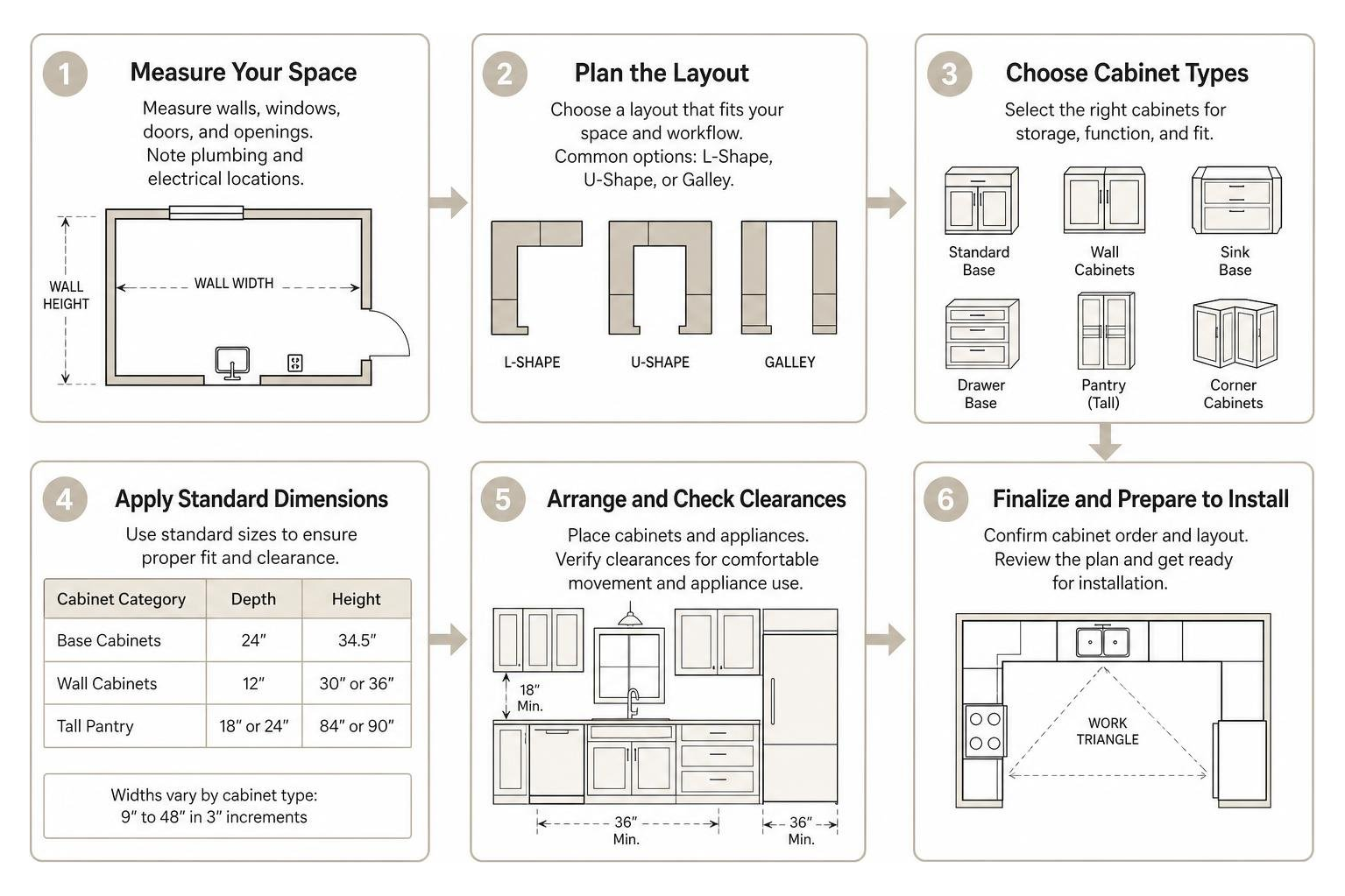
When planning an efficient kitchen workspace, combine this standard base with a dedicated 36 in. W x 24 in. D x 34.5 in. H Assembled Base Kitchen Cabinet in Unfinished with Recessed Panel or a 24 in. W x 24 in. D x 34.5 in. H Assembled Base Kitchen Cabinet in Unfinished with Recessed Panel across your primary prep runs. For the upper walls, pairing these with a 30 in. W x 12 in. D x 30 in. H Assembled Wall Kitchen Cabinet in Unfinished with Recessed Panel creates balanced sightlines while maintaining adjustable internal storage.
Material Breakdown and Construction Quality
The structural longevity of any unfinished cabinet depends heavily on its core materials. Understanding the differences between solid wood face frames, composite box walls, and engineered center panels will prevent premature cabinet failure.
Material Durability in Home Depot Unfinished Cabinets
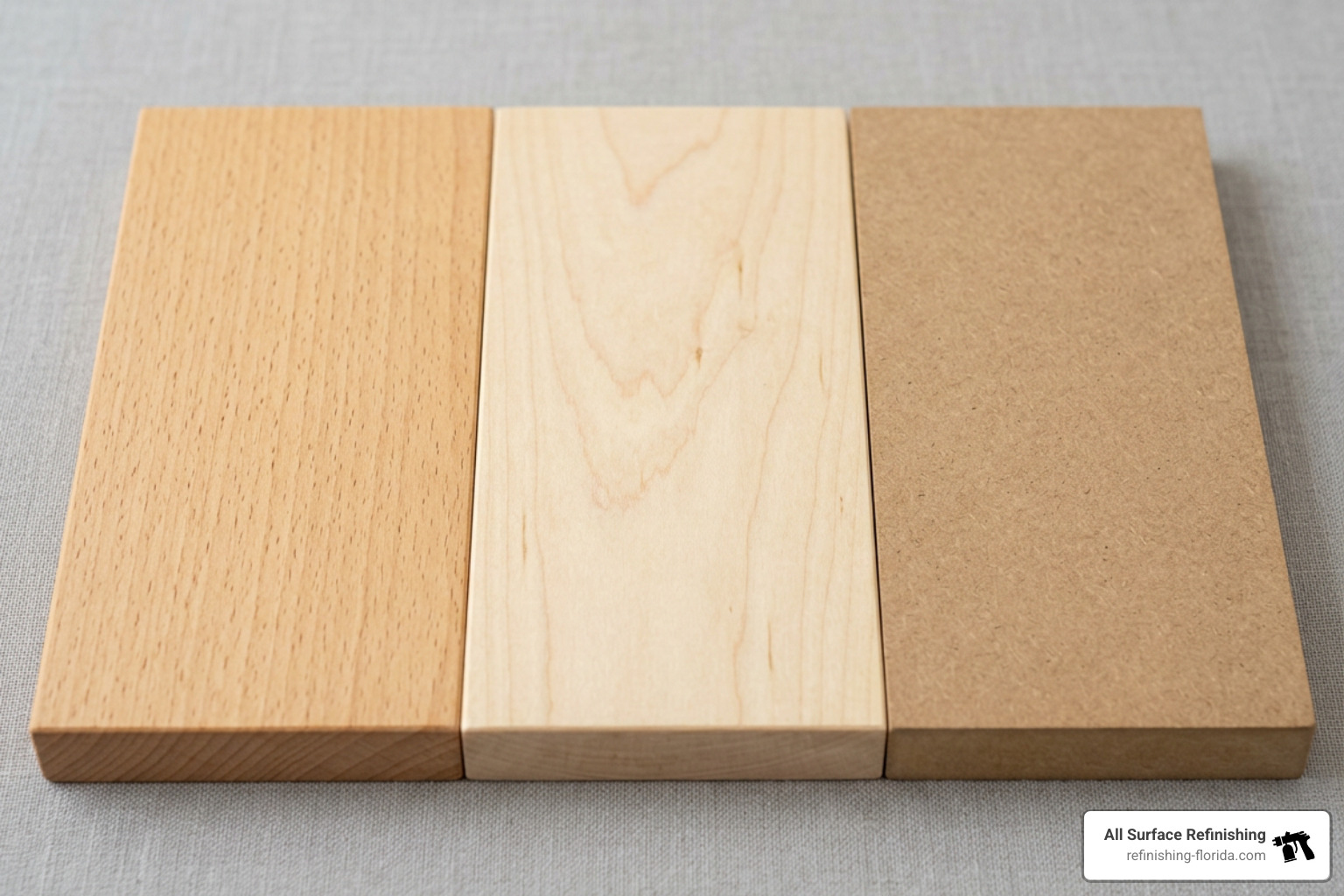
Entry-level unfinished cabinets typically use engineered furniture board or particle board for the box core, covered by a thin wood-grain veneer, alongside solid hardwood face frames (such as beech or birch) and Medium-Density Fiberboard (MDF) recessed center panels. While engineered furniture board helps keep costs low, it requires careful sealing. If liquid penetrates an unsealed edge, the core can swell and lose its structural integrity.
For homeowners looking into broader structural options, understanding cabinet resurfacing 101 can help clarify how original cabinet boxes compare to modern replacement components. Solid hardwood frames handle daily door swings well, while MDF door centers offer a smooth, uniform substrate that resists seasonal warping and temperature-driven cracking.
Finishing Potential: Staining vs. Enamel Painting
Because these units ship with bare, raw wood and composite surfaces, they must be sealed properly before use:
- Staining: Staining highlights the natural character of hardwood stiles and rails. However, composite center panels or mixed wood species may absorb stain at different rates. Applying a pre-stain wood conditioner helps prevent blotchy, uneven coloring across beech or birch face frames.
- Enamel Painting: Solid coatings are popular for raw cabinets. Painting creates an opaque, uniform finish that hides composite joints. To achieve professional results, you must know how to paint kitchen cabinets the right way by using a dedicated bonding primer followed by hard-curing urethane alkyd or acrylic enamel. If you are updating an entire space, learning how to change kitchen cabinet color like a pro ensures long-lasting adhesion and resistance to kitchen grease.
Assembled vs. Ready-to-Assemble (RTA) Options and Pricing
Home Depot offers both factory-assembled units and flat-packed ready-to-assemble (RTA) models across various brand lines.

- Factory-Assembled: Units from the core Hampton Bay line arrive glued, pocket-screwed, and clamped directly from the manufacturer. They are ready to be aligned, shimmed, and fastened to wall studs right away.
- Ready-to-Assemble (RTA): Brands like HOMEIBRO, FUNKOL, and Adrinfly ship flat-packed in compact cartons. RTA cabinets reduce freight costs, making them practical for bulk multi-unit properties or tight stairwells. However, they require hands-on assembly time using cam-lock fasteners, wood glue, and wooden dowels.
- CLICKREADY Technology: Select RTA designs utilize tool-free locking joints. Panels click securely into place, reducing assembly time per box from 30 minutes down to under 10 minutes without sacrificing squareness.
Cost Analysis and Value Comparison
Unfinished cabinets cost roughly 15% to 40% less upfront than factory-painted or pre-stained equivalents. A full set of unfinished base and wall cabinets for a modest 10×10 kitchen often totals between $1,200 and $2,200, compared to $2,500 to $4,500 for pre-finished stock cabinetry.
However, you must factor in finishing costs. When calculating your total investment, reviewing a cabinet painting cost estimate helps balance DIY paint purchases against hiring a spray-finishing crew. In many cases, comparing these numbers against our cabinet refinishing cost guide shows that upgrading raw boxes with factory-grade coatings yields a durable, premium kitchen at a fraction of custom-cabinet prices.
Assembly Simplicity and Hardware Compatibility
Standard unfinished lines keep costs down by using basic hardware. Most models feature standard overlay face-frame construction with semi-concealed or basic six-way adjustable hinges. Drawers typically operate on side-mounted epoxy roller glides rather than full-extension, soft-close undermount slides.
Upgrading to soft-close hardware is straightforward:
- Hinges: You can swap the factory hinges for compatible compact soft-close face-frame hinges using existing cup-hole drillings.
- Drawer Glides: You can replace standard epoxy glides with ball-bearing slides to support heavier kitchen tools.
- Trim & Toe-Kicks: Raw matching toe-kick boards and scribe moldings should be stained or painted alongside the boxes to seal floor transitions cleanly.
For a deeper dive into modern coating choices, our kitchen cabinet refinishing guide 2026 outlines the best topcoats and maintenance techniques for high-traffic kitchens.
Frequently Asked Questions About Home Depot Unfinished Cabinets
How much do unfinished kitchen cabinets at Home Depot cost?
Standard base cabinets range from $83 for a 9-inch unit up to $179 for a 36-inch double-door base. Specialized sink base units cost between $149 and $209, while tall 84-inch or 90-inch pantry cabinets range from $270 to $289. Wall storage units generally cost between $75 and $155 depending on width and height.
Can you immediately paint or stain raw wood cabinets?
No. Raw cabinets must first be sanded with 150-grit to 220-grit sandpaper to remove manufacturing marks and open the wood pores. Wipe away all residual dust before applying a dedicated wood-bonding primer for paint or a pre-stain conditioner for stains. For a complete step-by-step prep workflow, refer to our cabinet painting guide.
Are Home Depot unfinished cabinets delivered pre-assembled or flat-packed?
Both options are available. The popular Hampton Bay unfinished recessed-panel collection comes pre-assembled in protective cardboard crating. Online specialty brands, such as HOMEIBRO, Adrinfly, and select frameless lines, typically ship flat-packed as Ready-to-Assemble (RTA) kits that require assembly on-site.
Conclusion
Home Depot unfinished cabinets provide an accessible, customizable foundation for any kitchen renovation. They combine standard layout dimensions with the freedom to choose your own hardware, stain, or enamel color. While the upfront savings make them appealing, their long-term durability depends on how thoroughly the raw wood and composite materials are sealed and finished.
At All Surface Refinishing, we bring over 30 years of experience and more than 14,000 completed resurfacing projects to residential and commercial properties. We help homeowners turn raw cabinetry into durable, beautifully finished focal points across Fort Lauderdale, Miami, West Palm Beach, Boca Raton, Boynton Beach, Coral Gables, Hollywood, FL, Jupiter, Pembroke Pines, and Delray Beach.
Ready to give your new cabinets a flawless, factory-smooth coating? Contact us today to explore our professional cabinet refinishing and painting services and schedule your kitchen consultation.
