
Understanding Saltillo and Terracotta Vulnerabilities in South Florida
To succeed at Mexican tile refinishing in humid South Florida homes, homeowners and restoration specialists must follow a proven five-step protocol: strip old, yellowed topical waxes using non-acidic emulsifiers, neutralize residual alkalinity to pH 7.0, extract deep pore slurry with low-RPM rotary scrubbers, verify subfloor moisture levels, and apply breathable, vapor-permeable cross-linking sealers designed for coastal humid sub-slabs.
To understand why handmade clay flooring requires specialized refinishing, we have to look closely at its physical composition. Authentic Saltillo tile is crafted from natural riverbed clay harvested in Saltillo, Coahuila, Mexico. Unlike mass-produced ceramic materials, these clay tiles are molded by hand, sun-baked under the open sky, and kiln-fired at relatively low temperatures.
This traditional manufacturing technique creates distinct architectural characteristics: warm ochre, terracotta, and golden tones, subtle surface textures, and occasionally authentic dog paw prints stamped during open-air curing. However, this process also leaves the material exceptionally porous and absorbent.
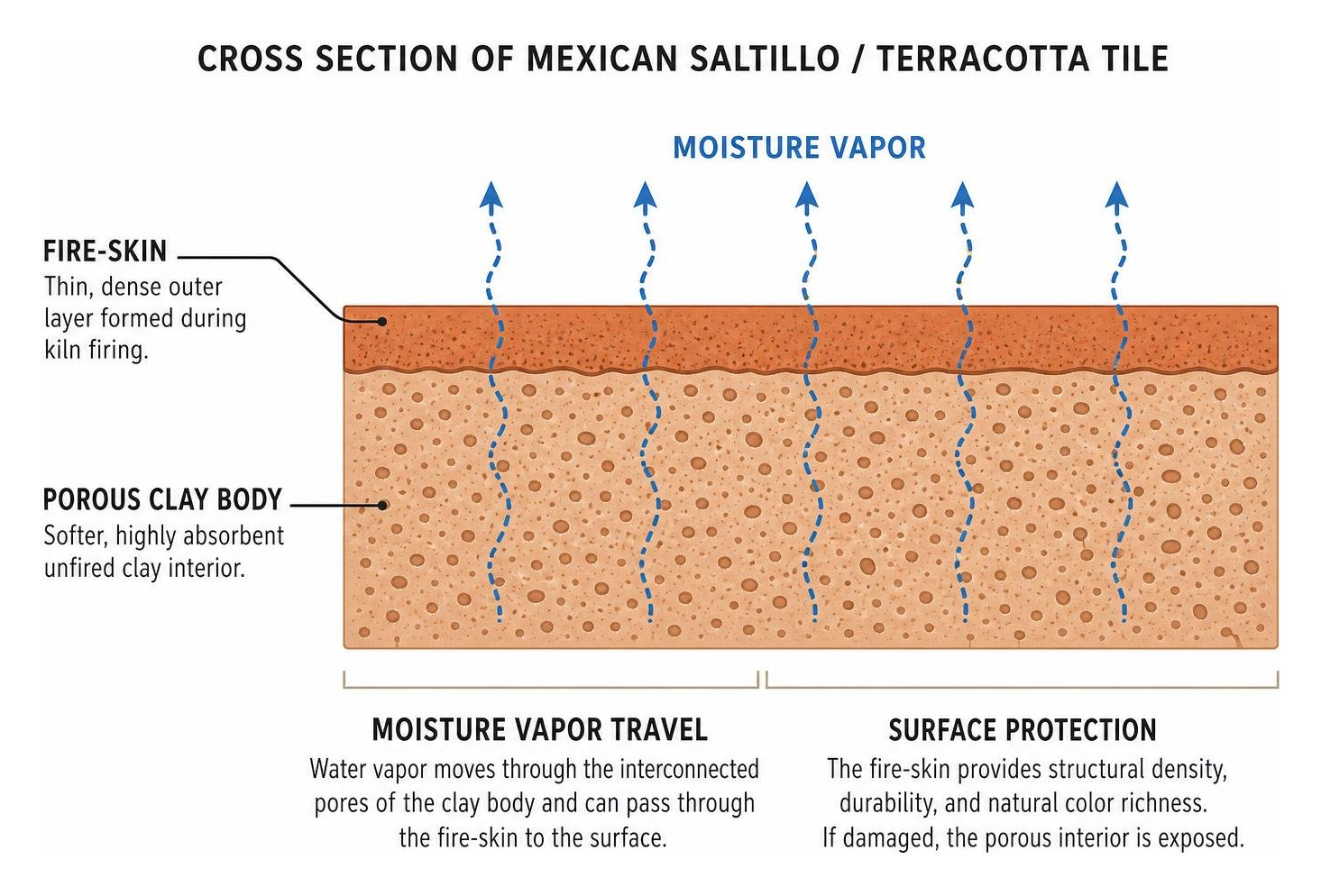
When the clay is kiln-fired, a thin, delicate outer layer forms known as the fire-skin. This natural surface layer provides structural density and color richness. If this fire-skin is compromised, the softer, highly absorbent unfired clay interior becomes exposed to the elements.
| Feature / Metric | Mexican Saltillo & Terracotta Tile | Glazed Ceramic Tile | Dense Porcelain Tile |
|---|---|---|---|
| Material Composition | Natural, low-fire porous earthenware clay | Refined natural clay with a glass-based glaze | Ultra-fine, dense porcelain clay feldspar blend |
| Porosity & Water Absorption | High (typically 10% to over 15% absorption) | Low (glazed surface is impervious; body 0.5%-3%) | Impervious (less than 0.5% absorption) |
| Surface Layer | Thin, delicate natural fire-skin (easily scratched) | Hard, non-porous baked vitreous glaze | Uniform vitrified body throughout the slab |
| Vapor Permeability Needs | Critical; requires breathable coatings | Non-breathable; moisture cannot penetrate face | Non-breathable; completely moisture resistant |
| Susceptibility to Efflorescence | High; draws minerals from sub-slab moisture | None through the glazed tile face | None through the tile surface |
| Refinishing Methodology | Chemical stripping, pH neutralization, breathable sealer | Mechanical etching, chemical bonding primers | Mechanical prep, specialty bonding topcoats |
In South Florida’s coastal climate, sub-slab moisture vapor pressure is a constant physical reality. Moisture from the humid ground continuously migrates upward through concrete slabs and into the tile assembly.
When property owners apply store-bought paste wax, high-build urethane coatings, or non-breathable topical clear coats, that upward moisture vapor becomes trapped underneath the synthetic film. This trapped humidity leads to three common failure modes:
- Oxidized Acrylic Yellowing: Topical coatings break down under humidity and foot traffic, oxidizing into an unsightly amber or cloudy yellow hue.
- Sub-Surface Efflorescence: Water moving through the substrate dissolves soluble mineral salts and lime from the thin-set mortar. As the moisture attempts to evaporate, white, crystalline deposits accumulate beneath or within the unbreathable coating.
- Film Delamination: Moisture pressure forces synthetic films to bubble, haze, crack, and peel off in high-traffic kitchen and living room paths.
5 Proven Methods for Mexican Tile Refinishing Miami Homeowners Trust
Restoring historic and architectural terracotta requires balancing chemistry, moisture control, and gentle mechanical agitation. Below are the five proven methods we use across South Florida to deliver reliable, long-lasting results.
Method 1: Controlled Chemical Stripping and pH Neutralization
The foundation of any successful restoration is the complete removal of failed acrylics, floor waxes, grease, and non-breathable coatings. Many inexperienced contractors make the mistake of using aggressive floor sanders or harsh acids, which pit the clay and permanently destroy the tile’s fire-skin.
Instead, our team applies professional-grade, non-acidic chemical emulsifiers tailored specifically for clay tile and stone.
- Dwell Time Management: The stripper is allowed to dwell on the tile for a measured period. This softens the layered wax and acrylic coatings, turning them into a workable emulsion without aggressive scraping.
- Manual Detail Stripping: For tight corners, decorative baseboards, and deep wide grout joints, technicians carefully hand-strip stubborn coatings using non-scratch scrubbing pads.
- pH Neutralization Rinse: Chemical strippers are naturally alkaline. If left unmitigated, residual alkalinity will prevent new protective sealers from bonding properly. We perform a thorough, pH-balanced neutralization rinse that brings the clay back to a neutral state (pH 7.0), clearing out all chemical residues and suspended soil.
Method 2: Precision Agitation and Deep Extraction
Once the old topical sealer is chemically emulsified, the suspended soils and slurry must be removed from deep within the clay’s pores and wide grout joints.
We utilize low-RPM rotary scrubbers fitted with soft-to-medium nylon bristles. These flexible bristles conform to the natural contours, dips, and handcrafted irregularities of Saltillo tile without scratching the surface.
- Extraction Without High-Pressure Steam: Pressurized steam machines can force excessive moisture deep into the porous clay, leading to structural spalling and moisture entrapment. Instead, we use high-volume, low-pressure slurry extraction vacuums that pull emulsified waxes and dirt out of the floor immediately.
- Deep Grout Line Restoration: Wide Spanish tile grout joints absorb heavy grease, dirty mop water, and food spills. Precision mechanical scrubbing deep-cleans these joints, restoring their original earthen gray or buff tone.
For homeowners updating an entire space, pairing restored floors with countertop resurfacing Miami services creates a fresh, coordinated look across both kitchen tile and counter surfaces.
Method 3: Subfloor Moisture Stabilization and Breathable Sealing
After cleaning and stripping, the clay floor contains moisture from the washing process as well as ambient humidity. Applying a sealer too quickly traps that moisture, causing cloudiness within days.

- Moisture Testing: Before applying a single drop of finish, our technicians use digital surface moisture meters to verify that the clay has dried to safe moisture parameters. Air movers and dehumidifiers are utilized when necessary to stabilize the interior environment.
- Vapor-Permeable Sealer Application: In South Florida’s humid climate, applying an impermeable plastic or polyurethane coating can lead to failure. We apply multiple thin coats of specialized, vapor-permeable (breathable) acrylic cross-linking sealers. These formulations protect the floor from food, grease, and liquid spills while allowing underlying moisture vapor to pass through harmlessly.
- Customizable Aesthetic Finishes: Property owners can select their desired sheen, ranging from an authentic low-luster natural matte to a rich semi-gloss or a radiant, wet-look gloss that enhances the natural red and orange clay tones.
Method 4: Professional Standards for Mexican Tile Refinishing Miami Contractors Follow
Clay tiles frequently exhibit small cosmetic imperfections, minor chips, hairline cracks, or missing chunks of grout from decades of settling.
When executing a detailed restoration project, qualified professionals never use generic gray concrete patch or rigid auto-body fillers. Instead, technicians employ specialized repair protocols:
- Oscillating Handheld Abrasion: If localized spots have deep chemical staining, adhesive residue, or black marks from old carpet pads, technicians use small oscillating detail sanders with fine-grit abrasive pads. This spot treatment removes embedded surface stains without removing the surrounding fire-skin.
- Color-Matched Terracotta Mortar: Chipped corners and spalled pockets are repaired using custom-pigmented, breathable terracotta repair mortars. These compounds match the natural clay grain and expand and contract at the same rate as the surrounding tile.
- No Heavy Grinding Machines: Grinding machines designed for marble, terrazzo, or travertine should never touch Saltillo tile. Grinding shears off the fire-skin, leaving the floor looking like rough, chalky clay that absorbs stains rapidly.
Method 5: Correct Maintenance Chemistry and Cleaning Practices
Even the most durable breathable sealer can be ruined by improper cleaning products. Many residential tile failures stem from well-intentioned homeowners using household cleaners that chemically break down acrylic sealers.
- The Neutral Cleaner Rule: Restored clay floors should only be cleaned with pH-neutral stone and tile cleaners. These formulas clean surfaces without stripping the protective film.
- Proper Mopping Tools: Avoid soaking the floor with heavy string mops that push dirty water into grout lines. Use microfiber flat mops dampened with clean solution, rinsing frequently.
- Carpet Padding Precautions: Never place standard rubber-backed area rugs or synthetic non-slip pads directly over sealed Mexican tile. The oils and plasticizers in synthetic rubber chemically migrate into the acrylic finish, causing permanent, dark circular stains. Instead, use natural woven fiber pads or breathable felt underlayments.
Restoration Value: Restoring vs Full Tile Replacement
Replacing an entire Mexican tile floor is a messy, loud, and costly renovation project. Saltillo tile is typically set in thick mortar beds (often wire-mesh reinforced mud beds) rather than standard thin-set. Demolishing this assembly requires jackhammers, creates fine silica dust throughout your living spaces, and can damage surrounding drywall, trim, and kitchen cabinetry.
Choosing professional restoration over full floor replacement allows property owners to preserve the historic, handcrafted charm of authentic terracotta while avoiding major remodeling headaches.
For complete kitchen or bathroom upgrades, combining floor refinishing with countertop surface restoration can refresh your home’s key spaces while preserving architectural character.
Cost Comparison: Mexican Tile Refinishing Miami vs Full Floor Replacement
When evaluating home improvement investments across Miami-Dade County and surrounding communities, the numbers show a clear economic advantage:
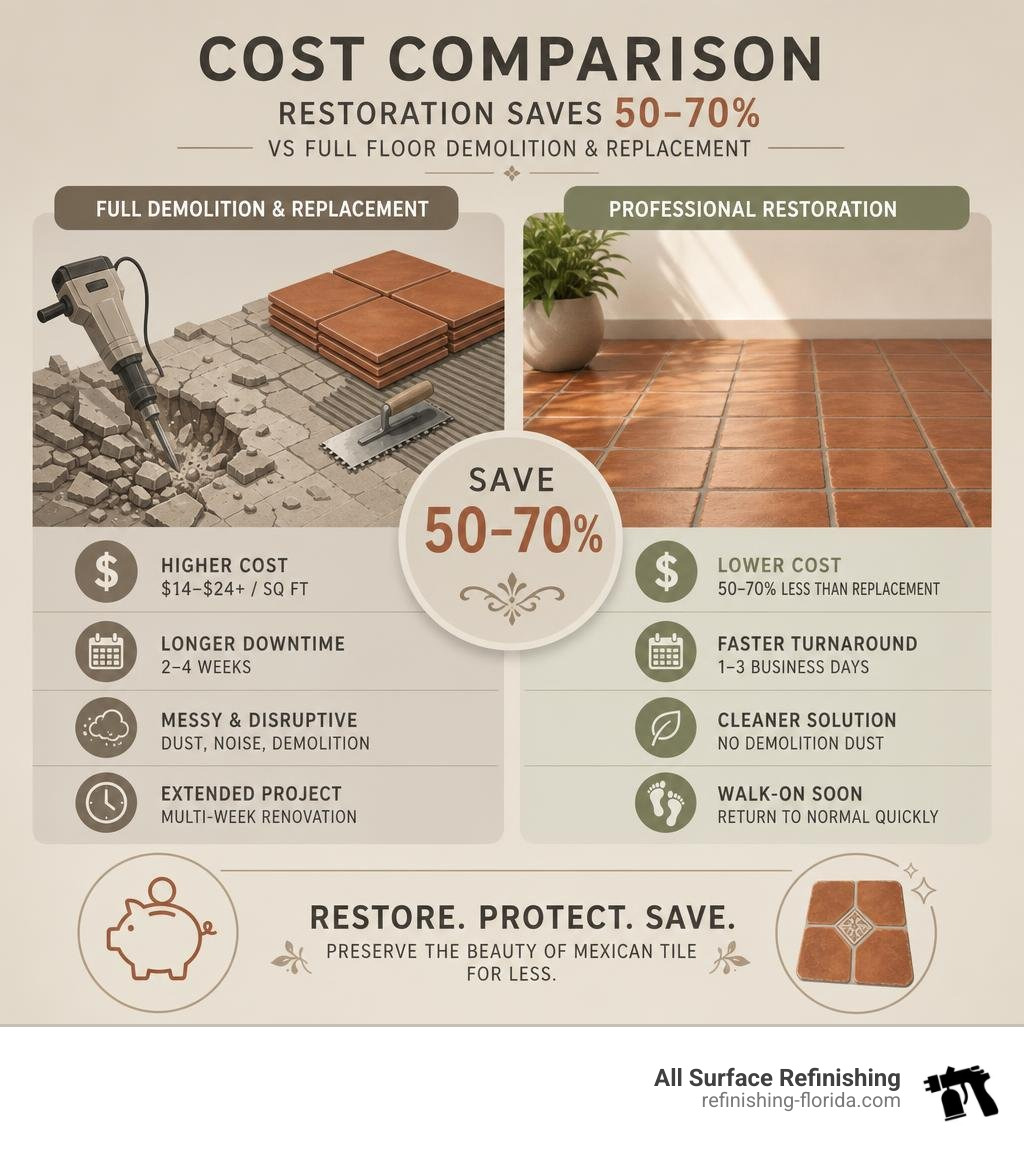
- Demolition & Replacement Costs: Complete removal, subfloor leveling, purchasing new premium tile, setting materials, and labor typically runs between $14.00 and $24.00+ per square foot. For a 1,500-square-foot home, replacement costs can easily exceed $21,000 to $36,000, excluding the cost of hotel stays during the dusty, multi-week demolition phase.
- Professional Restoration Costs: Comprehensive chemical stripping, deep pore extraction, repair, neutralization, and multi-coat breathable sealing generally costs 50% to 70% less than full replacement.
- Turnaround Time: While complete floor replacement can disrupt a household for 2 to 4 weeks, a complete professional restoration is typically completed in just 1 to 3 business days, allowing homeowners to walk on their floors shortly after application.
Frequently Asked Questions About Mexican Tile Refinishing
Can heavily yellowed or waxed Mexican tile be restored without damaging the clay?
Yes. Yellowed and cloudy Mexican tile is almost always caused by oxidized topical floor wax or acrylic sealers, not discoloration of the clay itself.
By applying professional non-acidic stripping agents with proper dwell times, we emulsify and lift old layers of yellowed wax and acrylics without harming the clay’s delicate fire-skin. Once the failed coatings are fully extracted, the natural warm red, gold, and terracotta tones of the clay emerge clean and unblemished.
Why are steam cleaning, vinegar, and Fabuloso destructive to terracotta floors?
Common household cleaners and high-heat equipment can cause three major problems on porous clay tiles:
- Vinegar (Acetic Acid): Vinegar is an acid. Acid chemically reacts with the minerals in clay and cementitious grout, causing microscopic pitting, chalking, and dissolving the acrylic sealers protecting the floor.
- Fabuloso and Sulfuric Derivatives: Many commercial multi-surface cleaners contain strong degreasers and acidic components that strip the sealer’s protective sheen, leaving behind sticky residues that attract dirt and cause patchy, cloudy spots.
- Steam Cleaning: Pressurized steam machines blast high-temperature water vapor into porous terracotta. This heat shock can cause the protective sealer to haze and delaminate, while forcing moisture deep into the subfloor, triggering efflorescence salt deposits.
How long does a professional Mexican tile restoration last in Miami?
In residential interior spaces, a professional breathable acrylic cross-linking sealer system typically lasts 8 to 10 years when maintained with pH-neutral cleaners and proper microfiber mopping techniques.
In high-traffic commercial spaces or areas exposed to tropical humidity and tracked-in sand, a light maintenance cleaning and single-coat protective re-application is recommended every 3 to 5 years to keep the protective barrier strong.
Conclusion
Authentic handmade clay tile is an integral part of South Florida’s architectural identity, adding character and warmth to homes across Miami, Miami Beach, Kendall, Coral Gables, Coconut Grove, Aventura, Bal Harbor, Hialeah, Homestead, Fort Lauderdale, Hollywood FL, Pembroke Pines, Miramar, West Palm Beach, and surrounding communities. Preserving these floors requires an understanding of clay porosity, breathable chemistry, and climate-specific techniques.
With over 30 years of experience and more than 14,000 completed surface transformations, our team at All Surface Refinishing helps homeowners protect their spaces without the mess, stress, and expense of structural demolition.
Whether you need to revive weathered Saltillo living room floors, restore a historic patio, or refresh your space with our professional tile refinishing services, we provide the specialized care your home deserves.
We proudly serve property owners across Miami-Dade County, Broward County, and Palm Beach County, including Aventura, Bal Harbor, Coconut Grove, Coral Gables, Fort Lauderdale, Kendall, Key Biscayne, Miami Beach, West Palm Beach, Weston, Tamarac, Pembroke Pines, and surrounding communities. Contact our team today to discuss your project and schedule an expert surface assessment.
