How to Choose Flat Pack Kitchen Cabinets That Last
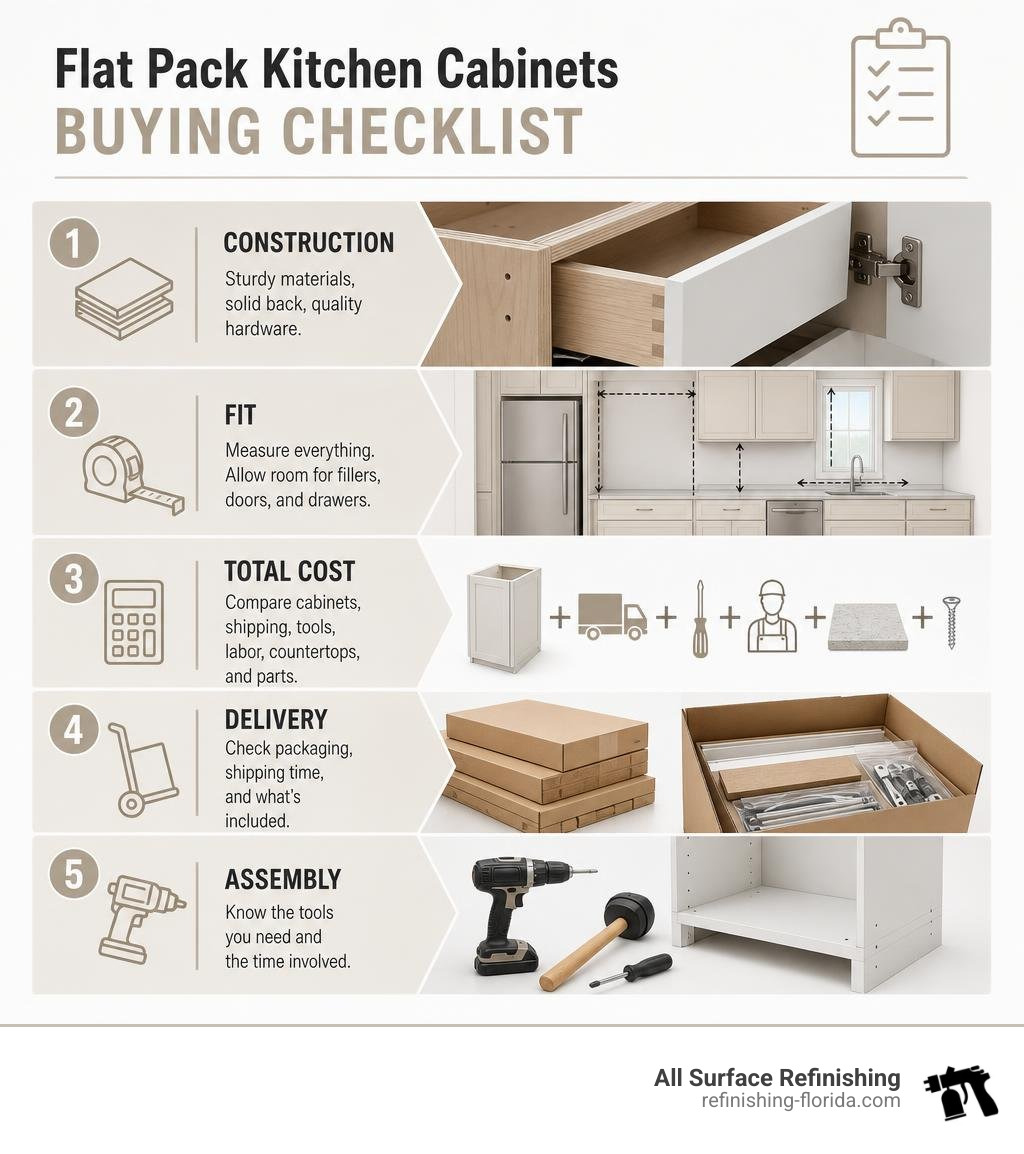
For a lower-cost kitchen update, buy flat pack kitchen cabinets with sturdy cabinet boxes, reliable hardware, and sizes that fit your layout before you order. Focus on these three checks:
- Construction: Look for plywood or 18 mm cabinet panels, a solid back panel, dovetailed drawers, and soft-close hinges or runners.
- Fit: Measure every wall, appliance opening, corner, and plumbing area. Include filler strips and space to open doors and drawers.
- Total cost: Compare the cabinet price with freight, assembly tools, installation labor, countertops, and any replacement parts.
Ready-to-assemble (RTA) cabinets arrive in flat boxes rather than as completed units. That can reduce shipping volume and often costs less than assembled cabinetry, but quality varies widely. A well-built kit can use the same essential parts and hardware as an assembled cabinet; a low-cost kit may rely on thinner board, weak backs, or basic fasteners.
This guide helps you compare cabinet materials, hardware, price ranges, delivery details, and assembly demands so you can make a smart kitchen purchase.
I am Frank Hernandez, President of All Surface Refinishing, and I have more than a decade of experience helping South Florida property owners assess kitchen cabinet condition, durability, and update options. While flat pack kitchen cabinets are a replacement purchase, my work with kitchen surfaces helps me recognize the construction details that affect their long-term appearance and performance.
Flat pack kitchen cabinets vocab explained:
Evaluating the Quality of Flat Pack Kitchen Cabinets

When homeowners decide to renovate, flat-pack options often surface as an attractive, budget-friendly alternative. However, the secret behind a long-lasting installation lies in the underlying materials and construction methods. Not all flat-pack cabinetry is created equal; understanding what separates flimsy temporary fixtures from heirloom-grade structures ensures your investment withstands daily wear and tear.
Understanding Flat Pack Kitchen Cabinets vs Pre-Assembled Units
The primary distinction between ready-to-assemble units and factory-assembled cabinetry lies in logistics and initial labor. In flat-pack designs, every carcass component, face frame, and drawer side is machined with precision computer-numerical-control (CNC) milling before being packed into flat cardboard cartons.
This flat format drastically minimizes shipping volume. Traditional assembled cabinets transport significant amounts of empty air, which increases shipping freight and requires larger staging areas. Flat cartons fit neatly through narrow hallways, tight condo stairwells, or service elevators without damaging door faces or frame edges.
Logistics aside, high-tier RTA cabinets weigh practically the same as their pre-assembled counterparts because they incorporate identical core materials, hardwood styles, and metal hinges. When you review a practical guide to compare cabinet costs, you will find that the major price gap stems from factory assembly labor and freight costs rather than material integrity.
Top Construction Features in Flat Pack Kitchen Cabinets
To ensure your kitchen cabinets remain durable under heavy use, seek out specific structural indicators during your product search:
- Plywood Box vs. Particleboard: Premium lines use 1/2-inch to 3/4-inch (or European standard 18mm board) furniture-grade plywood. Plywood holds mechanical fasteners tightly and provides superior structural resistance in humid coastal environments.
- Solid Backing: A sturdy back panel—ideally 8mm to 1/2-inch thick—prevents the entire cabinet box from racking out of square under heavy countertop loads.
- Dovetail Drawer Construction: Drawer boxes crafted with solid wood sides and interlocking dovetail joinery easily endure thousands of open-and-close cycles without separating.
- Integrated Soft-Close Hardware: Heavy-duty, six-way adjustable concealed hinges and under-mount drawer slides prevent daily slamming and prolong door alignment.
- Fastener Systems: High-end models use advanced cam-and-dowel fasteners, metal bracket systems, or pocket-hole screws that pull panels into tight, clean joints.
Whether evaluating White Kitchen Cabinets from Flat Pack Kitchens or modern flat-panel modular units, verified testing—such as FIRA Gold certification for heavy domestic and contract kitchen furniture—indicates the components meet stringent load and safety thresholds.
Pricing Breakdown and Overall Cost Comparison
Budgeting for a kitchen remodel requires factoring in the raw material purchase alongside ancillary tools, hardware, and site prep.
| Cabinet Category | Average Cost per Linear Foot | Typical 10×10 Kitchen Cost | Assembly Labor Required | Primary Material Core |
|---|---|---|---|---|
| Entry Flat-Pack (Big-Box) | $75 – $150 | $1,500 – $2,800 | High (DIY or Pro) | Particleboard / Thin MDF |
| Mid-to-High Tier RTA | $150 – $300 | $3,000 – $5,500 | Moderate (Cam/Dowel/Glue) | 18mm Plywood / Solid Wood Frames |
| Semi-Custom Pre-Assembled | $300 – $650 | $6,000 – $12,000 | Low (Installation Only) | Plywood or Furniture Board |
| Full Custom Built-In | $650 – $1,200+ | $13,000 – $25,000+ | None (Turnkey Pro Setup) | Premium Hardwoods & Plywood |
When calculating how much do new kitchen cabinets actually cost, ready-to-assemble systems typically run about half the price of pre-assembled units with matching finishes. A complete set of RTA cabinets for an average kitchen can cost just over $4,000 in materials, presenting substantial savings for property owners.
Cabinet Box Materials and Hardware Upgrades
Selecting the right cabinet box construction directly affects long-term ownership costs:
- High-Density Fiberboard (HDF) & MDF: Common for painted shaker door profiles because engineered wood expands and contracts less during seasonal temperature shifts, keeping paint seams smooth.
- Solid Birch or Maple Face Frames: Hardwood face frames provide a rugged anchoring point for hinges and doors while adding rigidity across the front perimeter of the box.
- European Hardware: Precision hardware systems, such as those found on a Kitchen Kit Flatpack Shaker Kitchen Cabinet Wall Unit Ultra Matt Dust Grey 500mm | Toolstation , feature multi-axis micro-adjustments so you can align doors precisely after mounting.
- Specialized Storage Bases: Configured organizers, such as a Kitchen Kit Flatpack Shaker Kitchen Cabinet Base 3 Drawer Unit Ultra Matt Light Grey 500mm | Toolstation , use integrated full-extension runners that allow easy access to pots and pans.
Shipping Logistics and Assembly Labor Costs
Freight delivery for flat-pack cabinets is usually handled via palletized freight or standard ground carriers. Because boxes are packed flat, shipping fees are markedly lower than for fully assembled units.
If you prefer hiring professional carpenters rather than handling full assembly yourself, factor in local installation rates. A three-person carpenter team can assemble and secure a complete kitchen layout in roughly 8 hours, significantly reducing overall contractor hours.
For homeowners tackling the assembly, here are the essential tools to have on hand:
- Cordless drill/driver with clutch control and #2 Phillips/square bits
- Quality wood glue (PVA or structural adhesive)
- Bar clamps (at least two 24-inch and two 36-inch clamps)
- Torpedo level and 48-inch spirit level (or precision laser level)
- Rubber mallet for tapping joints without marring finishes
- Cabinet installation screws (washer-head cabinet screws, not drywall screws)
- Composite or wood shims for leveling base units
Essential Steps for Planning and Assembling RTA Cabinets
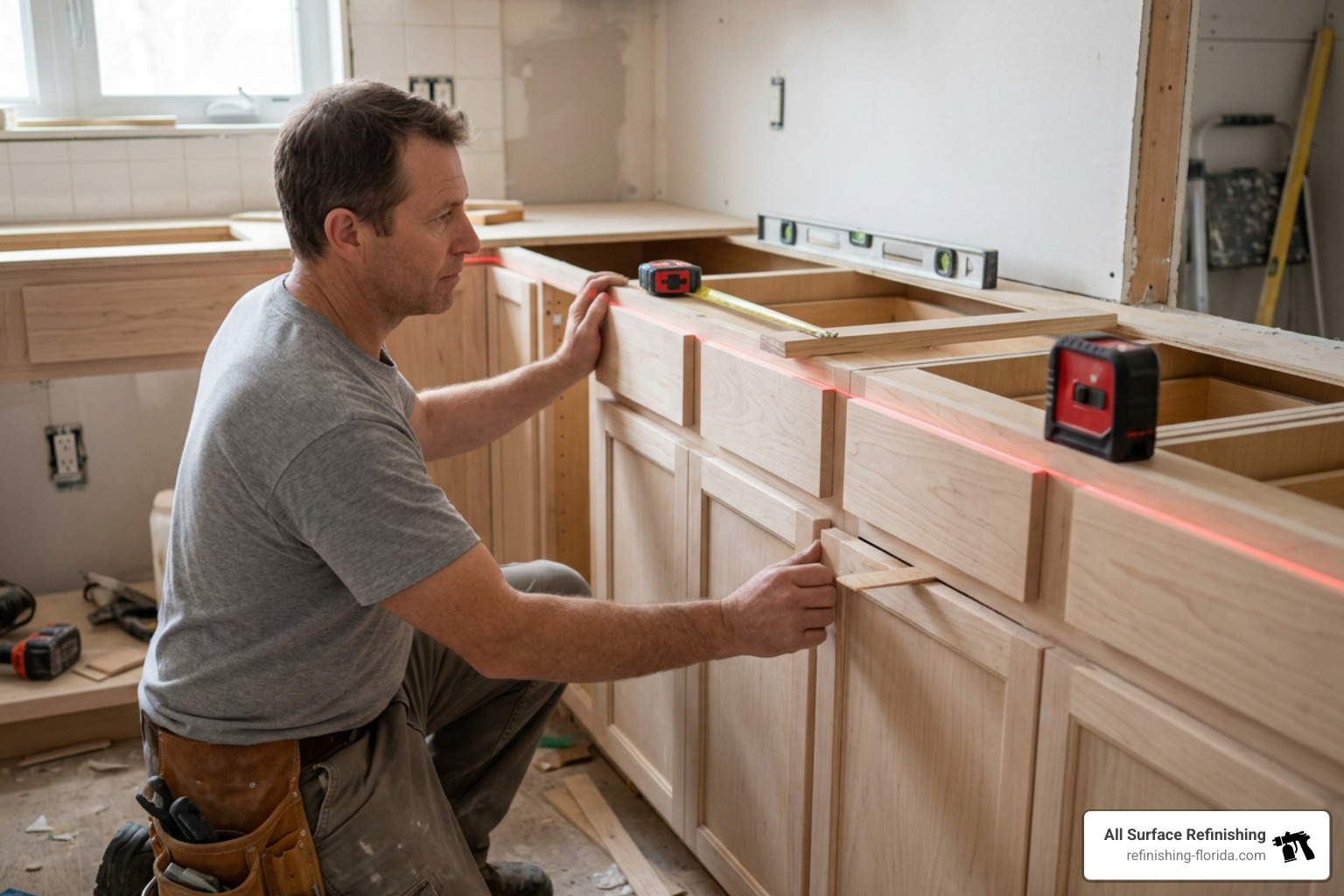
A functional kitchen installation relies on disciplined planning and methodical assembly. Skipping prep steps can quickly lead to misaligned doors, sagging boxes, or uneven joints.
Layout Planning and Measurement Guidelines
Before ordering cabinets from suppliers like Ready to Assemble Kitchen Cabinets – RTA Cabinet Store or Ready To Assemble Kitchen Cabinets , map your space on a detailed 2D grid. Standard modular sizes generally begin at 9 inches wide and increase up to 42 inches in 3-inch increments. Upper wall units typically come in 30-inch, 36-inch, and 42-inch heights, alongside 12-inch or 15-inch options designed for installation over refrigerators and ranges.
Keep these layout parameters in mind:
- Service Voids: Many modular designs—such as an 18mm Kitchen Kit Flatpack Shaker Kitchen Cabinet Base Unit Ultra Matt White 1000mm | Toolstation —feature a 49mm rear service void. This dedicated gap accommodates uneven walls, plumbing runs, and electrical conduit without requiring cutouts in the cabinet carcass.
- Filler Strips: Always leave a 1.5-inch to 3-inch margin in inside corners and against adjacent walls so drawers and doors open fully without hitting trim or appliances.
- Appliance Tolerances: Verify your dishwasher, range, and refrigerator cutouts match manufacturer installation guides, leaving an extra 1/4-inch to 1/2-inch buffer for effortless positioning.
Assembly and Installation Best Practices
Follow this sequence to ensure your cabinet run remains square, plumb, and structurally sound:
- Set Up a Flat Work Station: Place two sawhorses with a 3/4-inch sheet of plywood on top to create a clean, elevated bench. Lay down cardboard packing sheets to protect decorative finishes from scratches.
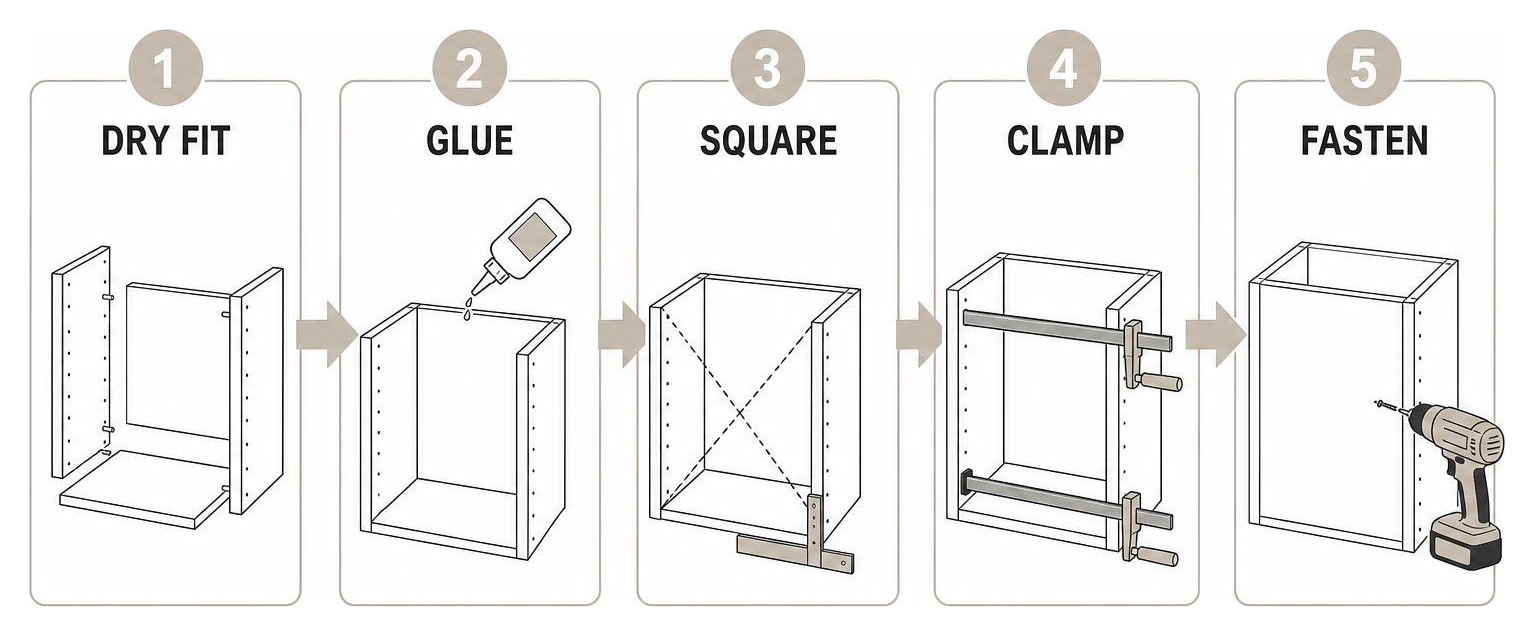
- Dry-Fit Components: Check all dado grooves, dowel pins, and cam locks before adding adhesive to make sure panels seat flush.
- Glue and Fasten the Carcass: Run a continuous bead of wood glue along the internal joints, seat the top, bottom, and side panels, and square the box by measuring diagonally corner-to-corner. Apply bar clamps until fasteners are driven home.
- Attach Face Frames & Hardware: Fasten the front face frame squarely onto the box using pre-drilled pocket screws or alignment dowels. Mount your soft-close hinges and drawer runners while the box is still on the bench.
- Install Upper Wall Cabinets First: Secure a temporary ledger board to the wall studs at your designated height line. Rest upper units on the ledger board, clamp adjacent face frames together, drill pilot holes, and connect them using specialized connector screws before driving heavy-duty cabinet screws through the back hanging rail into wall studs.
- Level and Fasten Base Cabinets: Locate the highest point of your subfloor using a laser level. Set your first base unit at that high point and work outward, shimming underneath low points to maintain a level horizontal plane across all boxes.
If you ever wish to refresh the appearance of your existing cabinetry rather than taking on a full teardown, our specialized cabinet color change service provides a quick, durable way to modernize finishes without replacing your structurally sound boxes.
Frequently Asked Questions About RTA Kitchen Cabinetry
How long does it take to assemble flat-pack cabinets?
For a beginner, the first cabinet box usually takes roughly 30 to 45 minutes as you familiarize yourself with the hardware and layout. Once you establish a rhythm, assembly time drops to 15 to 20 minutes per standard wall unit or base carcass. An entire average-sized kitchen can be completely assembled by two people in a single afternoon.
Are flat-pack cabinets durable enough for heavy countertops?
Yes. Quality flat-pack units built with 18mm or 1/2-inch to 3/4-inch plywood boxes and solid structural back panels easily support heavy solid-surface tops, including 3cm granite, quartz, and marble. When boxes are shimmed level, securely joined along their face frames, and anchored into wall studs, the downward load is distributed evenly across the floor and wall framing.
What tools are required for DIY cabinet assembly?
Standard DIY assembly requires a cordless drill/driver, rubber mallet, wood glue, bar clamps, a tape measure, a torpedo level, and a 4-foot spirit level or laser level. Having a supply of wooden or composite shims, washer-head cabinet screws, and clamp pads on hand will ensure clean, damage-free installation.
Conclusion
Flat pack kitchen cabinets offer a practical way to achieve a clean, modern kitchen layout on an approachable budget. By selecting sturdy box materials, durable joinery, and reliable soft-close hardware, you can complete a stylish upgrade that will look great for years.
If your current cabinet boxes are still structurally sound and you simply want to refresh their appearance, our team at All Surface Refinishing is here to help. With more than 30 years of experience and over 14,000 completed kitchen and bathroom projects, we serve homeowners across South Florida communities. We do not sell paint; instead, we provide professional resurfacing and refinishing that restores your surfaces with a durable, factory-grade finish.
Explore our professional cabinet refinishing and resurfacing services today to discover how easy it is to revitalize your kitchen.
