Financial Breakdown: Painting Cabinets vs Replacing in 2026
When evaluating your kitchen remodel budget in 2026, the cost difference between refinishing your existing layout and buying brand-new cabinetry is substantial. Custom and semi-custom cabinet prices have risen significantly, influenced by material costs, freight expenses, and updated trade tariffs on imported cabinetry. For budget-conscious homeowners, understanding every line item is critical before making a financial commitment.
A professional cabinet paint project typically costs between $1,200 and $7,000, depending on kitchen size, door count, and profile complexity. In contrast, new stock cabinets start between $4,000 and $13,000, while semi-custom and fully custom cabinetry projects routinely climb past $20,000 to $35,000+.
The sticker price of new cabinets also rarely reflects the true total cost. Replacing cabinet boxes requires demo, wall repairs, new countertop fabrication, plumbing hookups, electrical adjustments, and floor patching. Factoring in these secondary trades, painting your cabinetry costs roughly 80% to 85% less overall than a full gut and replacement.
| Feature / Metric | Professional Cabinet Painting | Full Cabinet Replacement |
|---|---|---|
| Typical Cost Range (2026) | $1,200 – $7,000 | $4,000 – $30,000+ |
| Average Savings | Up to 80–85% vs. replacement | None (Full retail + secondary trades) |
| Project Duration | 3 to 7 business days | 3 to 8+ weeks |
| Kitchen Disruption | Minimal (cooktop/sink accessible) | Extreme (kitchen completely offline) |
| Expected Lifespan | 8 to 12 years (with proper prep) | 15 to 25+ years (high-end wood) |
| Estimated ROI | 75% to 100% | 50% to 70% |
| Environmental Impact | Keeps sound wood out of landfills | Significant construction waste |
To plan your budget accurately, you can review our cabinet painting cost estimate to see how specific door counts and layouts influence overall pricing.
Is painting cabinets vs replacing better for resale value and ROI?
From a pure return-on-investment perspective, professional cabinet painting consistently outperforms complete cabinet replacement.
Industry data shows that minor kitchen remodels that preserve structurally sound cabinetry recoup roughly 77% of their cost at resale, with high-end painted finishes yielding an ROI between 75% and 100%. Because you invest significantly less capital upfront, you capture a much higher percentage of that value when selling. Complete cabinet replacement yields an average ROI of only 50% to 70%, because massive labor and demolition costs are difficult to fully recover in typical real estate transactions.
Color selection plays an influential role in maximizing resale value. Real estate market analyses show that homes featuring kitchens painted in soft, neutral tones—such as warm whites, gentle greiges, light blues, or soft grays—often sell for a premium over homes with heavily customized or dated wood stains. Buyers appreciate a bright, modern, move-in-ready aesthetic without having to discount their offers to fund an immediate kitchen tear-out.
What is the typical turnaround time for painting cabinets vs replacing?
Beyond financial costs, the timeline and lifestyle disruption of your project must be factored in.
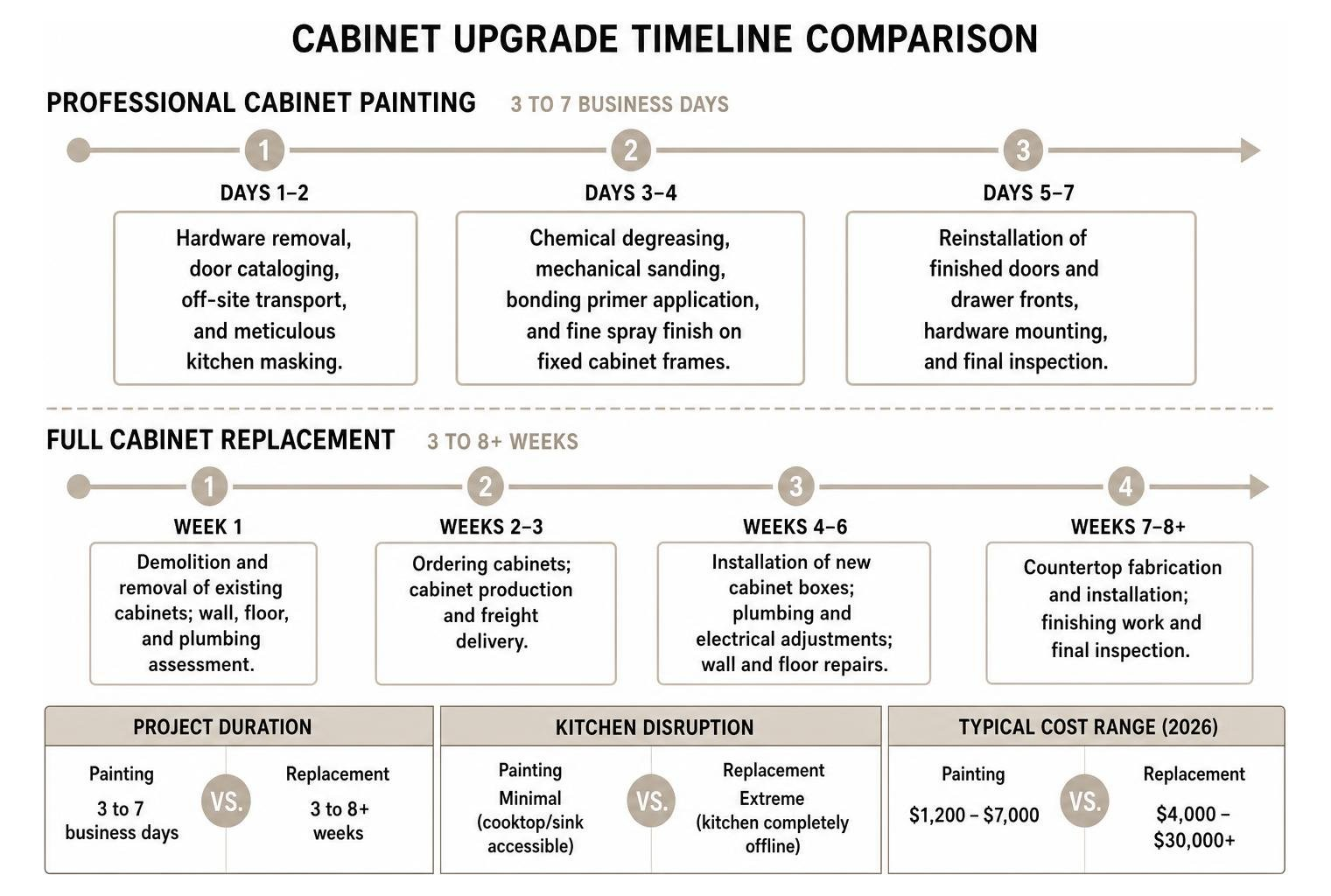
A professional kitchen cabinet painting service is designed for speed and efficiency:
- Days 1–2: Hardware removal, door cataloging, off-site transport, and meticulous kitchen masking.
- Days 3–4: Chemical degreasing, mechanical sanding, bonding primer application, and fine spray finish on fixed cabinet frames.
- Days 5–7: Reinstallation of finished doors and drawer fronts, hardware mounting, and final inspection.
During a paint project, your kitchen remains functional for light use during the evenings.
In contrast, replacing cabinetry is an invasive, multi-week undertaking. You must wait 4 to 8 weeks for custom cabinets to be manufactured and delivered. Once demolition begins, your kitchen becomes an active construction zone for 3 to 6 weeks while carpenters, drywallers, countertop fabricators, plumbers, and electricians work in sequence. For busy households, avoiding weeks of takeout meals and contractor foot traffic is often just as valuable as the monetary savings. According to the Kitchen cabinet overview, cabinet construction and installation choices directly affect both project cost and kitchen downtime.
When to Choose Painting Over Full Cabinet Replacement
Cabinet painting is the ideal remodeling route when your kitchen’s fundamental structure remains sound. If you are satisfied with where your refrigerator, sink, and range are located, there is little reason to spend tens of thousands of dollars rebuilding the exact same layout.
You should choose painting when:
- Your cabinet boxes are rock-solid: Older cabinetry built from solid plywood or furniture-grade hardwood often boasts superior craftsmanship compared to inexpensive modern stock units.
- You want to reduce environmental waste: Opting to refinish old kitchen cabinets keeps dozens of cubic feet of solid timber, hardware, and packaging out of local landfills.
- Your budget is allocated across multiple upgrades: Saving thousands on cabinetry allows you to invest in high-end quartz countertops, modern tile backsplashes, and premium appliances.
When Structural Damage Demands Full Replacement
While painting solves cosmetic and surface aging issues, it cannot fix underlying structural failure. We always provide honest assessments, and full cabinet replacement is necessary in the following scenarios:
- Severe Water Damage and Swelling: If plumbing leaks beneath the sink or dishwasher have caused cabinet bottoms to rot, mold, or disintegrate, the structural integrity is lost.
- Failed Particleboard: Inexpensive compressed wood that has sagged under weight or delaminated cannot reliably hold screws or anchor new hinges.
- Broken or Out-of-Square Carcasses: If cabinet frames are racked, out of plumb, or pulling away from the wall studs, paint will not resolve the alignment issues.
- Major Layout Reconfigurations: If your remodel requires knocking down load-bearing walls, adding an island where none existed, or relocating major appliances, new custom cabinetry is required to fit the new floorplan.
Materials, Paint Systems, and Long-Term Durability
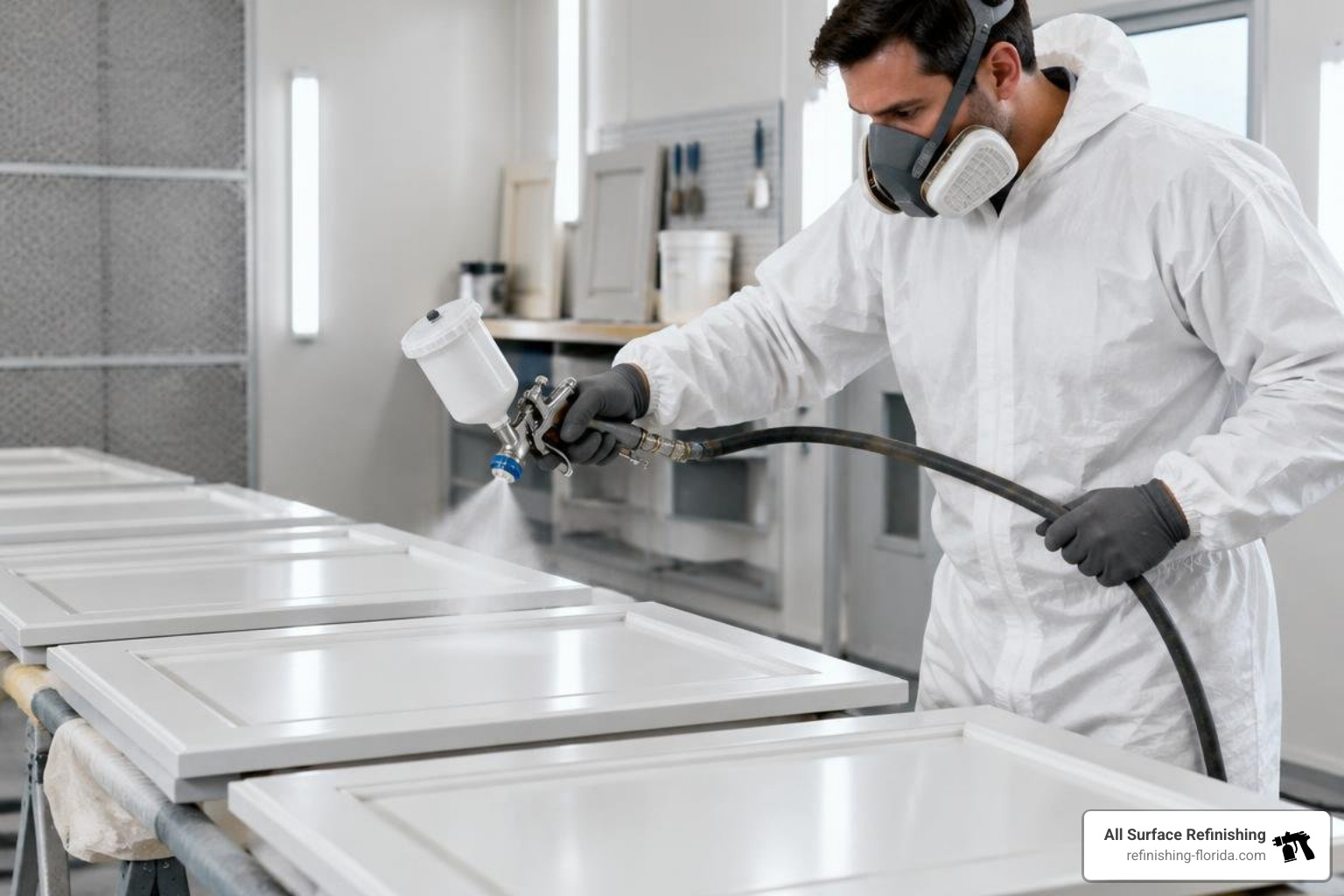
The longevity of painted cabinetry depends on using commercial-grade coatings and professional application techniques. Standard latex wall paint should never be used on kitchen cabinetry; it lacks the hardness required to resist hand oils, moisture, and daily impacts, inevitably leading to early peeling and sticking. We do not sell paint products directly, but we exclusively apply premium industrial coating systems designed specifically for cabinetry.
Modern professional refinishing relies on two primary coating classes:
- Cabinet-Grade Urethane Enamels: High-solids waterborne alkyd and urethane coatings that level smoothly and cure into a tough, washable surface.
- Two-Part (2K) Polyurethanes: Industrial-grade coatings blended with a chemical hardener that cure rapidly to produce a factory-grade, scratch- and chemical-resistant shell.
Achieving a durable finish requires following proven technical processes. When examining how to paint kitchen cabinets the right way, the preparation sequence dictates the final outcome:
- Intensive Chemical Decontamination: Surfaces must be stripped of cooking oils, wax, and grease using specialized industrial cleaners.
- Mechanical Abrasion: Sanding profiles creates a physical profile for maximum mechanical adhesion.
- High-Adhesion Bonding Primers: Solvent-based or high-performance synthetic primers seal porous wood grain, block tannin bleed-through, and bond tightly to the core material.
- Controlled HVLP Spraying: Applying thin, uniform coats with High-Volume Low-Pressure (HVLP) sprayers eliminates brush strokes and roller stipple, yielding an ultra-smooth, factory-original appearance that lasts 8 to 12 years.
Frequently Asked Questions About Kitchen Cabinet Upgrades
Can thermofoil and laminate cabinets be successfully painted?
Yes, provided the underlying core is structurally sound and the correct bonding primers are applied.
Laminate and sound thermofoil feature non-porous surfaces that cause ordinary paint to bead up or peel. To ensure lasting adhesion, surfaces must be scuff-sanded and coated with a dedicated bonding primer (such as specialized shellac- or urethane-based formulas) that chemically bites into slick substrates. If thermofoil is actively peeling away from the underlying MDF core, the loose vinyl coating must be carefully removed or heated off before prepping and spraying the smooth board underneath.
How long does a professional cabinet paint job last?
A professionally sprayed kitchen cabinet finish lasts between 8 and 12 years under normal household conditions.
Longevity depends heavily on proper post-care during the initial curing window. While painted cabinets are dry to the touch within hours and ready for light use in 5 to 7 days, industrial coatings require 14 to 21 days to reach full chemical cure and maximum hardness. During this initial curing period, avoid abrasive cleaners, heavy scrubbing, or aggressive impacts. Ongoing maintenance simply involves wiping surfaces with a soft microfiber cloth and mild soap and water.
Will painting dark wood cabinets look modern?
Painting dark wood cabinets—such as dated espresso, golden oak, or reddish cherry—is one of the most effective ways to modernize a kitchen.
When painting open-grain woods like oak, a specialized high-build primer or grain filler is used to smooth out deep grain pores before topcoating. Paired with stain-blocking primers that prevent dark wood tannins from bleeding through light colors, the result is a clean, crisp, contemporary look. Upgrading older ornate pulls to sleek matte black, brushed brass, or satin nickel hardware completes the modern aesthetic at a fraction of the cost of new installations.
Conclusion
Deciding between painting your cabinets or investing in full replacement comes down to assessing your cabinet boxes, your budget, and your timeline. If your current kitchen layout works and the cabinet carcasses are sturdy, professional painting provides a factory-grade transformation at a fraction of the cost, saving you thousands while delivering strong resale value.
At All Surface Refinishing, we bring over 30 years of hands-on experience and more than 14,000 completed resurfacing projects to homeowners across South and Southwest Florida. Our proven spray processes deliver smooth, durable, factory-grade finishes without the mess, extended downtime, or heavy price tag of full demolition.
We proudly serve homeowners throughout South Florida, including Fort Lauderdale, Miami, Boca Raton, West Palm Beach, Coral Gables, Hollywood, FL, Boynton Beach, Delray Beach, Pembroke Pines, Coral Springs, Jupiter, and surrounding communities.
Ready to revitalize your kitchen or bathroom cabinets with a durable, cost-effective finish? Explore our expert cabinet refinishing and painting solutions and request your free consultation today.
