What It Really Costs to Paint Your Own Kitchen Cabinets
How much does it cost to paint kitchen cabinets yourself? Here’s the quick answer:
| Cost Item | Typical Range |
|---|---|
| Paint (1-2 gallons) | $40 – $100 |
| Primer | $20 – $50 |
| Sandpaper & sanding supplies | $10 – $30 |
| Brushes, rollers, foam pads | $15 – $40 |
| Drop cloths & painter’s tape | $20 – $30 |
| HVLP sprayer rental (optional) | $50 – $100 |
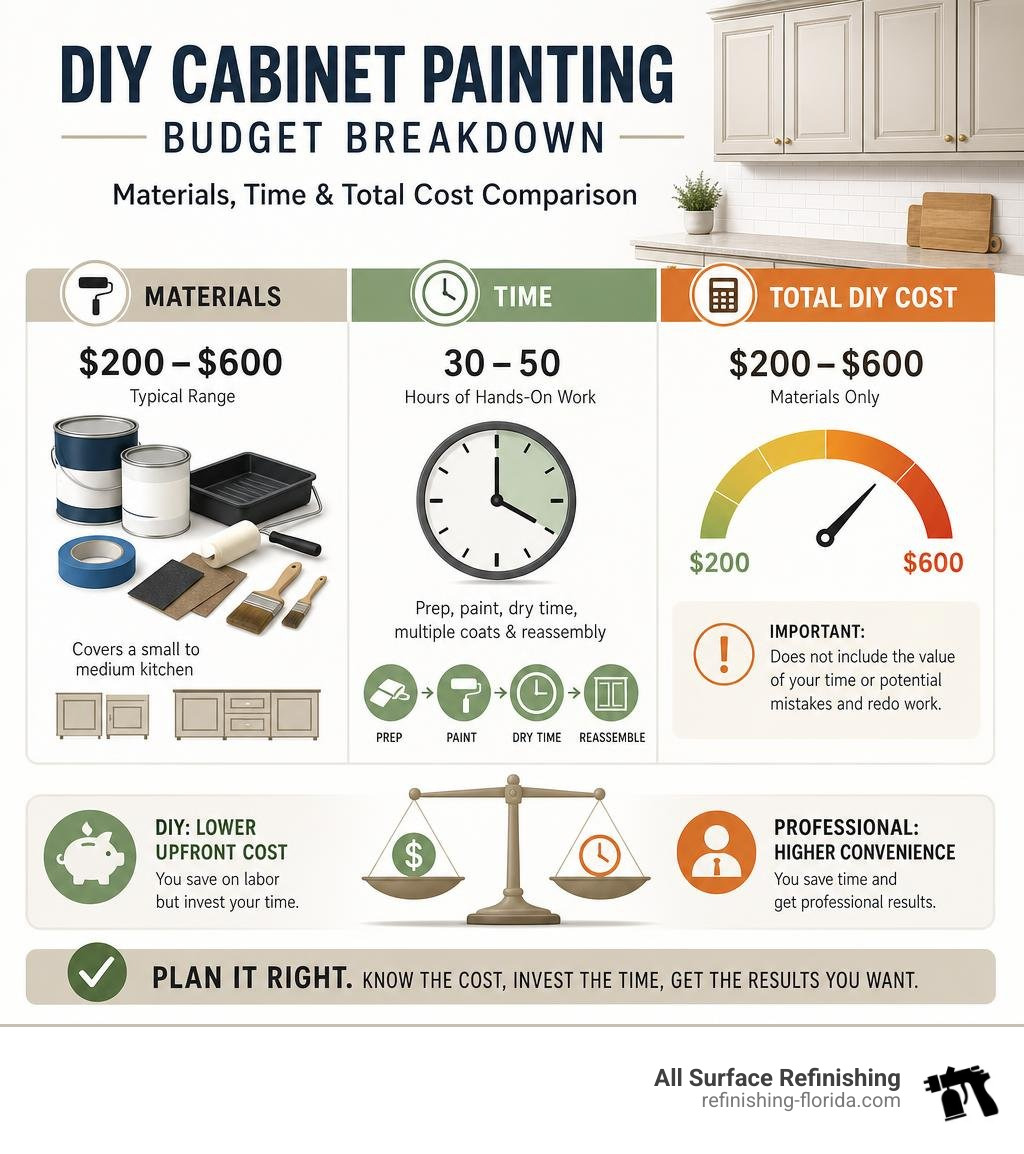
| Total DIY Supply Cost | $200 – $600 |
That $200–$600 range covers a small to medium kitchen. Larger kitchens with more cabinet doors and drawer fronts will push toward the higher end.
Keep in mind: that number covers materials only. It does not include the 30–50 hours of hands-on work most DIY projects require — which has real value, even if you don’t pay for it directly.
I’m Frank Hernandez, President of All Surface Refinishing, and I’ve been refinishing kitchen cabinets across South Florida since 1996 — so I’ve seen what how much does it cost to paint kitchen cabinets yourself really means once you factor in prep, mistakes, and redo work. In this guide, I’ll walk you through every cost, step, and decision so you can plan your project with clear eyes.
How much does it cost to paint kitchen cabinets yourself vocab explained:
How Much Does It Cost to Paint Kitchen Cabinets Yourself?
When calculating your DIY cabinet painting budget, it helps to understand the metrics that professional painters and home improvement stores use. Generally, painting kitchen cabinets runs between $3 and $10 per square foot, or between $30 and $60 per linear foot. For a standard 60-square-foot cabinet space (or about 20 to 25 linear feet), your raw material costs will sit comfortably in that $180 to $600 range.
According to The Spruce’s cabinet painting cost guide, while a professional job can cost thousands, a DIY approach saves significantly on upfront labor. However, that baseline budget assumes you already own basic tools like a screwdriver, a vacuum, and protective gear. If your kitchen layout is complex, has high-traffic areas, or requires specialized prep work for materials like laminate or thermofoil, those initial material costs can creep upward.
Breakdown of Supplies: How much does it cost to paint kitchen cabinets yourself?
To avoid mid-project trips to the home improvement store in Fort Lauderdale or West Palm Beach, you need a highly itemized shopping list. Here is exactly what goes into the shopping cart and how it impacts your wallet:
- Cabinet Paint ($40 – $100 per gallon): You will need one to two gallons. Standard brands cost $15 to $60, but high-end designer or specialized cabinet paints run $50 to $100 per gallon. Each gallon covers roughly 350 to 400 square feet.
- Primer ($20 – $50 per gallon): A high-quality bonding or stain-blocking primer is non-negotiable. You will need one gallon.
- Sanding Supplies ($10 – $30): Assorted grits of sandpaper (120-grit for stripping, 220-grit for finishing) and sanding blocks.
- Brushes and Rollers ($15 – $40): High-quality angled sash brushes and 4-inch high-density foam rollers designed for a smooth finish.
- Drop Cloths and Painter’s Tape ($20 – $30): Essential for protecting your countertops, appliances, and floors.
- Cleaning Agents ($10 – $20): Heavy-duty degreasers like TSP (trisodium phosphate) to remove years of cooking grease.
- HVLP Paint Sprayer Rental ($50 – $100 per day): If you want a brush-stroke-free factory finish, renting a professional sprayer is highly recommended.
As detailed in The Kitchn’s cost breakdown, cutting corners on cheap brushes or low-grade paint will result in visible brush marks, runs, and paint that peels off within a year.
The Hidden Cost of Your Time and Labor
While spending $300 on supplies sounds incredibly appealing compared to hiring a professional crew, you must factor in the “sweat equity.” Painting kitchen cabinets is not a quick Saturday afternoon chore. It is a meticulous, multi-step process that takes the average DIYer between 30 and 50 hours of active, hands-on labor.
If you value your time at a modest national painter’s wage of $23 per hour, those 40 hours of labor represent roughly $920 in time investment. When you add that to your $300 material receipt, the real cost of your DIY project is closer to $1,200.
Furthermore, you must consider kitchen downtime. Your kitchen will be a designated “construction zone” with cabinet doors removed, countertops masked in plastic, and supplies scattered across the floor. For a DIYer working evenings and weekends, this disruption typically lasts 7 to 14 days. If you live in a busy household in Miami or Boca Raton, the cost of eating takeout for two weeks can quickly eat away at your initial DIY savings. Before committing, it is wise to request a detailed Cabinet Painting Cost Estimate to see if the financial savings outweigh the disruption.
Step-by-Step Guide to Painting Kitchen Cabinets

Ready to take the plunge? To achieve a finish that looks beautiful and lasts for years, you must follow a structured, disciplined process. Rushing through the steps is the number one reason DIY cabinet paint jobs fail. Let’s break down the process of a successful kitchen transformation, keeping in mind the detailed strategies found in How to Paint Kitchen Cabinets the Right Way.
Proper Preparation: Cleaning, Sanding, and Priming
Preparation is 70% of the work in any professional-grade cabinet project. Kitchen cabinets are exposed to steam, moisture, and cooking oils daily. Paint will not adhere to grease.
- Deconstruct and Label: Remove all cabinet doors, drawer fronts, and hardware. Do not paint them while hanging! Label each door with a numbered piece of painter’s tape hidden in the hinge cup so you know exactly where it goes during reassembly.
- Deep Clean: Scrub every surface thoroughly with a heavy-duty degreaser like TSP. Pay extra attention to the areas around the stove and cabinet handles.
- Sand Thoroughly: Use an orbital sander or sanding blocks to scuff-sand all surfaces. You do not need to strip the wood bare, but you must remove the glossy topcoat to give the new paint “teeth” to stick to. If you are dealing with delicate materials or want to explore alternative prep methods, check out our guide on How to Paint Cabinets Without Sanding in Florida.
- Vacuum and Tack Cloth: Vacuum up all dust, then wipe down every inch of the wood with a tack cloth to remove microscopic debris.
- Prime: Apply a high-quality primer. For solid wood, a shellac-based or oil-based primer works best to seal in wood tannins. For laminate or MDF, a dedicated bonding primer is essential.
Painting Techniques: Brush, Roller, or Sprayer
How you apply the paint determines the final texture and look of your kitchen.
- Brush and Roller: This is the most common DIY method. Use a high-quality angled brush for the recessed corners of shaker-style doors, and immediately follow up with a 4-inch high-density foam roller on the flat panels to smooth out brush strokes. Avoid cheap rollers, which leave a textured “orange peel” finish.
- HVLP Paint Sprayer: Spraying is the gold standard for a factory-smooth finish. It applies a perfectly even, micro-thin layer of paint without brush marks. However, spraying has a steep learning curve, requires extensive masking to protect your kitchen from overspray, and uses about 20% to 30% more paint.
For a deeper look into professional application methods, refer to A Practical Guide to Painting Kitchen Cabinets Professionally.
Choosing the Best Paint and Materials for Longevity
The kitchen is the most demanding environment in your home. Your cabinets endure daily touching, slamming, humidity from boiling water, and splatters of acidic food. Using standard wall paint on cabinets is a recipe for chipping, peeling, and sticky surfaces within a few months.
The Best Paint Types and Finishes for Kitchen Cabinets
To ensure your hard work lasts 8 to 10 years rather than 8 to 10 months, you must select the right paint formulation:
- Alkyd Enamel / Water-Based Alkyd: This hybrid paint offers the self-leveling and durable properties of traditional oil-based paint but cleans up easily with soap and water. It cures to a rock-hard finish that resists chipping.
- Acrylic Polyurethane: Often used by professionals, this coating provides superior moisture resistance and chemical protection, making it incredibly easy to clean.
- The Right Finish: Always choose a semi-gloss, high-gloss, or satin finish for kitchen cabinets. Matte or flat finishes are porous, trap grease, and are nearly impossible to scrub clean without wearing away the paint.
Why Primer and Prep Prevent Chipping
Chipping is almost never a failure of the paint itself; it is a failure of the bond between the paint and the underlying surface.
- Wood Cabinets: Solid wood expands and contracts with South Florida’s high humidity. A flexible, high-quality primer ensures the paint moves with the wood rather than cracking.
- MDF Cabinets: MDF is incredibly absorbent. Without a proper solvent-based primer, it will soak up water-based paint like a sponge, causing the edges to swell and ruin the door.
- Laminate Cabinets: Laminate is completely non-porous. Standard paint will slide right off. You must use a specialized bonding primer to chemically bond to the slick surface.
DIY vs. Professional Cabinet Painting in South Florida

Living in South Florida means dealing with unique environmental factors. High humidity, salt air in coastal cities like Key Biscayne or Palm Beach, and intense heat can affect how paint dries, cures, and holds up over time. Let’s look at how a DIY project stacks up against a professional refinishing job in our local market.
| Feature | DIY Cabinet Painting | All Surface Refinishing |
|---|---|---|
| Average Cost | $200 – $600 | $1,500 – $4,500 (Depending on size) |
| Time Investment | 30 – 50 hours of active labor | 0 hours of your labor |
| Kitchen Downtime | 7 – 14 days | 2 – 4 days |
| Application Method | Brush, roller, or rented sprayer | Professional-grade HVLP spray system |
| Finish Quality | Good (potential brush marks/runs) | Factory-grade, perfectly smooth finish |
| Durability | 3 – 5 years (average) | 8 – 15 years (with proper care) |
| Warranty | None | Multi-year warranty protection |
The Real Math: How much does it cost to paint kitchen cabinets yourself?
When you hire a professional service like All Surface Refinishing, labor represents about 60% to 85% of the total invoice. That reflects the specialized training, precision equipment, and extensive prep work required to deliver a flawless result.
If a DIY project goes wrong — perhaps due to skipped sanding or using the wrong primer — the cost to fix it is incredibly high. Stripping ruined, sticky paint off 25 cabinet doors can cost $2,000 to $4,000 in professional labor. As we discuss in Kitchen Cabinet Painting Costs Explained So You Don’t Get Ripped Off, understanding the true balance of material costs versus professional labor helps you make the smartest financial decision for your home.
Why South Florida Homeowners Choose Professional Refinishing
Homeowners in Broward County, Palm Beach County, and Miami-Dade County often find that professional refinishing is the most cost-effective path. Here is why:
- Speed and Convenience: We complete most kitchen transformations in just a few days, minimizing the disruption to your daily life.
- Superior Products: We use specialized industrial coatings that cure much harder and faster than retail paints, offering maximum resistance to South Florida’s humidity.
- Flawless Factory Finish: Our professional spray booths and HVLP equipment ensure there are absolutely no brush marks, drips, or uneven textures.
Frequently Asked Questions about Cabinet Painting Costs
Do I need to remove cabinet doors and drawers to paint them?
Yes, absolutely. Attempting to paint cabinet doors while they are still hanging is the fastest way to get drips, runs, and paint pooled around the hinges. You must remove all doors, drawer fronts, and hardware.
Be sure to label each door with a numbered piece of tape that corresponds to its frame location. Wrap your hinges and screws in labeled baggies so reassembly is a breeze.
How many coats of primer and paint do kitchen cabinets need?
For a durable, professional-looking finish, you should apply:
- 1 to 2 coats of primer: One coat is usually sufficient for wood with a similar color transition. Two coats are highly recommended if you are painting over dark wood or switching to a light color like white or cream.
- 2 coats of premium cabinet paint: This ensures complete, even coverage and maximum durability.
How long does a DIY kitchen cabinet painting project take?
For a medium-sized kitchen, expect a DIY project to take 5 to 7 days of total elapsed time. While the active prep, sanding, and painting might take 30 to 40 hours, you must allow for proper drying and curing times (often 4 to 24 hours) between each coat of primer and paint before handling or reassembling the doors.
Conclusion
Answering the question, “how much does it cost to paint kitchen cabinets yourself?” comes down to balancing your budget against your time, patience, and desired finish quality. While a DIY project can save you money upfront with a supply cost of $200 to $600, it requires a massive commitment of time, precise preparation, and a tolerance for kitchen downtime.
If you want a flawless, factory-grade finish without the weekend headaches, mess, and risk of mistakes, we are here to help. With over 30 years of experience and more than 14,000 successful projects across South and Southwest Florida, All Surface Refinishing is your trusted local expert.
Whether you are in Miami, Fort Lauderdale, Boca Raton, or West Palm Beach, we can transform your kitchen in a fraction of the time. Ready to see how affordable a professional transformation can be? Explore our professional cabinet refinishing services and contact us today for a free estimate!
