Why a Non-Slip Tub Could Save Your Life
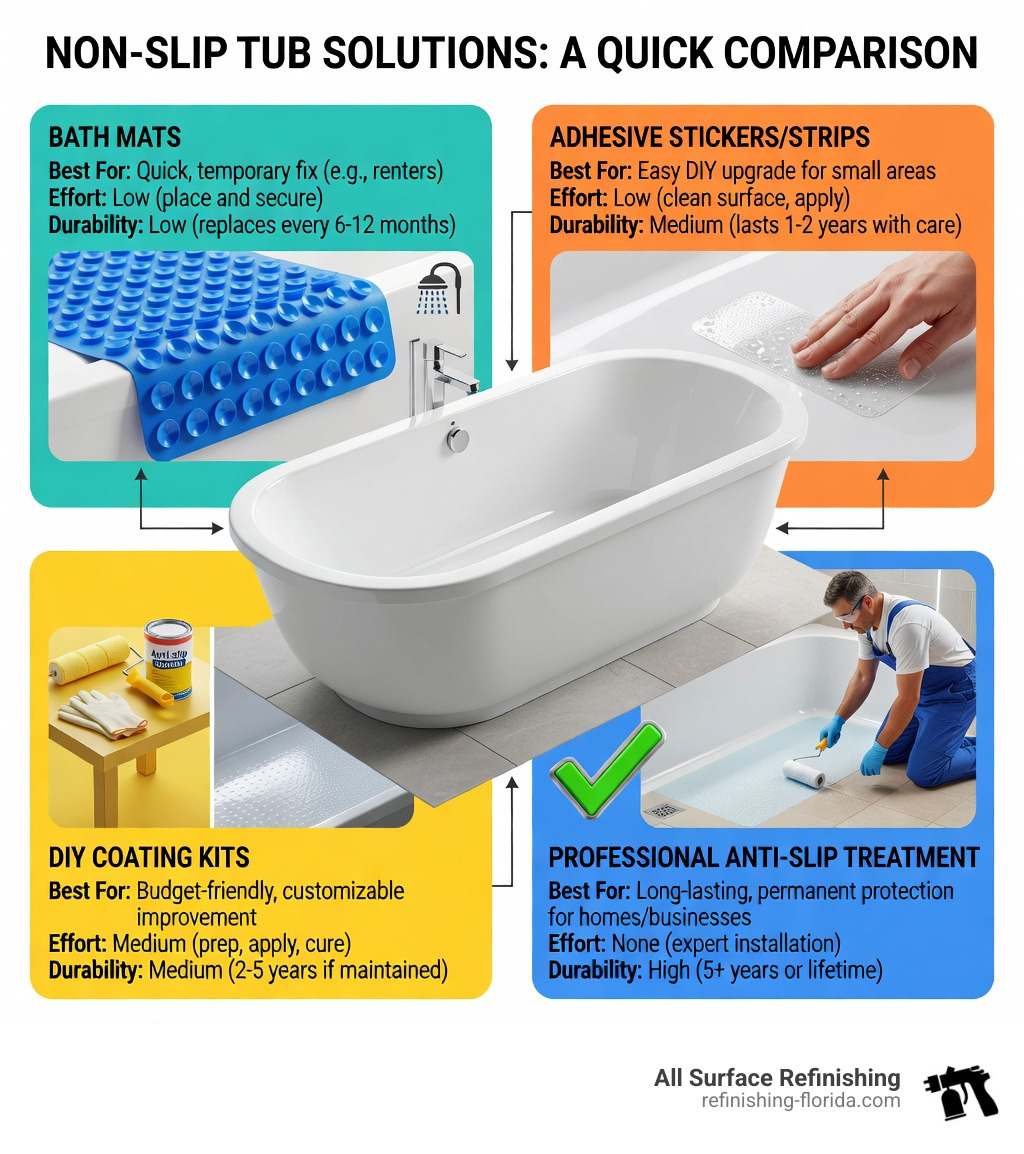
A non slip tub is one of the simplest and most important safety upgrades you can make in your bathroom. Here are the most effective solutions available:
| Solution | Best For | Effort | Durability |
|---|---|---|---|
| Bath mats | Quick, temporary fix | Low | Low |
| Adhesive stickers/strips | Easy DIY upgrade | Low | Medium |
| DIY coating kits | Budget-friendly improvement | Medium | Medium |
| Professional anti-slip treatment | Long-lasting, permanent protection | None (done for you) | High |
The numbers are hard to ignore. The CDC estimates that about two-thirds of accidental injuries in the home happen in the bathtub or shower. A 2018 study found that nearly 80% of bathroom accidents were caused by slipping — and nearly 5% of those resulted in loss of consciousness or concussions. That’s not a minor risk.
Whether you’re a homeowner, landlord, or property manager in South Florida, protecting your bathroom surfaces is a smart move — for safety and for your property’s value.
I’m Frank Hernandez, President of All Surface Refinishing, and with over a decade of hands-on experience refinishing bathtubs and bathroom surfaces across South Florida, I’ve seen how the right non slip tub treatment can make all the difference. Let’s walk through the best products and solutions so you can find the right fit for your space.
Key non slip tub vocabulary:
Understanding the Risks of a Slippery Tub

Have you ever wondered why your bathtub feels like an ice rink the moment it gets wet? It comes down to a combination of surface tension, physics, and the materials used in manufacturing. Most bathtubs are made from porcelain, ceramic, acrylic, or fiberglass. These materials are intentionally designed to be smooth and non-porous so that water flows easily toward the drain. While this is great for hygiene, it creates a treacherous environment for human feet.
When water hits these smooth surfaces, it creates a thin film that acts as a lubricant. Add in soap, shampoo, and hair conditioner, and you’ve essentially created a high-speed slide. Statistics show that 37% of bathroom injuries happen specifically while bathing or showering, while another 17% occur due to the slippery nature of the tub and the surrounding floor.
Many people assume that because their tub feels “textured” from the factory, they are safe. However, factory textures often wear down over time. As the surface erodes from daily use and cleaning, the slip resistance vanishes. This is why shower safety secrets often focus on restoring that lost traction. Without it, the risk of a concussion or a loss-of-consciousness event increases significantly, especially for children and seniors whose balance may be less stable.
Top Solutions for a Non Slip Tub
If you’re looking for a way to secure your footing, there are several paths you can take. The goal is to increase the “Coefficient of Friction” (COF). In simple terms, this is a measurement of how much “grip” a surface has. For a bathroom to be considered safe, it should ideally meet safety standards like ANSI A137.1, which measures Dynamic Coefficient of Friction (DCOF).
Comparing Mats and Stickers for a Non Slip Tub
The most common DIY solutions are bath mats and adhesive stickers.
Bath Mats and Suction Cups: Many of us grew up with the classic rubber or PVC bath mat. These rely on suction cups to stay in place.
- Pros: They are inexpensive and can be moved or replaced easily.
- Cons: They are notorious for bacteria and mold buildup underneath. Because water gets trapped between the mat and the tub, it becomes a breeding ground for mildew. Furthermore, suction cups often fail on tubs that have any existing texture, leading to the mat “sliding” while you’re standing on it—which is the very thing you’re trying to prevent!
Adhesive Strips and Stickers: No-skid stickers or aqua-safe treads are a step up in terms of hygiene. These are applied directly to the tub floor with a strong adhesive.
- Pros: They don’t trap as much bacteria as mats and offer a “barefoot-friendly” texture.
- Cons: Over time, the edges can peel, collecting dirt and soap scum. They can also cause uneven wear on your tub’s finish. If you ever remove them, you might find permanent “outlines” etched into the porcelain.
Long-Term Benefits of a Professional Non Slip Tub Treatment
For those who want a “set it and forget it” solution, a professional treatment is the gold standard. Unlike a mat that sits on top of the tub, a professional anti-slip bathtub coating chemically bonds with the surface of the tub.
These treatments are often used in high-end hotels and hospitals because they provide invisible protection without changing the look of the bathroom. At All Surface Refinishing, we use specialized formulas that exceed safety standards like ANSI A137.1 and NFSI B101.3. For example, some professional treatments can provide 4X the slip protection of the original surface.
The process is fast—usually taking about an hour—and the curing time is minimal. Once applied, the surface is integrated with the tub, meaning it won’t peel, crack, or discolor. It’s a permanent upgrade that makes the tub easier to clean because there are no suction cups or adhesive edges to scrub around.
Professional Safety Treatments and Bathroom Refinishing
If your bathtub is already looking a bit worn, chipped, or stained, you might want to consider a full refinishing service that includes a built-in non slip tub surface. This is one of our specialties at All Surface Refinishing.
When we refinish a tub in South Florida—whether you’re in Miami, Fort Lauderdale, or West Palm Beach—we don’t just make it look new; we make it safer. We apply a proprietary granular texture that is chemically bonded to the tub during the reglazing process. This isn’t a “one size fits all” sand-paper feel. We can actually adjust the coarseness to your specific needs.
This professional approach is vastly superior to DIY kits. DIY kits often involve acid etching, which can damage the tub if not done perfectly. Our anti-slip treatments are designed to be durable and sanitary. We serve a wide range of locations including:
- Palm Beach County: Boca Raton, Boynton Beach, Delray Beach, Jupiter, and Wellington.
- Broward County: Coral Springs, Hollywood, FL, Miramar, and Pembroke Pines.
- Miami-Dade County: Aventura, Coral Gables, and Miami Beach.
By choosing professional non-slip services, you ensure that the safety feature is a permanent part of the tub’s structure, not an afterthought that will peel off in six months.
Maintenance and Complementary Safety Measures
Once you have your non slip tub solution in place, proper maintenance is key to keeping it effective.
- Use pH-Neutral Cleaners: Harsh chemicals, bleach, and abrasive scouring pads can strip away non-slip coatings or degrade the adhesive on stickers. We recommend gentle, all-purpose sprays or pH-neutral cleaners.
- Soft Bristle Cleaning: If you have a textured coating, use a soft bristle brush in a circular motion to lift away soap scum without damaging the grip.
- Avoid Acids: Never use hydrofluoric acid or strong vinegar solutions on treated surfaces, as these can “melt” the slip-resistant granules.
Safety doesn’t stop at the tub floor. To create a truly safe environment, consider these complementary measures:
- Grab Bars: These should be anchored into the wall studs. They provide a reliable handhold when entering or exiting the tub.
- Lighting: Many slips happen because of poor visibility. Ensure your shower area is well-lit to help with depth perception.
- Tile Coatings: Don’t forget the floor! A tile anti-slip coating can prevent falls on the bathroom floor, which is just as dangerous as the tub itself.
- Shower Chairs: For seniors or those recovering from surgery, a shower chair provides a stable place to sit, reducing the need to balance on one leg.
Frequently Asked Questions about Tub Safety
Do new bathtubs come with built-in anti-slip features?
Surprisingly, many new bathtubs do not come with significant anti-slip features. Manufacturers often prioritize a smooth, “clean” look. While some fiberglass or acrylic tubs have a slight molded texture, it is often insufficient for true safety, especially as it wears down. High-end stone resin or cast iron tubs are almost always completely smooth unless a non-slip finish is specifically requested. This is why many homeowners choose to add their own solution shortly after installation.
How do I clean a non-slip surface without damaging it?
The secret is “gentle but frequent.” Don’t let soap scum build up, as the scum itself can become slippery, masking the grip of your non-slip surface. Use a non-abrasive cleaner and a sponge or soft cloth. If you have a professional coating, avoid any cleaner that contains bleach or harsh acids, as these can break down the chemical bond over several years.
What is the best non-slip solution for seniors?
For seniors, we almost always recommend a combination of a professional anti-slip treatment and grab bars. Mats are a tripping hazard because the edges can curl, and stickers can be difficult for someone with limited mobility to maintain. A professional treatment provides consistent grip across the entire floor of the tub. Additionally, using products with color contrast can help those with declining vision better see where the floor of the tub begins, reducing missteps.
Conclusion
At All Surface Refinishing, we believe that your bathroom should be a place of relaxation, not a hazard zone. With over 30 years of experience and 14,000+ projects completed across South Florida, we know exactly how to transform a dangerous, slippery surface into a secure, beautiful one.
From the quiet neighborhoods of Jupiter and Palm Beach Gardens to the bustling streets of Miami and Weston, we provide cost-effective and high-quality safety solutions. Don’t wait until a slip happens to take action. Whether you need a simple safety treatment or a full bathroom transformation, we are here to help.
Ready to make your bathroom safer for your family? Schedule a bathtub reglaze today and ask us about our integrated non-slip options!
