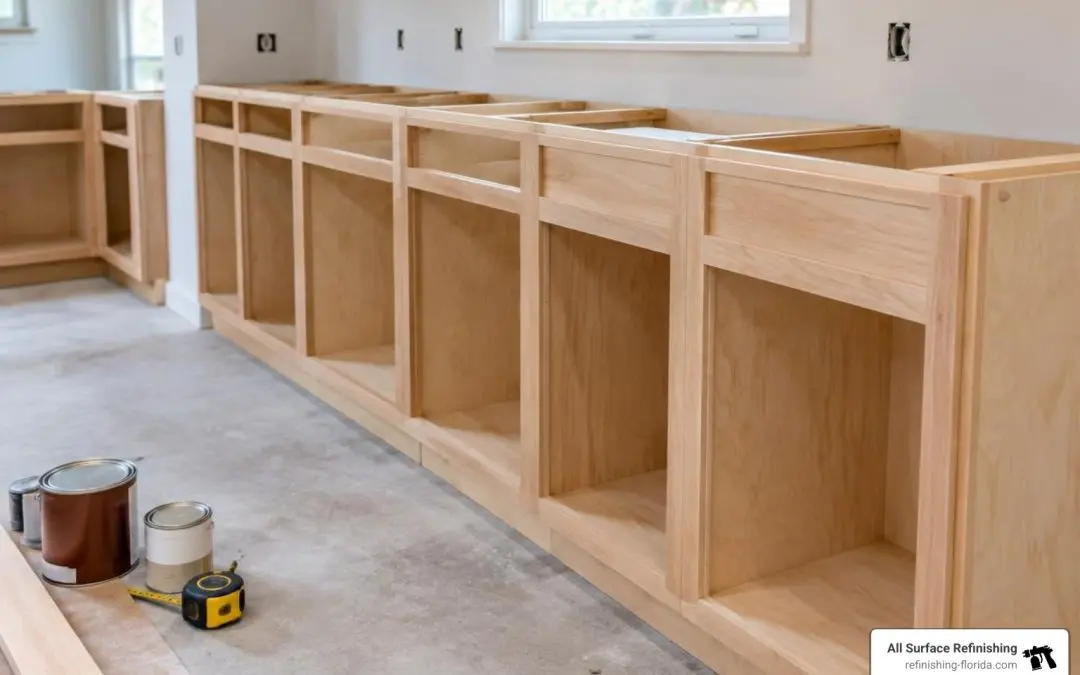
Unfinished Base Cabinets Offer a Custom Look for Less
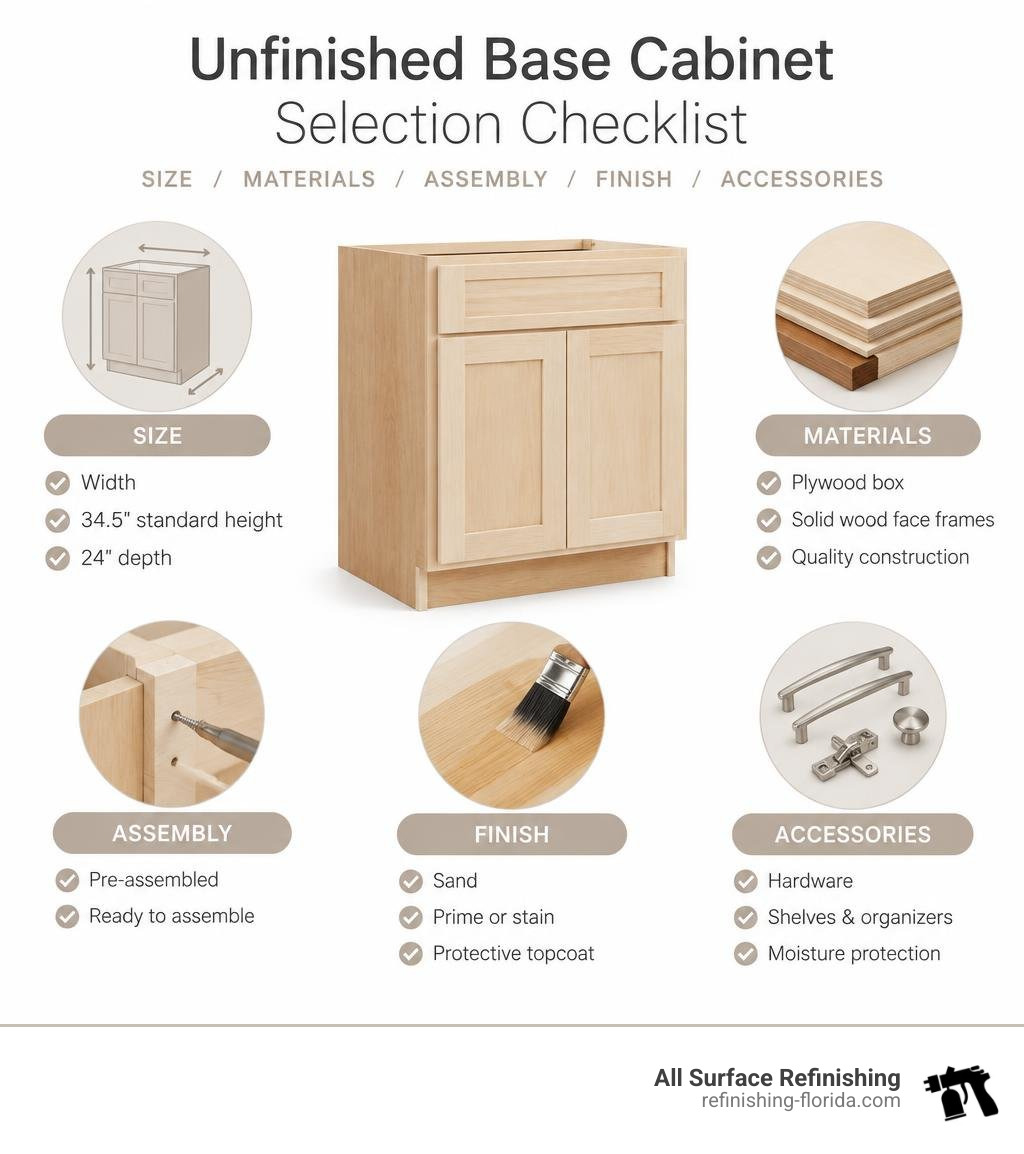
Unfinished base cabinets are raw, paint- or stain-ready cabinet units that let you control the final color, sheen, and style. For a kitchen or bathroom project, start by confirming the cabinet’s width, 34.5-inch standard height, 24-inch depth, box material, door style, and whether it arrives assembled or ready to assemble.
They can cost less upfront than finished cabinets and make color matching easier. A plywood cabinet box with solid wood face frames is often a stronger choice for high-use kitchens and bathrooms than lower-grade particleboard. But raw wood still needs proper sanding, priming or staining, and a durable protective topcoat before it faces humidity, spills, and daily wear.
For property owners in South Florida, unfinished cabinetry can be a practical way to update a kitchen or bathroom while keeping design choices open. The key is balancing overall kitchen cabinet prices with finishing labor, hardware quality, moisture protection, and the requirements for installing kitchen cabinets. Many homeowners also compare retail alternatives, including Home Depot unfinished cabinets, to weigh custom builds against off-the-shelf inventory.
I am Frank Hernandez, President of All Surface Refinishing, with more than a decade of hands-on surface refinishing experience and years of leading kitchen and bathroom update projects across South Florida. In this guide, I will help you compare unfinished base cabinets so you can make a durable, budget-aware choice for your space.
Benefits of Choosing Raw Wood Over Pre-Finished Units
Opting for raw wood base cabinets offers significant flexibility for budget-conscious homeowners and property renovators. Instead of being locked into a factory palette of three or four stock colors, raw cabinetry functions as a blank slate.
When you evaluate inexpensive kitchen cabinets, pre-finished stock options often carry baked-in finish markups or come wrapped in thin thermofoil that can peel when exposed to coastal Florida moisture. Raw units strip away retail markup, allowing you to allocate your renovation funds toward better hardware or professional finishes. As we navigate kitchen design trends in 2026, raw units give you total design freedom to pivot between modern organic aesthetics, rich heritage stains, or bold accent islands.
Custom Color Matching and Staining Versatility
The biggest advantage of raw wood is complete control over the surface treatment. Whether you are working with paint-grade poplar or clear birch veneers, raw wood accepts custom pigments, conversion varnishes, and deep penetrating stains that factory lines cannot replicate.
- Paint-Grade Poplar: Features tight grain and minimal pores, making it ideal for smooth, factory-grade solid paint finishes.
- Solid Birch: Offers a subtle, warm grain pattern that accepts both translucent stains and high-durability clear sealers.
- Targeted Sheen Selection: Choose exact sheens—from ultra-matte for modern spaces to high-gloss or satin for easier cleaning.
Understanding the step-by-step cabinet painting process ensures your primer bonds tightly with the wood grain, preventing tannin bleed and moisture intrusion.
Long-Term Value and Repairability
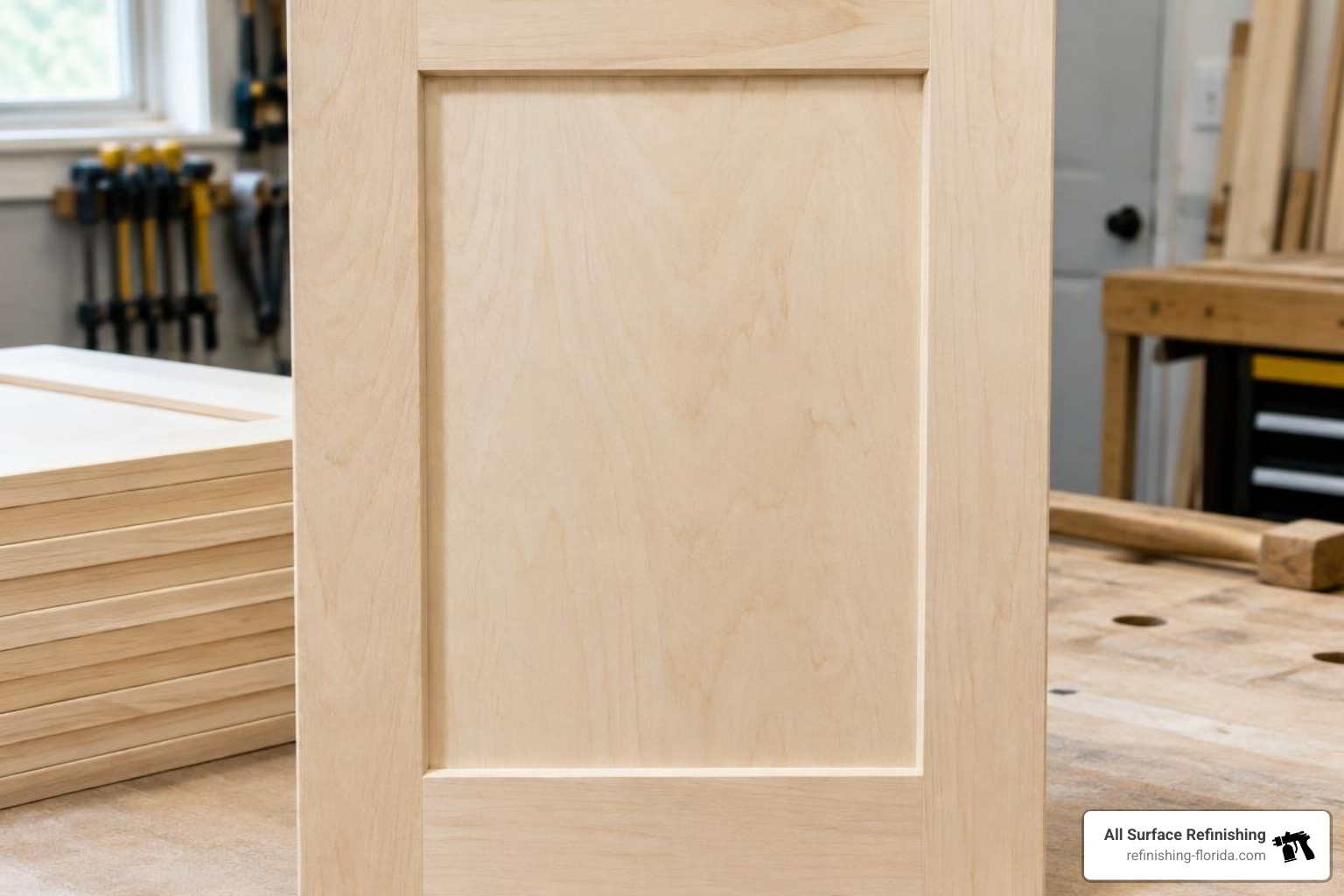
Pre-finished composite surfaces are notoriously difficult to patch when chipped, gouged, or scuffed. In contrast, solid wood face frames and raw wood doors provide superior repairability over their operational lifespan.
If a solid wood door gets dinged by a dropped pot or vacuum cleaner, you can sand down the specific damage, fill it, and spot-blend the finish without replacing the entire door. Exploring our guide to kitchen cabinet styles and options shows how solid-wood Shaker and flat-panel profiles maintain their architectural relevance for decades, making them a wise long-term investment for historic homes and modern coastal residences alike.
Evaluating Materials and Construction in Unfinished Base Cabinets
The longevity of your kitchen or bathroom renovation depends heavily on the internal skeleton of the cabinet box. Raw wood units range widely from basic builder-grade particleboard to heavy-duty, multi-ply hardwood boxes.
Always check for CARB2 compliance to ensure low formaldehyde emissions and safe indoor air quality. When selecting units, verify that face frames are square, side panels are rigid, and internal joinery utilizes dado grooves, pocket screws, or metal reinforcement brackets rather than simple plastic staples.
Plywood Boxes vs. MDF and Particleboard
Understanding cabinet box materials helps you avoid premature sagging, water damage, and structural failure.
| Feature / Metric | 1/2″ to 3/4″ Grade Plywood Box | MDF / High-Density Fiberboard | Standard Particleboard (PB) |
|---|---|---|---|
| Structural Integrity | Exceptional; cross-laminated plies resist racking | High weight capacity; prone to bending over wide spans | Low; fasteners pull out under heavy countertop loads |
| Moisture Resistance | High; natural wood plies dry without crumbling | Moderate; edges swell when unsealed | Poor; swells and disintegrates when exposed to leaks |
| Screw Holding Power | Excellent for drawer glides and hinge plates | Good, but requires specialized pilot holes | Weak; repeated door swings strip mounting holes |
| Weight | Lightweight yet rigid | Heavy; hard to handle during solo installs | Moderate weight; brittle edges |
Plywood remains the industry standard for durability and warp resistance, particularly beneath heavy stone, quartz, or concrete countertops.
Solid Wood Face Frames and Hardware Quality
The exterior durability of an unfinished base cabinet hinges on its face frame and hardware components. Premium units feature 3/4-inch solid birch or poplar face frames joined with pocket screws. Look for these functional hardware specifications:
- Full-Extension Under-Mount Drawer Glides: Allow full access to drawer interiors while supporting loads up to 75–100 lbs.
- European-Style Concealed Hinges: Provide 6-way adjustability with integrated soft-close dampening to prevent door slamming.
- Dovetail Drawer Boxes: Solid hardwood drawer sides with interlocking dovetail joints resist front-panel separation over thousands of pull cycles.
- Adjustable Shelving: 3/4-inch plywood shelves prevent sagging across wide 30- to 36-inch spans.
Sizing, Layout Configurations, and Essential Hardware
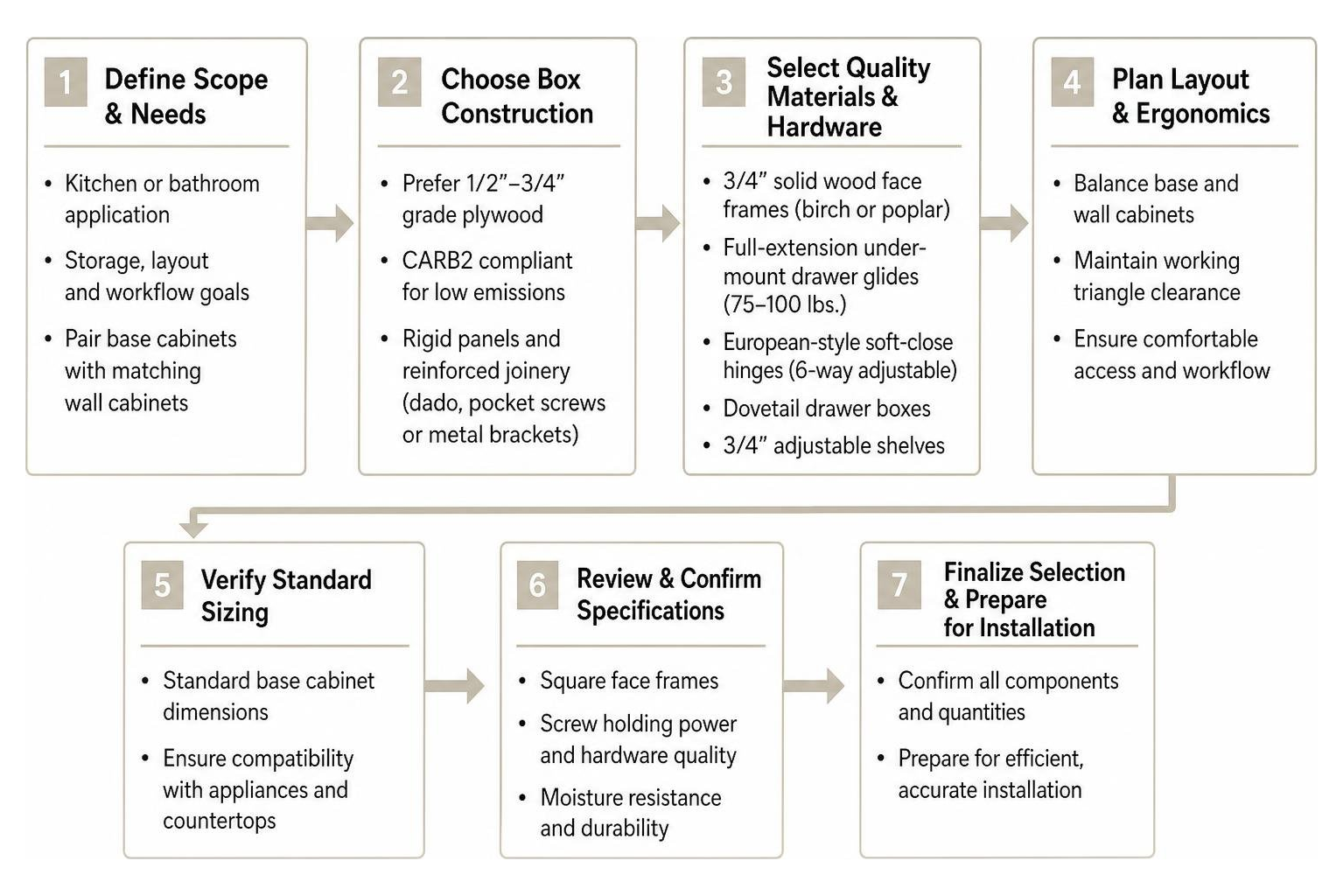
Proper kitchen ergonomics require a cohesive balance between wall cabinets and base units. Pairing base storage with matching overhead units—as detailed in our guide to kitchen wall cabinet styles and materials—creates vertical balance and optimizes working triangle clearance.
Standard Sizing for Unfinished Base Cabinets
Standard residential base cabinets follow standardized dimensional rules to accommodate appliances and countertops:
- Height: 34.5 inches (reaches 36 inches with a standard 1.5-inch countertop installed).
- Depth: 24 inches to match integrated dishwashers and standard countertop overhangs.
- Widths: Available from 9 inches to 42 inches in 3-inch increments (e.g., 9″, 12″, 15″, 18″, 21″, 24″, 27″, 30″, 33″, 36″, 42″).
Single-Door, Double-Door, and Drawer Base Layouts
Varying your cabinet configurations keeps your kitchen functional:
- Single-Door / Single-Drawer (12″–21″ W): Perfect for narrow spaces, utensil storage, and spice pullouts.
- Double-Door / Single- or Double-Drawer (24″–36″ W): Standard configuration for pots, pans, and dry goods.
- Drawer Banks (15″–36″ W): Three- or four-drawer stacks offering ergonomic access to cookware without kneeling.
- Sink Bases (30″–36″ W): Open interior cavities without shelves to clear plumbing, sink basins, and garbage disposals.
- Blind Corner Bases (36″–42″ W): Designed to maximize corner storage while maintaining clearance for adjacent doors and drawer pulls.
Reviewing proper kitchen cabinet installation techniques will ensure your layout is plumb, level, and securely fastened to wall framing.
Essential Add-Ons, Fillers, and Base Panels
Raw cabinet boxes have unfinished outer sides that require integrated end panels or trim to look complete. Essential accessories include:
- Unfinished Shaker Base Panels: 1/4-inch to 3/4-inch panels applied to exposed cabinet ends for a flush, cohesive appearance.
- Toe Kick Boards: Continuous 4.5-inch raw wood strips attached across the recessed cabinet base to conceal leveling shims and seams.
- Filler Strips: 3-inch wide raw hardwood strips used between cabinets and adjacent walls to clear door trim and ensure 90-degree door opening clearance.
- Scribe Molding: Thin trim applied where cabinet boxes meet uneven walls or floors to create seamless transition lines.
Sourcing Options: Retailers, Ready-to-Assemble, and Costs
Unfinished base cabinets are sourced primarily through three channels: big-box home improvement retailers, online ready-to-assemble (RTA) specialty distributors, and wholesale commercial millwork suppliers.
Assembled vs. RTA Unfinished Base Cabinets
Choosing between pre-assembled and RTA units involves balancing convenience against shipping costs and setup labor:
- Fully Assembled Cabinets:
- Pros: Factory-squared with industrial clamp pressure; ready to paint and install straight off the pallet.
- Cons: Higher freight shipping rates due to pallet volume; requires wider doorways for staging.
- Ready-to-Assemble (RTA) Cabinets:
- Pros: Flat-pack shipping saves 30% to 50% on freight; easier to transport into tight condo elevators and narrow hallways.
- Cons: Requires assembly time (15–30 minutes per box) using wood glue, cam-locks, or pocket screws.
Price Breakdown and Budget Planning
Pricing varies by size, joinery quality, and hardware inclusions:
- 24-Inch Single/Double-Door Base: Entry-level builder models range from $114.45 to $129.00, while premium plywood Shaker units range from $239.00 to $446.40.
- 36-Inch Sink Base or 3-Drawer Bank: Expect $275.00 to $480.00 depending on glide mechanisms and plywood grade.
- End Panels & Fillers: Allocate $25.00 to $65.00 per panel/trim strip.
- Finish Application: Factoring in professional spray finishes, conversion varnishes, and primer systems ensures long-term performance without DIY brush marks.
Frequently Asked Questions About Raw Cabinetry
Are unfinished wood cabinets resistant to moisture and warping?
Unfinished wood is porous and naturally absorbs ambient humidity if left unsealed. However, cabinets constructed with 7-ply hardwood plywood boxes offer strong natural warp resistance compared to particleboard. Once properly sealed with high-performance primers, stains, or waterproof clear topcoats, raw wood cabinets become highly resilient against moisture, spills, and everyday humidity in kitchen and bathroom environments.
What surface prep is required before painting raw wood cabinets?
To prepare raw wood cabinets:
- Sand all exposed surfaces with 120-grit sandpaper, finishing with 220-grit along the direction of the wood grain.
- Remove all sanding dust using compressed air and a tack cloth.
- Apply a high-adhesion, stain-blocking bonding primer to seal the raw wood pores and prevent tannin bleed-through.
- Lightly scuff-sand the primer with 320-grit paper before applying durable cabinet enamel or conversion topcoats.
How much money do unfinished cabinets save compared to finished units?
Unfinished cabinets can reduce upfront cabinetry costs by 30% to 50% compared to pre-finished factory alternatives. A standard 27-inch factory-finished cabinet retailing around $800+ can often be sourced raw for $400 to $450. These cost savings allow property owners to invest in premium solid plywood construction and professional-grade custom spray finishes while staying within renovation budgets.
Conclusion
Unfinished base cabinets provide an exceptional balance of structural strength, layout flexibility, and complete aesthetic control. By selecting durable all-plywood construction, solid hardwood face frames, and soft-closing hardware, you create a long-lasting foundation for your kitchen or bathroom remodel.
At All Surface Refinishing, we bring over 30 years of hands-on experience and more than 14,000 completed transformations across South and Southwest Florida. While we do not sell paint, our expert team specializes in high-durability surface coatings, cabinet painting, and tub and tile transformations.
We proudly serve homeowners and property managers throughout South and Southwest Florida.
If you are planning a kitchen or bathroom renovation, explore our professional cabinet refinishing services to see how we can turn raw wood boxes into stunning, factory-smooth focal points built to last. Contact us today to schedule your consultation and bring your custom design vision to life.
